Chinese teen sets sights on Asian Games after historic World Breaking gold
Breaking new ground
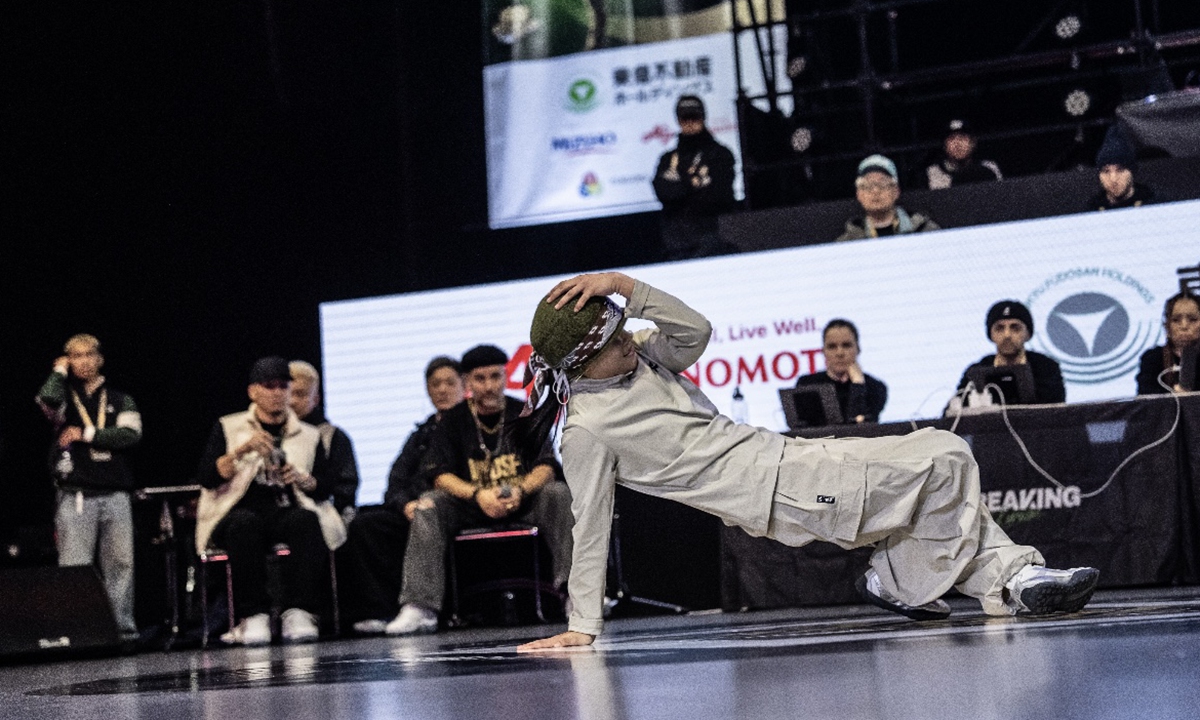
Guo Pu competes at the 2025 World Breaking Championships in Japan. Photo: Courtesy of Guo Pu
At just 17, Chinese breakdancer Guo Pu walked onto the floor of the 2025 World DanceSport Federation World Breaking Championships carrying more than personal ambition. She made history by winning China's first-ever world championship gold in women's breaking in Fukuoka, Japan, on December 13.Guo, known on stage as B-Girl Royal, was the sole Chinese entrant in the women's competition and dominated the field throughout the tournament. She opened with a second-place finish in the preliminaries, then won successive elimination rounds on December 12, ultimately advancing to the Top 8 as the only Chinese athlete to break through a field dominated by five Japanese breakers.
"I knew it would be tough," Guo told the Global Times. "Reaching the finals, I told myself I had to win. It was a special day, and I wanted our national anthem to play here."
By the night's end, the anthem rang out on the podium. "The moment I heard our national anthem on the podium, tears welled up in my eyes. Feeling such a strong motherland behind me made me incredibly proud."
With her historic win, Guo now feels a responsibility to inspire the next generation of b-girls, encouraging them to dance beautifully while expressing their individuality.
Historic breakthrough
From the quarterfinals onward on Saturday, Guo faced a string of Japanese opponents. She edged past Ayane Nakarai (B-Girl Ayane) by a 2-1 decision in the quarterfinals and then cruised past Hiyo with a 3-0 sweep in the semifinals.
In the championship battle against 42-year-old veteran Ayumi Fukushima (B-Girl Ayumi), Guo showed remarkable composure and consistency, dictating the pace with explosive power moves and tight, intricate footwork to secure the title. Lithuania's Dominika Banevic (B-Girl Nicka) finished third.
During the interview with the Global Times, Guo acknowledged the challenge, saying Japan is among the world's top countries in breaking, and with the championships held in Japan, the competition was even tougher.
"I was quite nervous before the competition. Facing many home-country competitors added pressure, and I felt I had to win. Now I'm really happy. Next, I'll continue training and hope to achieve even better results next year," Guo said after the win.
Her triumph marked the best finish ever by a Chinese breakdancer at the World Championships. Prior to her breakthrough, China's top results had been silver medals won by Liu Qingyi (B-Girl 671) in 2022 and 2024.
"During the competition, my coach told me to bring the same mindset I have in training. I should dance as myself and show the moves I know, presenting them on stage for everyone to see," she said.
Strategy also played a key role. According to Guo, each round was planned with specific opponents in mind, with adjustments made on the fly based on how each battle unfolded.
That adaptability has become her trademark and one of the main reasons she has emerged as one of China's leading figures in women's breaking over the past year. Earlier in 2025, she won the FISE World Series in Montpellier, France, and followed it by claiming back-to-back titles at the Asian Youth Championships and the Asian Championships, cementing her rise on the international stage.
In November, at the 15th National Games in Guangzhou, South China's Guangdong Province, Guo earned the silver medal in breaking. Her rise has been swift, but it did not come overnight.
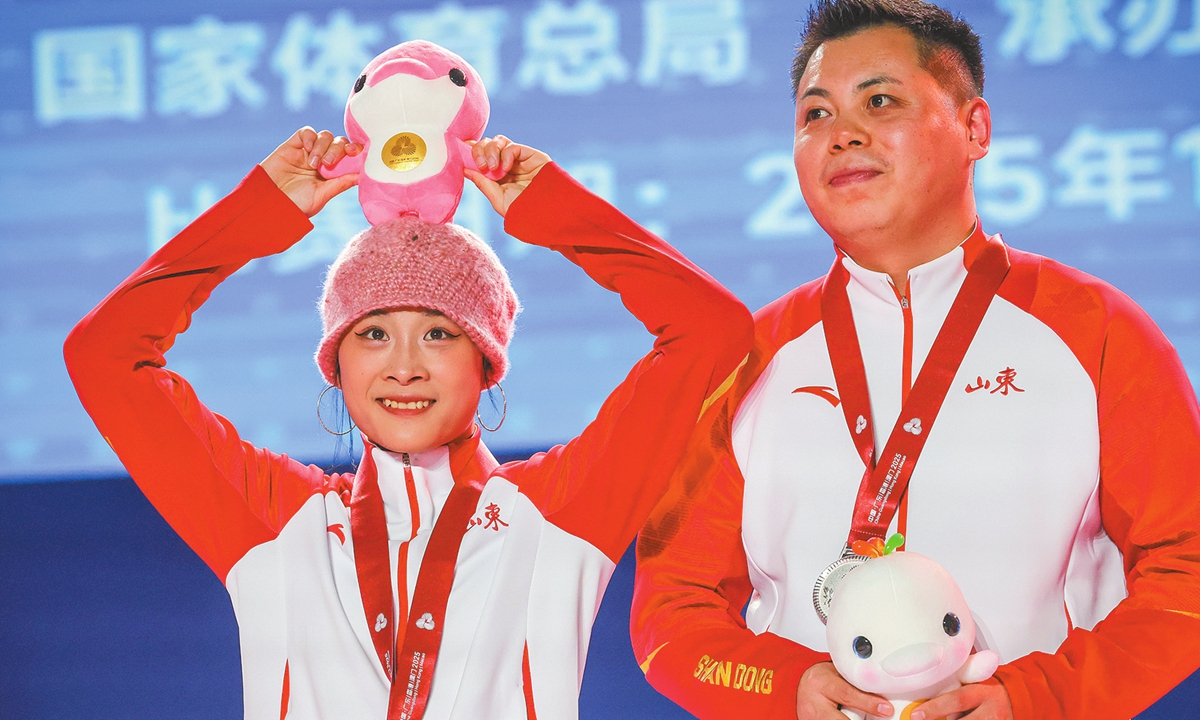
Guo Pu poses with a mascot at the 15th National Games in Guangzhou, South China's Guangdong Province, on November 18, 2025. Photo: VCG
Early spark
Born in Linyi, East China's Shandong Province, Guo studied piano, learned to draw and trained in traditional Chinese dance. It wasn't until a local performance that her current coach noticed her potential.
"He said there was light in my eyes," Guo recalled.
The coach encouraged her to try street dance. Her parents were hesitant at first, uncertain about the future of such a path, but as Guo's talent became undeniable, their support gradually followed.
Those early lessons in music never left her. Guo said her piano training helped shape her sense of rhythm and musicality, elements she considers essential to breaking.
Now 17, Guo has been training for nearly 10 years. She described breaking as a fusion of "mind, body and soul." Her daily routine is demanding, often reaching eight hours of training a day, and the grind has not been without its low points.
"I've had periods where I was at a low point," she said. "But I never thought about giving up."
Instead, she learned to step back when needed, allowing both her body and mind to recover, before returning to training with renewed focus.
But as a competitive sport, breaking inevitably comes with wins and losses. In Guo's view, however, competition does not strip breaking of its cultural essence.
Guo said competitive sports focus on achieving height, while street dance culture emphasizes depth. "For us, it's about combining both: reaching high levels while maintaining the depth," she added.
Even though breaking will not return to the 2028 Los Angeles Olympics after its debut at Paris 2024, Guo's goals remain clear. Her next major target is winning the gold in breaking at the 2026 Asian Games in Nagoya, Japan, another chance to perform on Japanese soil, and another opportunity to prove herself.
For children who are committed to learning street dance, she said her advice is simple: "If you choose something you truly love, stick with it, perseverance will eventually bring results."
RELATED ARTICLES