Direct frozen durian exports to China cut cost, benefit Indonesian growers, exporters: business insider
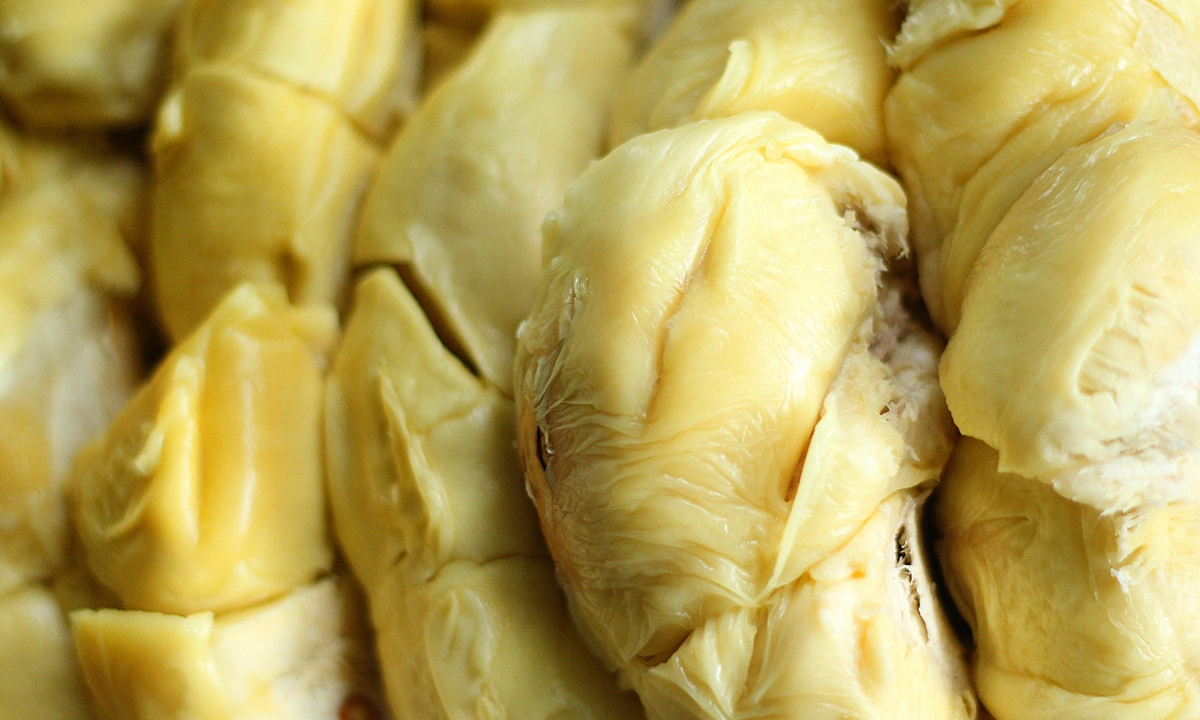
Photo: VCG
China's durian market is worth about 128 trillion rupiah ($7.66 billion) per year, and Indonesia's climate and diverse varieties position it to become a stable, sustainable supplier, an Indonesian business insider said on Wednesday.
Aditya Pradewo, secretary-general of the Indonesian Durian Plantation Association, told the Global Times that industry players welcomed the opening of direct exports to China and stressed the potential economic benefits.
"We project Indonesia could capture 5 to10 percent of the Chinese market, generating an estimated 6.4 to 12.8 trillion rupiah in annual foreign exchange earnings," he added.
On Monday, Indonesia launched its first direct export of frozen durian to China, shipping 48 tons of the commodity worth 5.1 billion rupiah. The inaugural shipment, processed in West Java, was shipped from Tanjung Priok Port in North Jakarta en route to Qingdao Port in East China's Shandong Province.
"This marks the culmination of a long series of processes that took a considerable amount of time and required substantial resources," head of the Agricultural Quarantine Agency (Barantin) Sahat M. Panggabean said on Monday, adding that the process took nearly two years to complete, the Jakarta Post reported.
Since Indonesia signed a frozen durian export protocol with China's General Administration of Customs in May, eight local companies have passed the verification process, according to local news portal Tempo.co on Monday. This means that Indonesian producers can export directly to China, bypassing intermediaries such as Thailand and Malaysia.
The first batch of frozen durian exported to China was produced and processed by these eight companies.
Direct exports of Indonesian frozen durian to China bring many benefits, primarily a significant reduction in costs. Indonesia's state-owned public television broadcaster TVRI cited a durian industry professional who said that Indonesian frozen durian exports to China previously had to transit through Thailand, with logistics costs of about $18,000 per container. Now, transportation costs have dropped to about $10,000 to $11,000, saving about $8,000 per shipment.
Industry players said that the new direct channel for frozen durian could contribute to further deepening economic ties and greater value capture by Indonesian producers.
Previously, Indonesian durian exporters supplied the fruit mainly to neighboring countries, where it was processed and re-exported to China.
Recognizing this opportunity, Indonesian durian-producing regions are accelerating efforts to upgrade the value chain, including building packaging facilities and plantations that meet international standards and quarantine requirements, and improving traceability and food-safety measures.
Those improvements are intended to ensure that exports meet Chinese market standards and support higher returns for farmers and exporters, Pradewo of the Indonesian Durian Plantation Association said.
Analysts said that the shift from transshipment to direct supply could open new growth space for Indonesia's durian industry.
The frozen-durian agreement comes against a backdrop of expanding China-Indonesia trade ties. Bilateral trade reached about 1.05 trillion yuan ($149 billion) in 2024, and in the first 10 months of this year bilateral trade reached 963.06 billion yuan, up 14.9 percent year-on-year.
RELATED ARTICLES