ARTS / CULTURE & LEISURE
Art flourishes when it meets the public
By Published: Dec 17, 2025 10:47 PM
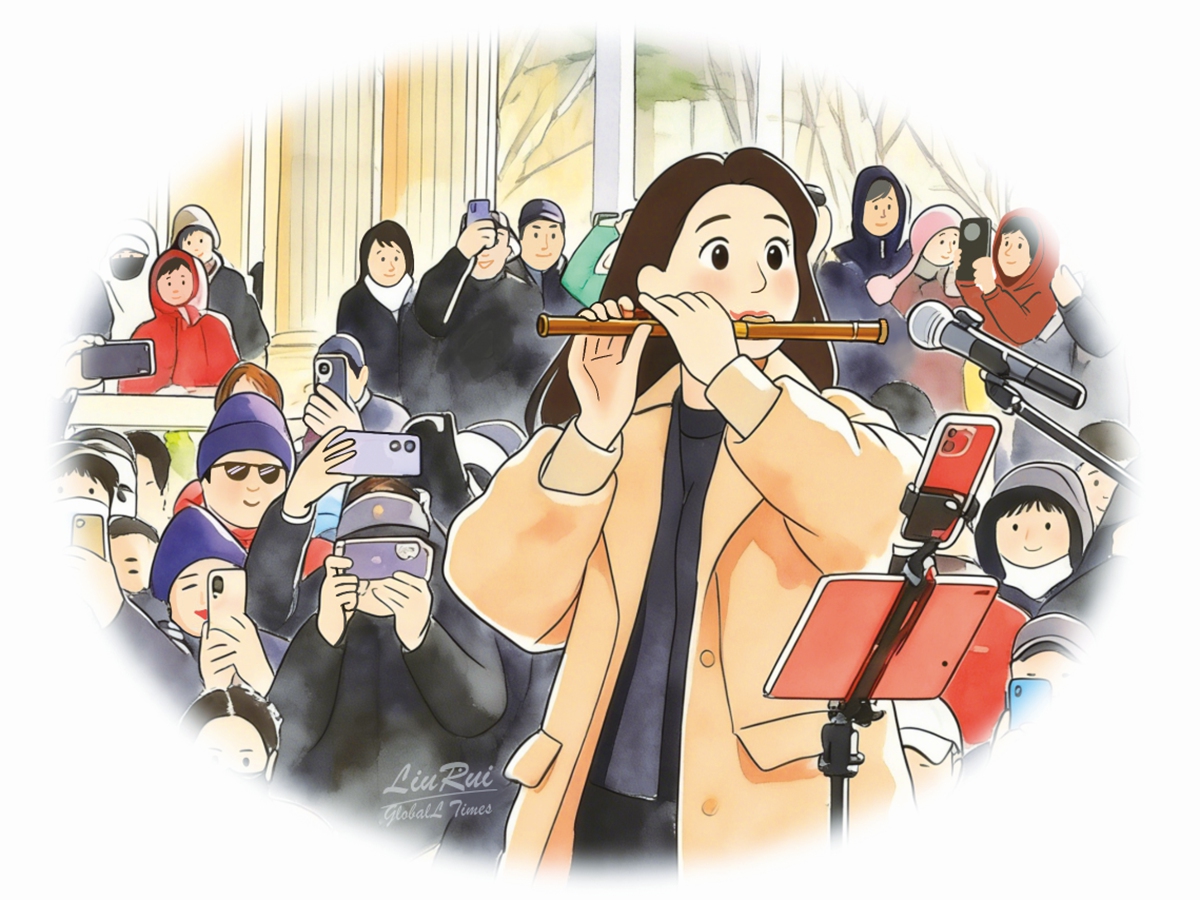
Illustration: Liu Rui/GT
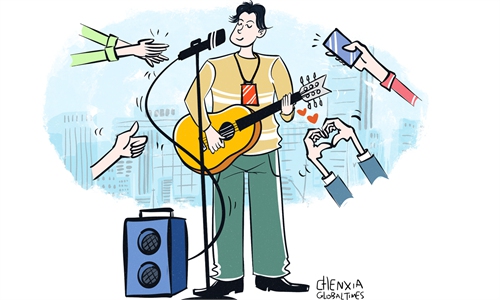
Before sunrise, Beijing parks look ordinary in winter - bare trees, empty benches, a few bundled-up early risers. But then, a melody begins to thread its way through the air, and suddenly the space is transformed. People gather, strangers become neighbors, and art fills the public space with possibility.
This is a new sight in Beijing's parks, where the gentle notes of Sun Chubo's bamboo flute have turned winter mornings into communal celebrations. The young professional from the China National Opera and Dance Drama has moved the stage from the theater to the masses and made performances both a showcase of individual taste and a reflection of the voice of the people. The countless likes both offline and online prove that this is a means for art to burst forth with vigorous and dynamic vitality.
"In outdoor performances, I can see everyone's expressions up close. It is much easier to intuitively sense whether the audience enjoys the piece I am playing and to directly feel their emotions," Sun told the Global Times.
Some audience members on site remarked, "More and more artists are stepping out of grand venues, letting us enjoy high-level performances for free. All we need is a small folding stool to enjoy the show at street corners and in parks."
Sun's story is not an isolated case. Increasingly, artists and creators are recognizing the importance of engaging directly with the public.
For example, Jiang Tiehong, dean of the College of Dance at Minzu University of China, performed traditional folk dance with amateur troupes in Beijing's Zizhuyuan Park, drawing thunderous applause. Vocalist Wei Guangde spent four months touring five cities, holding more than 80 "park concerts." Some audience members even climbed trees to listen. Musicians such as pipa player Luo Yi and suona player Liu Xizhan have joined Sun's ensemble, turning the park flute performance into a "folk music trio." These "Sun Chubos" have left the stage lights behind to perform among the people, and their popularity - both in acclaim and attendance - remains undiminished.
When artists move into public spaces such as parks and squares to create and perform, they break the spatial boundaries of traditional venues. Art thus steps out from the relatively closed environment of theaters and concert halls into the more open, everyday settings of public life, making literature and art truly "seen, heard, and participated in," Xia Rui, secretary-general of the Street Dance Committee of the China Dancers Association, told the Global Times on Wednesday.
From a communication perspective, public spaces are inherently open and fluid, making it easier for art to reach people of all ages, occupations, and backgrounds. These arenas also facilitate further dissemination via social media and other channels, expanding the social influence of artistic works. From a creative perspective, authentic audience feedback and the interactive atmosphere of live events often inspire artists, prompting them to reconsider how they express and communicate through their work.
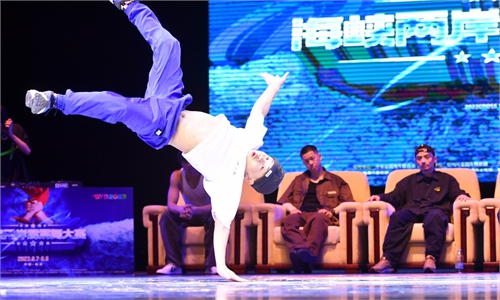
Take street dance as an example. Xia pointed out that this art form, which originated on the street and emphasizes improvisation and interaction, is naturally suited to public spaces. When street dance enters parks and neighborhoods, it maintains its professional expression while also forming the most direct emotional connection between art and ordinary people.
Whether traditional opera, folk music, contemporary dance, or emerging art forms, their vitality all stems from close ties to people's lives. Once artistic creation becomes removed from the genuine experiences and aesthetic needs of the public, it risks falling into a closed loop of self-expression, making it difficult for works to achieve lasting impact.
The relationship between art and the public is mutually nourishing. On the one hand, art draws material, emotions, and inspiration from everyday life; on the other hand, it enriches public life through aesthetic expression, spiritual guidance, and the presentation of values, thereby enhancing the warmth and depth of public culture. Truly vital works of art often find a balance between professional expression and public understanding.
To allow art to truly permeate public life, more cultural activities should be encouraged to step outside fixed venues and enter communities, parks, campuses, and neighborhoods, creating cultural scenes that are "within reach"of the public. This presents challenges for urban spaces. For example, Sun's performances in parks have sometimes attracted such large crowds that safety risks arise, requiring preventive measures. To ensure these cultural events benefit more people, comprehensive planning and strengthened coordination and management are necessary.
Relevant authorities have indeed provided Sun and others with more convenient and safer platforms. After coordination, Sun moved her performances to Beijing's Tianqiao citizen's square, which offers a spacious area and a ready-made stage.
From the depths of a bamboo forest to city squares, the venue may change, but the connection between art and the public remains constant. When performers enter more public spaces and residents pause for art, this "mutual journey" in the city's public spaces gives art its truest warmth.
The author is a reporter with the Global Times. life@globaltimes.com.cn
RELATED ARTICLES