Harbin Ice-Snow World opens to public, elevating interactive experience with AI, cutting-edge tech
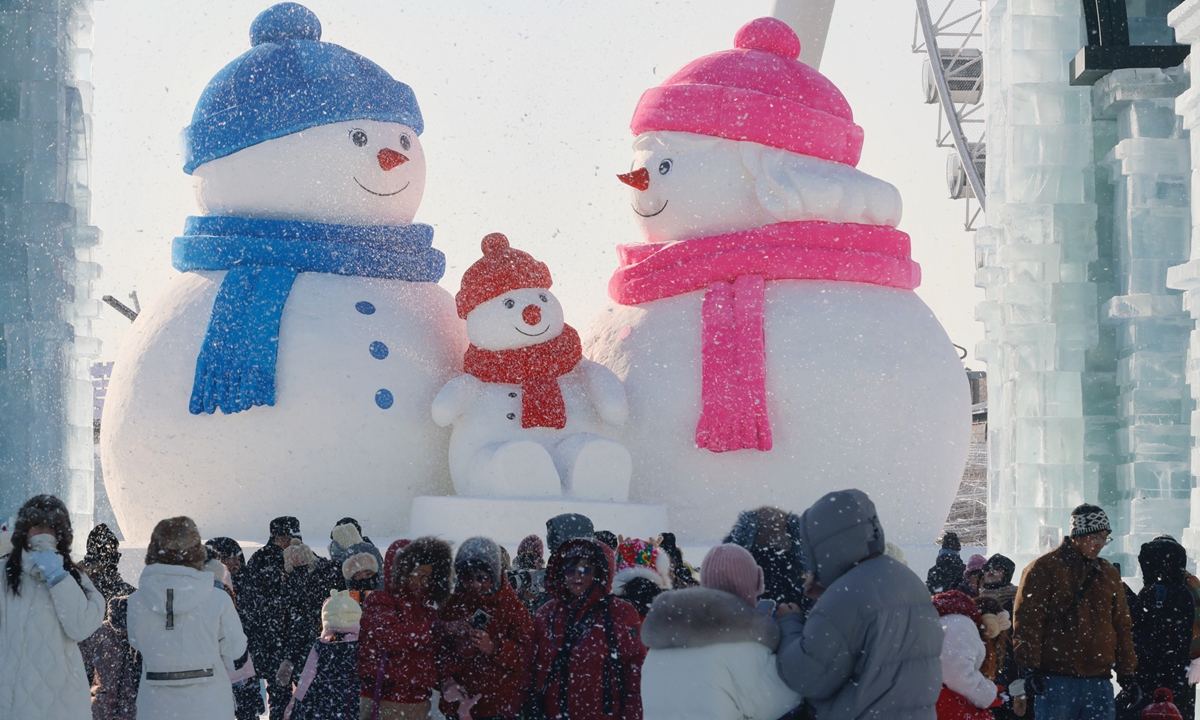
Tourists visit the Harbin Ice-Snow World in Harbin, Northeast China's Heilongjiang Province, December 17, 2025. The Harbin Ice-Snow World, world's largest ice and snow theme park, officially opened for the season on the day. Photo: VCG
The world's largest ice-and-snow theme park, the 27th edition of the Harbin Ice-Snow World, officially opened its gates to visitors on Wednesday in Harbin, the capital of Northeast China's Heilongjiang Province, heralding the upcoming winter tourism peak in the "ice city," and igniting winter tourism fever.
According to official releases and photos, videos posted by tourists, the Harbin Ice-Snow World kicked off featuring its iconic super ice slides, magnificent ice sculptures, and new projects including hot spring campsites, ski routes and various winter sports activities.
Meanwhile, there are iconic structures at this year's Harbin Ice-Snow World: an ice replica of Yellow Crane Tower, located in Central China's Wuhan, while ice sculpture of Belgium's Manneken-Pis celebrates China-Belgium friendship, according to the Xinhua News Agency.
This year's theme park also elevated interactive experience. The highlight is a super ice slide with 24 lanes stretching 521 meters total. A 120-meter-high "snowflake ferris wheel" offers panoramic views of the "ice city." New additions include artificial intelligence (AI) interactive installations and "frozen flower" technology, blending tradition with cutting-edge tech for immersive experiences.
Spanning 1.2 million square meters and using a record-breaking 400,000 cubic meters of ice and snow, the park has created a grand "ice and snow frozen fairytale" on an unprecedented scale, according to media reports.
A 33-year-old Beijing resident surnamed Cai told the Global Times that she planned to visit Harbin during the New Year's Day holiday, and the Harbin Ice-Snow World is a must-visit of the trip.
"I have seen posts by visitors on Wednesday. The theme park is as attractive as I imagined. It was a pity to miss this attraction last snow season. This time, I will go with three of my friends," said Cai.
Booming ice-snow economy
"The opening of the iconic Harbin Ice-Snow World marks another milestone in China's booming ice-snow economy. With China's vast population, upgrading consumption patterns, and rapidly rising participation in winter sports, ice-snow spending has enormous growth potential," Tian Yun, an economist based in Beijing, told the Global Times on Wednesday.
Tian highlighted China's technological edge in smart manufacturing, AI, and extreme-cold equipment, positioning the country to create a globally distinctive Chinese-style ice-snow experience. "From intelligent snow-making systems and AI-guided tours to immersive light shows, cold-weather robots, and wearable thermal gear, these hard-tech applications form the core of competitiveness and growth drivers," Tian said.
It is also worth noting that this year, ice-snow tourism is no longer confined to the northern part of China, which possesses natural snow resources and is colder than the southern part.
Data from domestic travel platform Qunar sent to the Global Times showed such extensions to the southern part during the New Year's Day holiday. Jiuzhaigou in Southwest China's Sichuan Province ranked in the top 20 hot spots of ice-snow travel, while Jiaozi Snow Mountain in Southwest China's Yunnan saw ticket bookings double year-on-year.
Beyond tourism, participation in winter sports is expanding the consumer base. Skiing has become a popular family vacation choice. Booking data for major destinations - tickets, accommodations - remains strong, painting a picture of a robust demand, Yu Fenghui, senior researcher at Pangoal Institution, told the Global Times.
Qunar's report highlighted Northeast China's Jilin's Changbai Mountain drawing crowds for its snowy forests and skiing during the New Year's Day holiday, making it among top 10 in bookings. Heilongjiang's Snow Town and Yabuli Ski Resort saw ticket volumes surge 2.7-fold and 2-fold respectively.
According to data from Muniao, a short-term rental booking platform, East China's Jiangsu, Zhejiang, and Shanghai, also locate in the southern part of China, have emerged as top hotspots for indoor ski resort consumption.
"Provinces' systematic investments in infrastructure, innovative scenarios, and industrial synergy exemplify supply-side structural reform - going far beyond tourism to unlock domestic demand and reinvent consumer experiences through high-quality, differentiated, and intelligent offerings," said Tian.
Policy support
In recent years, China's ice-and-snow industry has evolved from a once-seasonal tourism niche into a comprehensive, year-round ecosystem that now spans resort vacations, equipment manufacturing, sports training, event management, and cultural experiences.
Now, Chinese localities have turned "cold resources" into a "hot industry" through continuous efforts and policy support.
Yu pointed out that supportive policies and improved infrastructure are propelling China's ice-snow tourism into a golden era. As consumers demand higher-quality leisure, the market's growth potential continues to unfold. The sector's core competitiveness is shifting from natural endowments to "tech + service."
Recent policies have also added momentum. For example, on December 10, Northeast China's Liaoning Province released a draft three-year plan (2025-2027) for high-quality ice-snow tourism, aiming for 10 provincial-level ski resorts, over 10 premium tourism routes, and annual receptions of ice and snow tourists exceeding 260 million by 2027, with comprehensive revenue topping 250 billion yuan.
During the recently concluded Central Economic Work Conference, which set the economic development tone for 2026, it was noted that "domestic demand will remain as a focus in building a robust domestic market," Xinhua reported.
The meeting also said that "special initiatives should be advanced to boost consumption, and the supply of high-quality consumer goods and services should be expanded."
Regarding the expansion of supply of high-quality consumer goods and services, Cheng Shi, chief economist at ICBC International, and Xu Jie, senior economist at the company, said in a note sent to the Global Times that the latest round of supply-side structural reform has shifted toward leveraging new technologies, new business models, and new application scenarios to achieve finer-grained, higher-precision alignment between supply and demand,
"Icons like Harbin Ice-Snow World demonstrated how such premium offerings stimulate spending and fuel growth," Tian said, suggesting infusing Chinese aesthetics, Northeast China's folklore, and industrial heritage for creative transformation and global appeal, elevating the seasonal spectacle into a year-round brand.
"This could drive cultural creatives, film, digital content, and derivatives, forging a sustainable IP growth engine," said Tian.
Last winter, Harbin welcomed a record 90.36 million visitors, generating 137.22 billion yuan ($19.4 billion) in revenue, a 16.6 percent year-on-year increase, according to Xinhua.
Analysts projected that the number of visitors to Harbin during the 2025-2026 snow season will likely increase.
By delivering world-class, innovative experiences, ice and snow attractions draw millions of tourists, while spurring related sectors: hospitality, transport, retail, and IP-related cultural and creative products, they noted.
According to a recently released industrial research report, the size of China's ice-and-snow industry is projected to surpass 1 trillion yuan in 2025, reaching 1.0053 trillion yuan. This positions ice-snow as a powerful emerging driver of economic growth.
Tian saw this as reflecting consumption shifts: from survival-oriented to development-enjoyment; and the need to better match supply with surging demand for quality offerings.
Analysts pointed out that consumption is a major growth engine for China. Its steady expansion stabilizes the economic foundation amid external uncertainties, powering domestic circulation. The formation of new consumption growth drivers, such as the ice and snow economy, will fuel China's economic development.
RELATED ARTICLES

