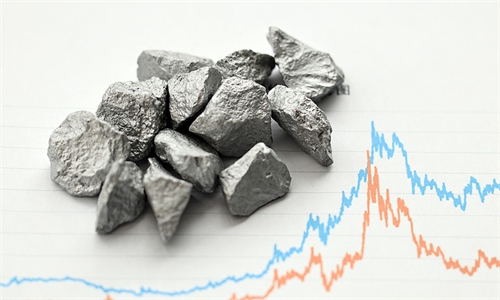
New mineral discovered in South China is named Jinxiuite, or nickel-bismuth-antimony-arsenic sulfide

Photo: Screenshot from China Media Group
A new mineral — a nickel-bismuth-antimony-arsenic sulfide — discovered in South China’s Guangxi Zhuang Autonomous Region and proposed by researchers from the Chinese Academy of Geological Sciences has been officially approved, with its Chinese name designated as Jinxiuite, China Media Group learned from China Geological Survey under the Ministry of Natural Resources on Wednesday.
Jinxiuite was discovered in a nickel-cobalt deposit in Jinxiu Yao Autonomous County of Guangxi. Experts said that the nickel-cobalt deposit is an exceptionally rich nickel-cobalt ore body, with nickel and cobalt contents of approximately 17.5 percent and 1.5 percent, respectively—nearly 80 times higher than the conventional mineralization standards of 0.2 percent for nickel and 0.02 percent for cobalt, according to the report.
Experts noted that the nickel-cobalt deposit in which Jinxiuite was formed is a critically scarce mineral resource, particularly cobalt, which China has long relied heavily on imports for. The discovery of Jinxiuite holds significant importance for research into the genesis of hydrothermal nickel-cobalt deposits and for guiding breakthroughs in mineral exploration, per the report.
Experts added that discovering a new mineral not only demonstrates China’s advanced geological survey capabilities but also adds a new member to the global family of minerals on Earth. The discovery of a new mineral represents a milestone scientific breakthrough, which expands humanity’s understanding of the boundaries of the material world and holds promise for the synthesis of new materials with special properties, the report said.
Yan Jiayong, director of a mineral exploration theory and technology research Office at the Chinese Academy of Geological Sciences said in the report that a new mineral is a ‘design blueprint’ gifted by nature—a stable structure selected through 4.6 billion years of geochemical experimentation on Earth. Its unique atomic stacking pattern may possess properties that are difficult to achieve through conventional artificial synthesis.
Materials scientists can draw inspiration from the crystal structures of metallic minerals and attempt to synthesize similar artificial minerals or compounds in the laboratory, developing new energy materials that are more efficient, more stable, or lower in cost, Yan said.
At the same time, a new mineral also serves as a “code” that records the unique geological history of Earth and even the universe, revealing the evolutionary behavior of elements under extreme geological conditions, per the report.
Global Times
RELATED ARTICLES