China’s first UHV power line reaching heart of Qinghai-Tibet Plateau goes into operation
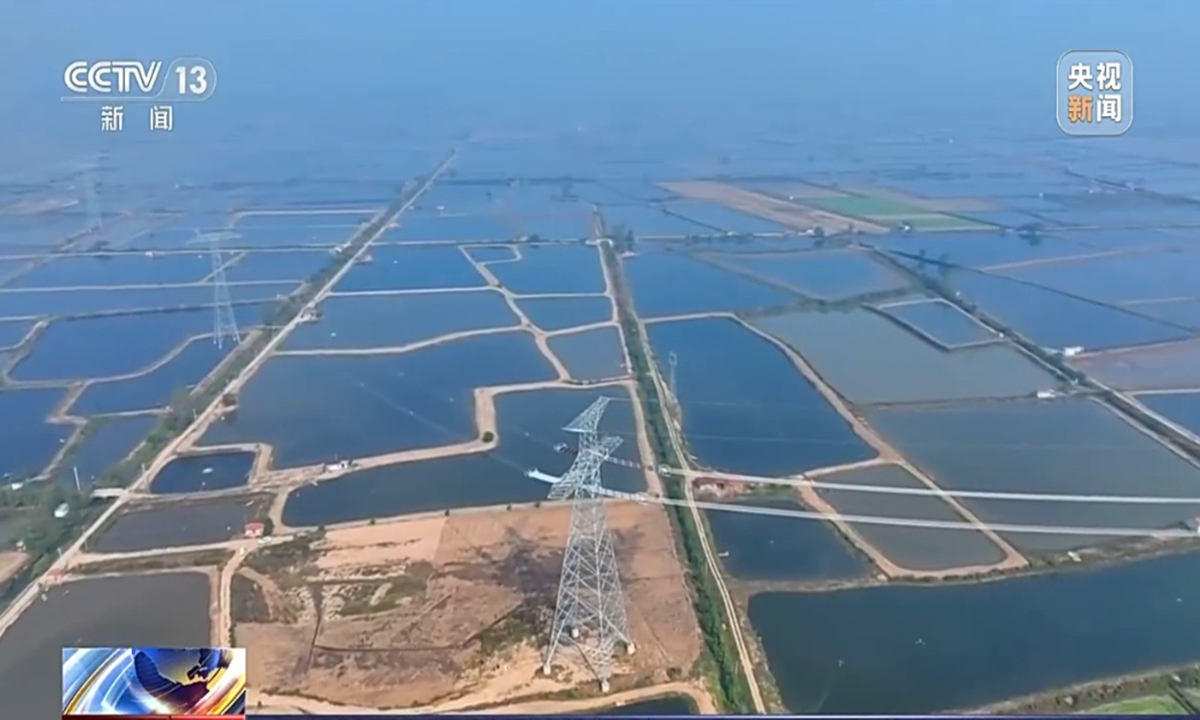
China's first ±800-kilovolt ultra-high-voltage (UHV) power transmission project extending into the heart of the Qinghai-Tibet Plateau Photo: Screenshot of a CCTV report
China's first ±800-kilovolt ultra-high-voltage (UHV) power transmission project extending into the heart of the Qinghai-Tibet Plateau officially entered operation at midnight on Thursday, China Central Television (CCTV) reported, marking a major step in optimizing cross-regional energy allocation and advancing the clean energy transition.
The UHV direct current (DC) transmission project, built by the State Grid Corporation of China (SGCC), runs from the upper reaches of the Jinsha River and traverses the Southwest China's Xizang Autonomous Region, Sichuan Province, Chongqing Municipality and Central China's Hubei Province, before terminating at the Daye converter station in Huangshi, Hubei.
The project spans nearly 1,900 kilometers and involves a total investment of 33.4 billion yuan ($4.7 billion), according to the report.
It has played a key role in advancing the large-scale, integrated development of hydropower, wind power and solar energy resources in the upper reaches of the Jinsha River, according to Lan Jianjun, deputy director of the Construction Department of State Grid Sichuan Electric Power Company.
By enabling surplus hydropower from Sichuan to be allocated more efficiently across a wider area, the line will facilitate the consumption of clean energy from the Qinghai-Tibet Plateau and help convert western China's resource advantages into economic advantages, Lan said.
Once fully operational, the project is expected to transmit nearly 40 billion kilowatt-hours of clean electricity annually to Central China. This is equivalent to replacing about 12 million tons of standard coal each year and cutting carbon dioxide emissions by approximately 30 million tons.
The annual transmission capacity of the line is roughly equal to one-sixth of Hubei Province's total annual electricity consumption, said Wu Ziliang, deputy director of the UHV Project Construction Management Office of State Grid Hubei Electric Power Co.
Wu noted that the project will significantly increase the share of clean electricity in Hubei's imported power supply, while strengthening the grid's ability to balance power surpluses and shortages and achieve complementary supply across different regions and time periods.
This will support Hubei's transition from relying on "electricity imported from outside the province" to greater use of "green electricity imported from outside the province," he said.
In 2025, SGCC has continued to ramp up investment in power grid construction. Four UHV DC transmission projects are scheduled to be completed and put into operation during the year, with the scale and intensity of grid construction reaching a historical high, according to CCTV.
So far this year, the company has accelerated the construction of major transmission corridors, successively completing and commissioning four UHV DC projects linking western and northern energy bases with eastern and central load centers, further strengthening the national energy transmission network.
The company has built and put into operation 42 UHV projects, with cross-regional and cross-provincial transmission capacity reaching 370 million kilowatts, forming UHV AC backbone grids across East, North, Central and Southwest China and enhancing the resilience and reliability of the national power supply, the report citing an technical official from SGCC as saying.
UHV projects put into operation so far this year have significantly strengthened China's cross-regional allocation of clean energy, delivering wind, solar and hydropower from western and northern regions to major load centers in eastern and central China and adding more than 100 billion kilowatt-hours of clean electricity transmission annually.
Looking ahead to the 15th Five-Year Plan period (2026-30), SGCC will continue to advance interconnection between southwestern hydropower bases, northwestern renewable energy bases and central and eastern load centers, and further facilitate China's green and low-carbon energy transition, the report noted.
Global Times
RELATED ARTICLES