GT Voice: National standard for digital humans underscores brisk pace of AI application
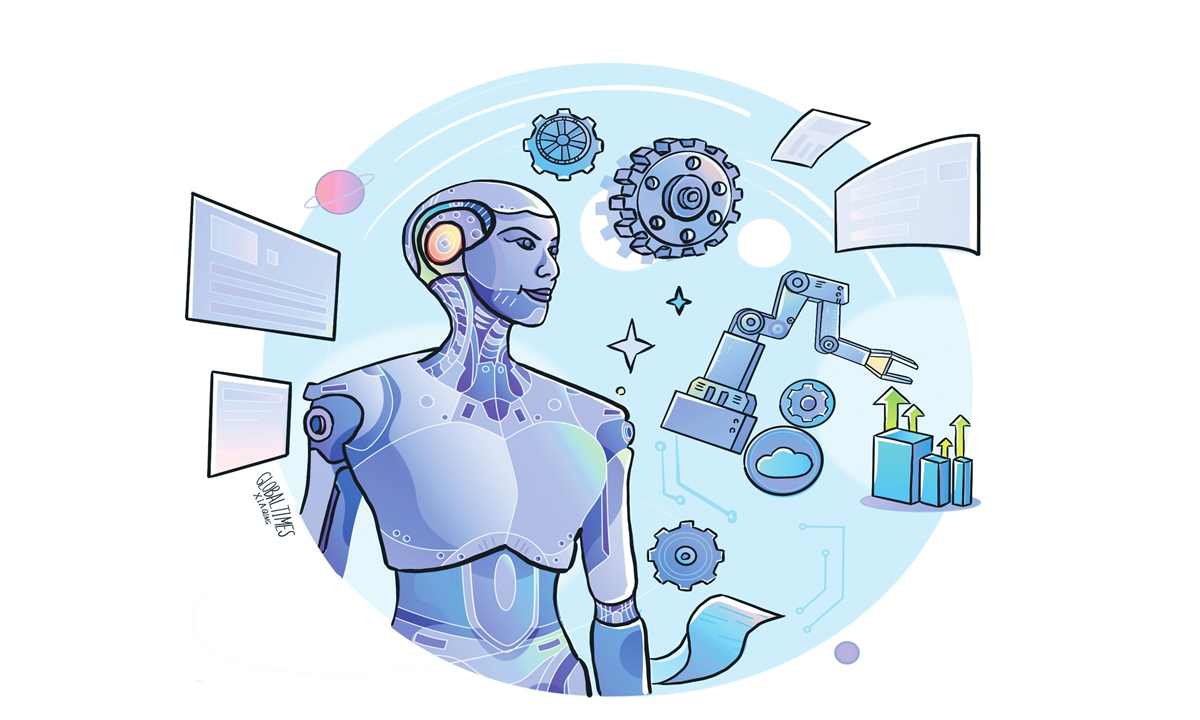
Illustration: Xia Qing/GT
China has released its first national standard for virtual digital humans, CCTV News reported on Thursday. This standard addresses a long-standing lack of uniform technical guidelines within the industry, providing clear requirements and benchmarks for the research, development, production, and application of customer-service virtual humans.This move reflects more than just progress for the virtual human sector; it highlights China's efforts in integrating artificial intelligence (AI) into real-world applications and fostering new business models.
As an important carrier for AI application, customer service-oriented virtual humans have gradually penetrated into diverse fields such as e-commerce, finance, education and healthcare. In the e-commerce sector, for example, virtual customer service can provide 24/7 intelligent consultation, greatly improving the efficiency of service response and customer satisfaction.
In the medical field, virtual humans can assist in preliminary consultations and information collection, alleviating the pressure on on-site medical resources. These applications restructure traditional service processes while also bringing more convenience and efficiency to consumers, becoming an active innovative force in the digital economy.
However, virtual digital humans developed by different companies have varied greatly in terms of interactive experience and functional performance. These disparities not only affected user experience but also hindered the coordinated development and large-scale application of the entire industry.
Now, with the national standard in place, companies have a clearer direction for improving and innovating their products. Specifically, the standard sets clear, measurable benchmarks such as a lip-synch accuracy rate of at least 90 percent, an average success rate of 90 percent for gesture and body movement interaction, and an emotional interaction success rate of at least 80 percent. These concrete indicators can help establish a common baseline for quality, build user trust, and support the responsible application of virtual humans across more scenarios.
The rapid growth of AI application in China has been significantly driven by commercialization. However, as virtual humans, which represent a critical use case for AI, explore new frontiers, challenges inevitably arise. This is where standards play a crucial role: they help set basic requirements, prevent systemic risks, and ensure that innovation proceeds in a healthy and sustainable manner.
This focus on standardization aligns with China's broader digital economy objectives. The National Development and Reform Commission and the National Data Administration clearly stated in the 2025 Digital Economy Development Work Highlights that China will enhance the core competitiveness of the digital economy and promote the deep integration of technological innovation and industrial innovation.
The high-quality development of the digital economy must be supported by a strong standards framework. According to the State Administration for Market Regulation, China has released 30 AI national standards, with another 84 standards under development, covering areas from basic software and hardware to key technologies, industry applications, and security governance. These standards are increasingly seen as a guide and catalyst for innovation in related industries.
The true potential of a general-purpose technology such as AI lies in its deep integration with all sectors of the economy. But such integration cannot be chaotic or disorderly. It requires common interfaces, agreed-upon protocols, and recognized quality benchmarks. Standards provide exactly that foundation.
The release of this virtual human standard is a fresh starting point for China's exploration of AI-powered new business models.
Guided and protected by such standards, AI technology can empower various industries in a safer, more reliable, and more efficient manner. This will not only give rise to new service formats such as digital human livestreaming and intelligent consulting but also propel the entire digital economy toward higher quality and more sustainable development, continuously injecting fresh innovative energy into economic transformation.
RELATED ARTICLES