IN-DEPTH / DIPLOMATIC CHANNEL
The 15th Five-Year plan could be important marker in China’s solidarity with Global South: Ex-World Bank economist
Editor's Note:
The Fourth Plenary Session of the 20th Central Committee of the Communist Party of China (CPC) deliberated and adopted the "Recommendations of the CPC Central Committee for Formulating the 15th Five-Year Plan for Economic and Social Development," which clarifies the guiding principles and main objectives for China's economic and social development over the next five years. In this issue, Global Times reporters Xie Wenting and Bai Yunyi (GT) conducted an exclusive interview with Mwangi Wachira, a former economist with the World Bank. In the interview, the renowned economist affirmed the resilience of the Chinese economy and its strong innovative capacity, and expressed his belief that China's experience in combining national planning with market mechanisms offers valuable lessons for other developing countries.
He also stated that China is transitioning from the "factory of the world" to "innovation architect," and the 15th Five-Year Plan (2026-30) blueprint will create new opportunities for cooperation between China and other Global South countries in areas such as industrialization and digitalization.
GT: In your opinion, what are the new highlights of the 15th Five-Year Plan?
Wachira: The 14th Five-Year plan (2021-25) sought to consolidate the gains of years of export-driven growth by encouraging domestic consumption, expanding the social safety net, and promoting green development to tie the fortunes of the economy to a safe driver, China's domestic consumer.
The 15th Five-Year Plan (2026-30) prioritizes reducing dependence on other countries for high-end technologies because such a dependence is clearly a vulnerability. It will also continue to support "dual circulation" in which the domestic and global markets are less integrated and can thrive independently in case of need.
GT: To what extent do you believe China's investment in science and technology can support its economic growth? Which sectors or technologies are most likely to become new growth engines?
Wachira: Various reports show that the search for new productive forces, a preoccupation with turning breakthroughs in science and technology into actual products, is strong in many sectors of China's economy. Investment in research and development is a rough indicator of priorities.
According to the National Bureau of Statistics, in 2024, the five leading sectors in terms of investment in research and development were: Computers and communication equipment, electrical machinery, automobiles, special purpose machinery, and general-purpose machinery. Taken together, these favored sectors show a preoccupation with innovation, a key to maintaining or acquiring new comparative advantages in making many everyday products. In time, these sectors are likely to become the new engines of growth.
GT: How do you evaluate China's innovation capacity? There has long been a view in the West that China excels at imitation while the US excels at innovation, and that the US system is better at incentivizing innovation than China. What is your take on this assessment?
Wachira: History suggests that the early stages of industrialization entail some degree of copying and imitation. This was true when others copied paper making from China or stole the secrets of making high quality silk. It was also true when China copied car production from other countries.
Driven by a mistaken underlying belief that they have a monopoly on innovation, some Western countries now accuse China of copying. Perhaps it is human to denigrate achievements made by others. As it is, many breakthroughs from China in scientific and technical fields strongly suggest local ingenuity rather than imitation.
With respect to efficiency in incentivizing innovation, the difference between the US system, which relies on universities and private research centers, and the more centrally driven Chinese system is overdrawn for political reasons. Many US universities and private institutions that lead in innovations in frontier technologies are so heavily dependent on the federal government that they are virtually departments of the federal government. In other words, in practice, they are not all that different from China's institutions.
GT: How do you assess the growth prospects of China's economy during the 15th Five-Year Plan period? In the face of global uncertainties such as geopolitical changes and supply chain restructuring, how do you evaluate the resilience of China's economy?
Wachira: Early this month, the IMF projected that China's economy will grow by 5 percent in 2025, thanks, in part, to lower tariffs and the stimulus for domestic consumption. Clearly, China's economy is resilient even with current trade tensions. This resilience was on display for a few years as China pulled out of the COVID-19 malaise.
The IMF urged China to continue moving to a consumption-led growth model and away from over-reliance on exports and investment. In addition, the IMF recommended continued support for strengthening the social safety net, and redirecting household savings. As discussed elsewhere, these steps are already underway. They already account for the resilience. In short, maintain the direction but pick up the pace.
GT: Some analysts argue that China is shifting from its "traditional manufacturing advantage" toward a growth model driven by "advanced manufacturing." In your view, how will this transition shape China's economic performance over the next five years? What suggestions do you have for maintaining a balance between upgrading traditional manufacturing and developing advanced and high-end manufacturing?
Wachira: China's economy has risen using its comparative advantages in traditional manufacturing. The emerging robotics-driven productive forces will require a smaller and qualitatively different workforce. Preparing and deploying this new workforce will almost surely require retooling education and training facilities, which is in itself a process. The benefits - lower production costs - will be minimal in the next five years. As with the digital revolution, it will probably take more than five years for the full benefits of advanced manufacturing to be realized.
GT: In recent years, some Western countries have intensified their technological blockades against China. How do you view the impact of this on China and the global technological innovation system?
Wachira: Restricting access to technology naturally limits openness and globalization. There is no easy way out of this except hard work. Aspiring to attain technological self-reliance is the most prudent path. China's sustained investment in science and technology surely must be driven by the conviction that no one country or people has a monopoly on ingenuity, and creativity. The unintended consequence of restricting access to dual-purpose technologies is to spur ingenuity and creativity in the global innovation system. This has always been true.
GT: In comparison to the Western emphasis on "complete reliance on market regulation," what significance do you believe China's practice of formulating five-year plans while combining market mechanisms holds for other economies?
Wachira: Market-driven governance is better suited when objectives are unclear or diffuse. It invites and encourages many objectives and the pursuit of private good. It enshrines individualism, which can usher constructive or destructive features into the fabric of the society. Therefore, under some circumstances market-driven governance can be extremely wasteful of resources, human beings, and time. It can also produce dramatic ingenuity.
Goal-oriented and centrally-managed governance is an efficient way to attain clear and common objectives such as confronting an existential threat. It concentrates effort by shutting out competing objectives. Throughout US history, the economy has not been entirely dependent on market mechanisms.
But the difference between the two is not a dichotomy. In practice, the two approaches to governance co-exist in any one country irrespective of the labels on the form of government. Lucky is the country in which the two approaches are in balance. China appears to be a reasonable blend of centrally-managed and market-driven governance. Other countries, especially African countries, have been studying China for this very reason.
GT: What global value do you think China's 15th Five-Year Plan will offer? During the 15th Five-Year Plan period, what new opportunities do you see for China's cooperation with Global South countries in industrialization, digital transformation, and green development?
Wachira: China's 15th Five-Year Plan (2026-30) shifts from labor-intensive growth to high-quality development focusing on innovation, green transformation, and social inclusion. This shift to "new quality productive forces"-science, technology, and human talent for artificial intelligence, biotechnology, clean energy, and advanced semiconductors - is in response to challenges facing China globally. The shift will foster innovation at home thereby transforming China from the "factory of the world" to an "innovation architect."
The global value of this shift will be felt most strongly in countries within China's subregion where China already produces many consumer goods alone or in collaboration with local investors. Other Global South countries will also benefit albeit at a lower scale. Overall, China's shift to new quality productive forces will create opportunities for accelerated industrialization in the Global South.
It is less clear that the Global South can accompany China in shifting to the new quality productive forces. Can the Global South leapfrog over this stage of labor-intensive growth? Using smart farming technologies, artificial intelligence, and satellite data to monitor crop health and improve yields does not change the fact that factories are needed to process the yields into consumer goods in Global South countries. In this vein, the minerals, or commodities of East and Central Africa, for example, still need to be mined and processed and used to produce consumer products in Africa. This is the local need. Treacherous as industrialization can be, it is the only path to self-reliance for the Global South.
Viewed from this perspective, the shift in the 15th Five-Year plan could be an important marker in China's solidarity with the Global South.
The Fourth Plenary Session of the 20th Central Committee of the Communist Party of China (CPC) deliberated and adopted the "Recommendations of the CPC Central Committee for Formulating the 15th Five-Year Plan for Economic and Social Development," which clarifies the guiding principles and main objectives for China's economic and social development over the next five years. In this issue, Global Times reporters Xie Wenting and Bai Yunyi (GT) conducted an exclusive interview with Mwangi Wachira, a former economist with the World Bank. In the interview, the renowned economist affirmed the resilience of the Chinese economy and its strong innovative capacity, and expressed his belief that China's experience in combining national planning with market mechanisms offers valuable lessons for other developing countries.
He also stated that China is transitioning from the "factory of the world" to "innovation architect," and the 15th Five-Year Plan (2026-30) blueprint will create new opportunities for cooperation between China and other Global South countries in areas such as industrialization and digitalization.
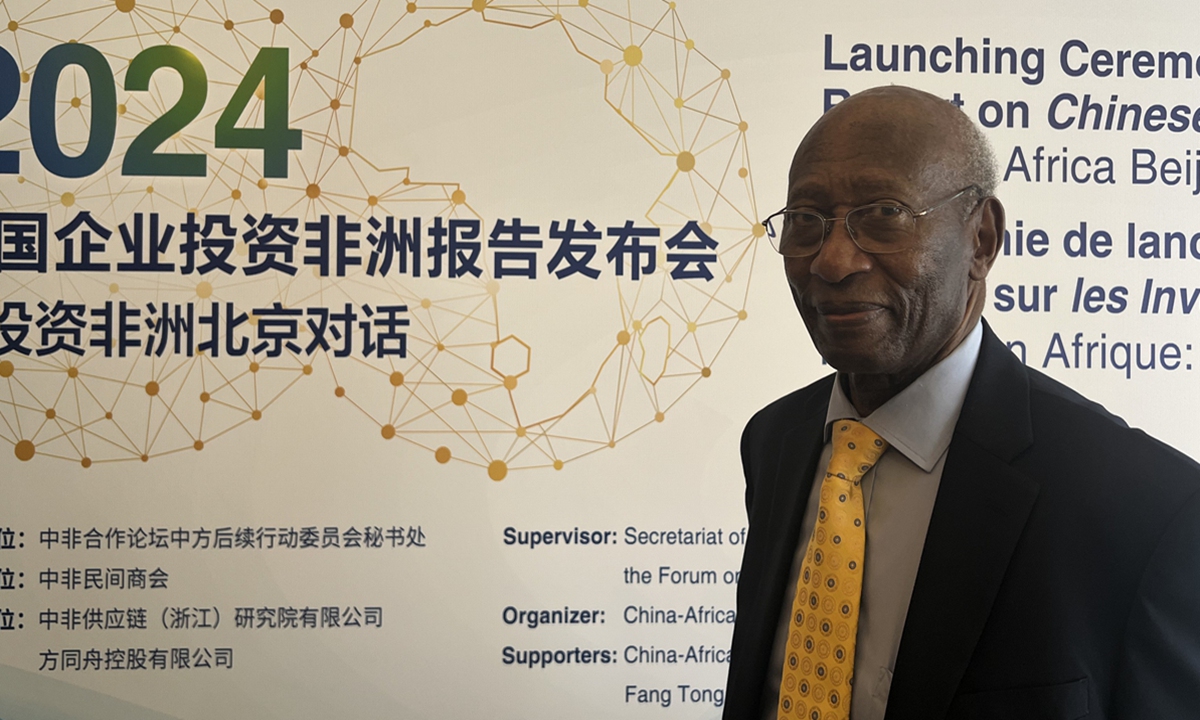
Mwangi Wachira, a former economist with the World Bank Photo: Zhao Yusha/GT
GT: In your opinion, what are the new highlights of the 15th Five-Year Plan?
Wachira: The 14th Five-Year plan (2021-25) sought to consolidate the gains of years of export-driven growth by encouraging domestic consumption, expanding the social safety net, and promoting green development to tie the fortunes of the economy to a safe driver, China's domestic consumer.
The 15th Five-Year Plan (2026-30) prioritizes reducing dependence on other countries for high-end technologies because such a dependence is clearly a vulnerability. It will also continue to support "dual circulation" in which the domestic and global markets are less integrated and can thrive independently in case of need.
GT: To what extent do you believe China's investment in science and technology can support its economic growth? Which sectors or technologies are most likely to become new growth engines?
Wachira: Various reports show that the search for new productive forces, a preoccupation with turning breakthroughs in science and technology into actual products, is strong in many sectors of China's economy. Investment in research and development is a rough indicator of priorities.
According to the National Bureau of Statistics, in 2024, the five leading sectors in terms of investment in research and development were: Computers and communication equipment, electrical machinery, automobiles, special purpose machinery, and general-purpose machinery. Taken together, these favored sectors show a preoccupation with innovation, a key to maintaining or acquiring new comparative advantages in making many everyday products. In time, these sectors are likely to become the new engines of growth.
GT: How do you evaluate China's innovation capacity? There has long been a view in the West that China excels at imitation while the US excels at innovation, and that the US system is better at incentivizing innovation than China. What is your take on this assessment?
Wachira: History suggests that the early stages of industrialization entail some degree of copying and imitation. This was true when others copied paper making from China or stole the secrets of making high quality silk. It was also true when China copied car production from other countries.
Driven by a mistaken underlying belief that they have a monopoly on innovation, some Western countries now accuse China of copying. Perhaps it is human to denigrate achievements made by others. As it is, many breakthroughs from China in scientific and technical fields strongly suggest local ingenuity rather than imitation.
With respect to efficiency in incentivizing innovation, the difference between the US system, which relies on universities and private research centers, and the more centrally driven Chinese system is overdrawn for political reasons. Many US universities and private institutions that lead in innovations in frontier technologies are so heavily dependent on the federal government that they are virtually departments of the federal government. In other words, in practice, they are not all that different from China's institutions.
GT: How do you assess the growth prospects of China's economy during the 15th Five-Year Plan period? In the face of global uncertainties such as geopolitical changes and supply chain restructuring, how do you evaluate the resilience of China's economy?
Wachira: Early this month, the IMF projected that China's economy will grow by 5 percent in 2025, thanks, in part, to lower tariffs and the stimulus for domestic consumption. Clearly, China's economy is resilient even with current trade tensions. This resilience was on display for a few years as China pulled out of the COVID-19 malaise.
The IMF urged China to continue moving to a consumption-led growth model and away from over-reliance on exports and investment. In addition, the IMF recommended continued support for strengthening the social safety net, and redirecting household savings. As discussed elsewhere, these steps are already underway. They already account for the resilience. In short, maintain the direction but pick up the pace.
GT: Some analysts argue that China is shifting from its "traditional manufacturing advantage" toward a growth model driven by "advanced manufacturing." In your view, how will this transition shape China's economic performance over the next five years? What suggestions do you have for maintaining a balance between upgrading traditional manufacturing and developing advanced and high-end manufacturing?
Wachira: China's economy has risen using its comparative advantages in traditional manufacturing. The emerging robotics-driven productive forces will require a smaller and qualitatively different workforce. Preparing and deploying this new workforce will almost surely require retooling education and training facilities, which is in itself a process. The benefits - lower production costs - will be minimal in the next five years. As with the digital revolution, it will probably take more than five years for the full benefits of advanced manufacturing to be realized.
GT: In recent years, some Western countries have intensified their technological blockades against China. How do you view the impact of this on China and the global technological innovation system?
Wachira: Restricting access to technology naturally limits openness and globalization. There is no easy way out of this except hard work. Aspiring to attain technological self-reliance is the most prudent path. China's sustained investment in science and technology surely must be driven by the conviction that no one country or people has a monopoly on ingenuity, and creativity. The unintended consequence of restricting access to dual-purpose technologies is to spur ingenuity and creativity in the global innovation system. This has always been true.
GT: In comparison to the Western emphasis on "complete reliance on market regulation," what significance do you believe China's practice of formulating five-year plans while combining market mechanisms holds for other economies?
Wachira: Market-driven governance is better suited when objectives are unclear or diffuse. It invites and encourages many objectives and the pursuit of private good. It enshrines individualism, which can usher constructive or destructive features into the fabric of the society. Therefore, under some circumstances market-driven governance can be extremely wasteful of resources, human beings, and time. It can also produce dramatic ingenuity.
Goal-oriented and centrally-managed governance is an efficient way to attain clear and common objectives such as confronting an existential threat. It concentrates effort by shutting out competing objectives. Throughout US history, the economy has not been entirely dependent on market mechanisms.
But the difference between the two is not a dichotomy. In practice, the two approaches to governance co-exist in any one country irrespective of the labels on the form of government. Lucky is the country in which the two approaches are in balance. China appears to be a reasonable blend of centrally-managed and market-driven governance. Other countries, especially African countries, have been studying China for this very reason.
GT: What global value do you think China's 15th Five-Year Plan will offer? During the 15th Five-Year Plan period, what new opportunities do you see for China's cooperation with Global South countries in industrialization, digital transformation, and green development?
Wachira: China's 15th Five-Year Plan (2026-30) shifts from labor-intensive growth to high-quality development focusing on innovation, green transformation, and social inclusion. This shift to "new quality productive forces"-science, technology, and human talent for artificial intelligence, biotechnology, clean energy, and advanced semiconductors - is in response to challenges facing China globally. The shift will foster innovation at home thereby transforming China from the "factory of the world" to an "innovation architect."
The global value of this shift will be felt most strongly in countries within China's subregion where China already produces many consumer goods alone or in collaboration with local investors. Other Global South countries will also benefit albeit at a lower scale. Overall, China's shift to new quality productive forces will create opportunities for accelerated industrialization in the Global South.
It is less clear that the Global South can accompany China in shifting to the new quality productive forces. Can the Global South leapfrog over this stage of labor-intensive growth? Using smart farming technologies, artificial intelligence, and satellite data to monitor crop health and improve yields does not change the fact that factories are needed to process the yields into consumer goods in Global South countries. In this vein, the minerals, or commodities of East and Central Africa, for example, still need to be mined and processed and used to produce consumer products in Africa. This is the local need. Treacherous as industrialization can be, it is the only path to self-reliance for the Global South.
Viewed from this perspective, the shift in the 15th Five-Year plan could be an important marker in China's solidarity with the Global South.
RELATED ARTICLES