IN-DEPTH / DIPLOMATIC CHANNEL
Let young people from both countries view South Korea and China as a community moving forward together: South Korean Ambassador to China
By Bai Yunyi and Published: Dec 19, 2025 12:09 AM

Editor's Note:
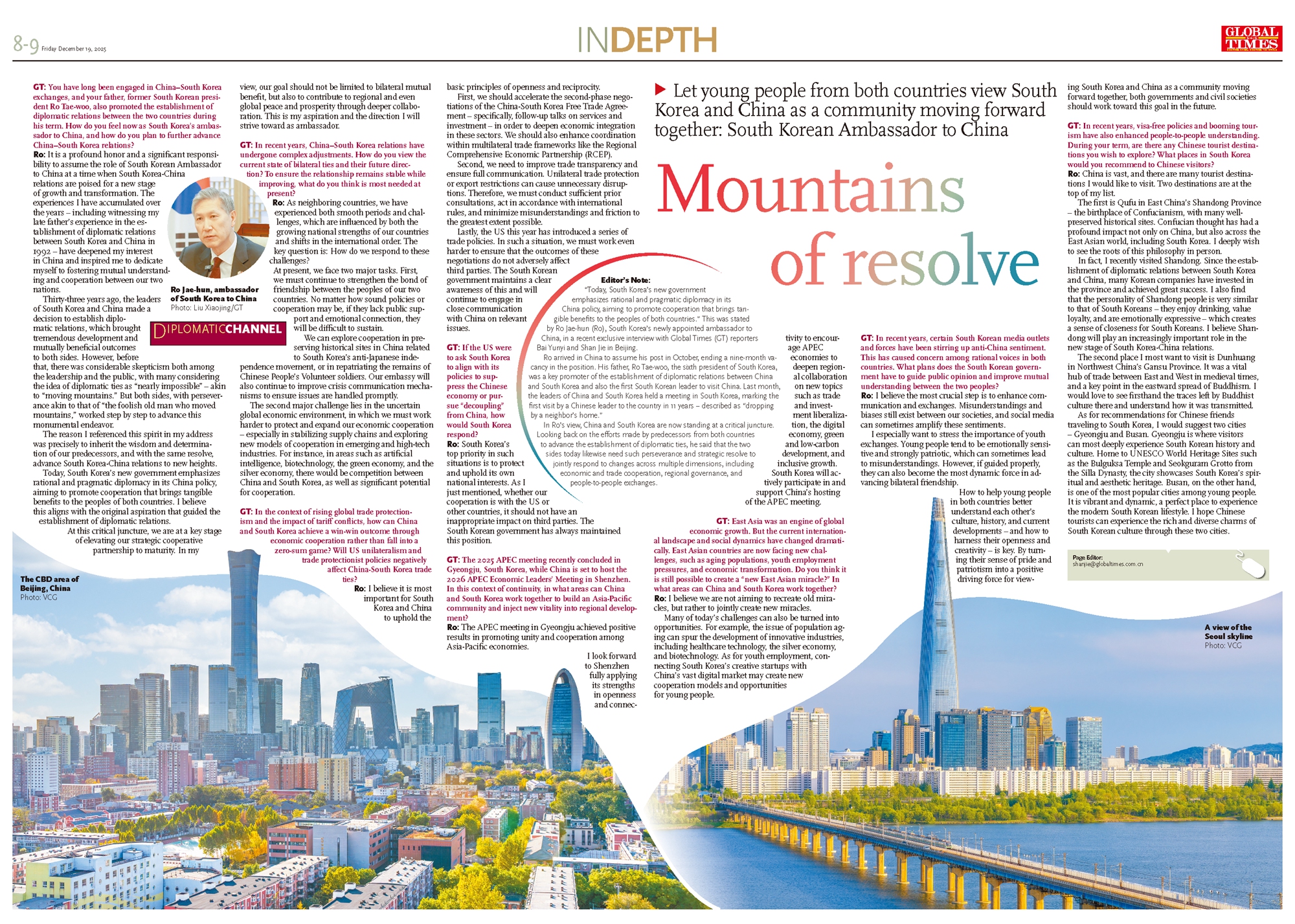
"Today, South Korea's new government emphasizes rational and pragmatic diplomacy in its China policy, aiming to promote cooperation that brings tangible benefits to the peoples of both countries." This was stated by Ro Jae-hun (Ro), South Korea's newly appointed ambassador to China, in a recent exclusive interview with Global Times (GT) reporters Bai Yunyi and Shan Jie in Beijing.
Ro arrived in China to assume his post in October, ending a nine-month vacancy in the position. His father, Ro Tae-woo, the sixth president of South Korea, was a key promoter of the establishment of diplomatic relations between China and South Korea and also the first South Korean leader to visit China. Last month, the leaders of China and South Korea held a meeting in South Korea, marking the first visit by a Chinese leader to the country in 11 years - described as "dropping by a neighbor's home."
In Ro's view, China and South Korea are now standing at a critical juncture. Looking back on the efforts made by predecessors from both countries to advance the establishment of diplomatic ties, he said that the two sides today likewise need such perseverance and strategic resolve to jointly respond to changes across multiple dimensions, including economic and trade cooperation, regional governance, and people-to-people exchanges.
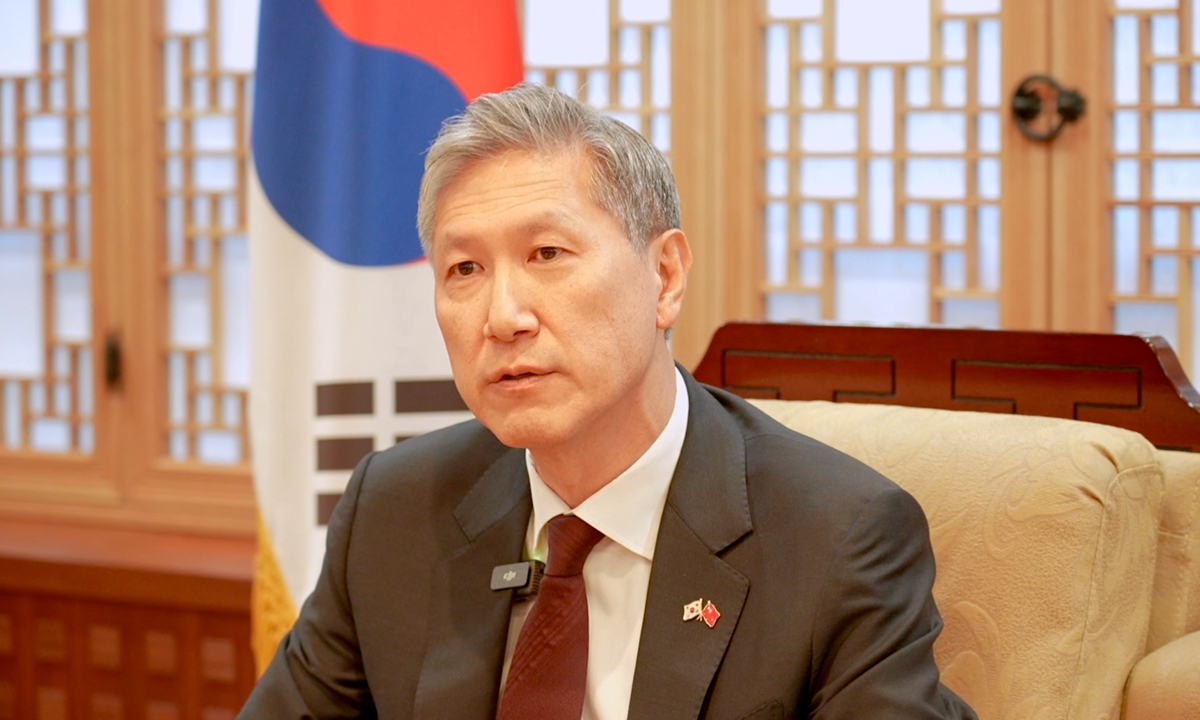
Ro: It is a profound honor and a significant responsibility to assume the role of South Korean Ambassador to China at a time when South Korea-China relations are poised for a new stage of growth and transformation. The experiences I have accumulated over the years - including witnessing my late father's experience in the establishment of diplomatic relations between South Korea and China in 1992 - have deepened my interest in China and inspired me to dedicate myself to fostering mutual understanding and cooperation between our two nations.
Thirty-three years ago, the leaders of South Korea and China made a decision to establish diplomatic relations, which brought tremendous development and mutually beneficial outcomes to both sides. However, before that, there was considerable skepticism both among the leadership and the public, with many considering the idea of diplomatic ties as "nearly impossible" - akin to "moving mountains." But both sides, with perseverance akin to that of "the foolish old man who moved mountains," worked step by step to advance this monumental endeavor.
The reason I referenced this spirit in my address was precisely to inherit the wisdom and determination of our predecessors, and with the same resolve, advance South Korea-China relations to new heights.
Today, South Korea's new government emphasizes rational and pragmatic diplomacy in its China policy, aiming to promote cooperation that brings tangible benefits to the peoples of both countries. I believe this aligns with the original aspiration that guided the establishment of diplomatic relations.
At this critical juncture, we are at a key stage of elevating our strategic cooperative partnership to maturity. In my view, our goal should not be limited to bilateral mutual benefit, but also to contribute to regional and even global peace and prosperity through deeper collaboration. This is my aspiration and the direction I will strive toward as ambassador.
GT: In recent years, China-South Korea relations have undergone complex adjustments. How do you view the current state of bilateral ties and their future direction? To ensure the relationship remains stable while improving, what do you think is most needed at present?
Ro: As neighboring countries, we have experienced both smooth periods and challenges, which are influenced by both the growing national strengths of our countries and shifts in the international order. The key question is: How do we respond to these challenges?
At present, we face two major tasks. First, we must continue to strengthen the bond of friendship between the peoples of our two countries. No matter how sound policies or cooperation may be, if they lack public support and emotional connection, they will be difficult to sustain.
We can explore cooperation in preserving historical sites in China related to South Korea's anti-Japanese independence movement, or in repatriating the remains of Chinese People's Volunteer soldiers. Our embassy will also continue to improve crisis communication mechanisms to ensure issues are handled promptly.
The second major challenge lies in the uncertain global economic environment, in which we must work harder to protect and expand our economic cooperation - especially in stabilizing supply chains and exploring new models of cooperation in emerging and high-tech industries. For instance, in areas such as artificial intelligence, biotechnology, the green economy, and the silver economy, there would be competition between China and South Korea, as well as significant potential for cooperation.
GT: In the context of rising global trade protectionism and the impact of tariff conflicts, how can China and South Korea achieve a win-win outcome through economic cooperation rather than fall into a zero-sum game? Will US unilateralism and trade protectionist policies negatively affect China-South Korea trade ties?
Ro: I believe it is most important for South Korea and China to uphold the basic principles of openness and reciprocity.
First, we should accelerate the second-phase negotiations of the China-South Korea Free Trade Agreement - specifically, follow-up talks on services and investment - in order to deepen economic integration in these sectors. We should also enhance coordination within multilateral trade frameworks like the Regional Comprehensive Economic Partnership (RCEP).
Second, we need to improve trade transparency and ensure full communication. Unilateral trade protection or export restrictions can cause unnecessary disruptions. Therefore, we must conduct sufficient prior consultations, act in accordance with international rules, and minimize misunderstandings and friction to the greatest extent possible.
Lastly, the US this year has introduced a series of trade policies. In such a situation, we must work even harder to ensure that the outcomes of these negotiations do not adversely affect third parties. The South Korean government maintains a clear awareness of this and will continue to engage in close communication with China on relevant issues.
GT: If the US were to ask South Korea to align with its policies to suppress the Chinese economy or pursue "decoupling" from China, how would South Korea respond?
Ro: South Korea's top priority in such situations is to protect and uphold its own national interests. As I just mentioned, whether our cooperation is with the US or other countries, it should not have an inappropriate impact on third parties. The South Korean government has always maintained this position.
GT: The 2025 APEC meeting recently concluded in Gyeongju, South Korea, while China is set to host the 2026 APEC Economic Leaders' Meeting in Shenzhen. In this context of continuity, in what areas can China and South Korea work together to build an Asia-Pacific community and inject new vitality into regional development?
Ro: The APEC meeting in Gyeongju achieved positive results in promoting unity and cooperation among Asia-Pacific economies.
I look forward to Shenzhen fully applying its strengths in openness and connectivity to encourage APEC economies to deepen regional collaboration on new topics such as trade and investment liberalization, the digital economy, green and low-carbon development, and inclusive growth. South Korea will actively participate in and support China's hosting of the APEC meeting.
GT: East Asia was an engine of global economic growth. But the current international landscape and social dynamics have changed dramatically. East Asian countries are now facing new challenges, such as aging populations, youth employment pressures, and economic transformation. Do you think it is still possible to create a "new East Asian miracle?" In what areas can China and South Korea work together?
Ro: I believe we are not aiming to recreate old miracles, but rather to jointly create new miracles.
Many of today's challenges can also be turned into opportunities. For example, the issue of population aging can spur the development of innovative industries, including healthcare technology, the silver economy, and biotechnology. As for youth employment, connecting South Korea's creative startups with China's vast digital market may create new cooperation models and opportunities for young people.
GT: In recent years, certain South Korean media outlets and forces have been stirring up anti-China sentiment. This has caused concern among rational voices in both countries. What plans does the South Korean government have to guide public opinion and improve mutual understanding between the two peoples?
Ro: I believe the most crucial step is to enhance communication and exchanges. Misunderstandings and biases still exist between our societies, and social media can sometimes amplify these sentiments.
I especially want to stress the importance of youth exchanges. Young people tend to be emotionally sensitive and strongly patriotic, which can sometimes lead to misunderstandings. However, if guided properly, they can also become the most dynamic force in advancing bilateral friendship.
How to help young people in both countries better understand each other's culture, history, and current developments - and how to harness their openness and creativity - is key. By turning their sense of pride and patriotism into a positive driving force for viewing South Korea and China as a community moving forward together, both governments and civil societies should work toward this goal in the future.
GT: In recent years, visa-free policies and booming tourism have also enhanced people-to-people understanding. During your term, are there any Chinese tourist destinations you wish to explore? What places in South Korea would you recommend to Chinese visitors?
Ro: China is vast, and there are many tourist destinations I would like to visit. Two destinations are at the top of my list.
The first is Qufu in East China's Shandong Province - the birthplace of Confucianism, with many well-preserved historical sites. Confucian thought has had a profound impact not only on China, but also across the East Asian world, including South Korea. I deeply wish to see the roots of this philosophy in person.
In fact, I recently visited Shandong. Since the establishment of diplomatic relations between South Korea and China, many Korean companies have invested in the province and achieved great success. I also find that the personality of Shandong people is very similar to that of South Koreans - they enjoy drinking, value loyalty, and are emotionally expressive - which creates a sense of closeness for South Koreans. I believe Shandong will play an increasingly important role in the new stage of South Korea-China relations.
The second place I most want to visit is Dunhuang in Northwest China's Gansu Province. It was a vital hub of trade between East and West in medieval times, and a key point in the eastward spread of Buddhism. I would love to see firsthand the traces left by Buddhist culture there and understand how it was transmitted.
As for recommendations for Chinese friends traveling to South Korea, I would suggest two cities - Gyeongju and Busan. Gyeongju is where visitors can most deeply experience South Korean history and culture. Home to UNESCO World Heritage Sites such as the Bulguksa Temple and Seokguram Grotto from the Silla Dynasty, the city showcases South Korea's spiritual and aesthetic heritage. Busan, on the other hand, is one of the most popular cities among young people. It is vibrant and dynamic, a perfect place to experience the modern South Korean lifestyle. I hope Chinese tourists can experience the rich and diverse charms of South Korean culture through these two cities.
"Today, South Korea's new government emphasizes rational and pragmatic diplomacy in its China policy, aiming to promote cooperation that brings tangible benefits to the peoples of both countries." This was stated by Ro Jae-hun (Ro), South Korea's newly appointed ambassador to China, in a recent exclusive interview with Global Times (GT) reporters Bai Yunyi and Shan Jie in Beijing.
Ro arrived in China to assume his post in October, ending a nine-month vacancy in the position. His father, Ro Tae-woo, the sixth president of South Korea, was a key promoter of the establishment of diplomatic relations between China and South Korea and also the first South Korean leader to visit China. Last month, the leaders of China and South Korea held a meeting in South Korea, marking the first visit by a Chinese leader to the country in 11 years - described as "dropping by a neighbor's home."
In Ro's view, China and South Korea are now standing at a critical juncture. Looking back on the efforts made by predecessors from both countries to advance the establishment of diplomatic ties, he said that the two sides today likewise need such perseverance and strategic resolve to jointly respond to changes across multiple dimensions, including economic and trade cooperation, regional governance, and people-to-people exchanges.
Ro Jae-hun, ambassador of South Korea to China Photo: Liu Xiaojing/GT
GT: You have long been engaged in China-South Korea exchanges, and your father, former South Korean president Ro Tae-woo, also promoted the establishment of diplomatic relations between the two countries during his term. How do you feel now as South Korea's ambassador to China, and how do you plan to further advance China-South Korea relations?Ro: It is a profound honor and a significant responsibility to assume the role of South Korean Ambassador to China at a time when South Korea-China relations are poised for a new stage of growth and transformation. The experiences I have accumulated over the years - including witnessing my late father's experience in the establishment of diplomatic relations between South Korea and China in 1992 - have deepened my interest in China and inspired me to dedicate myself to fostering mutual understanding and cooperation between our two nations.
Thirty-three years ago, the leaders of South Korea and China made a decision to establish diplomatic relations, which brought tremendous development and mutually beneficial outcomes to both sides. However, before that, there was considerable skepticism both among the leadership and the public, with many considering the idea of diplomatic ties as "nearly impossible" - akin to "moving mountains." But both sides, with perseverance akin to that of "the foolish old man who moved mountains," worked step by step to advance this monumental endeavor.
The reason I referenced this spirit in my address was precisely to inherit the wisdom and determination of our predecessors, and with the same resolve, advance South Korea-China relations to new heights.
Today, South Korea's new government emphasizes rational and pragmatic diplomacy in its China policy, aiming to promote cooperation that brings tangible benefits to the peoples of both countries. I believe this aligns with the original aspiration that guided the establishment of diplomatic relations.
At this critical juncture, we are at a key stage of elevating our strategic cooperative partnership to maturity. In my view, our goal should not be limited to bilateral mutual benefit, but also to contribute to regional and even global peace and prosperity through deeper collaboration. This is my aspiration and the direction I will strive toward as ambassador.
GT: In recent years, China-South Korea relations have undergone complex adjustments. How do you view the current state of bilateral ties and their future direction? To ensure the relationship remains stable while improving, what do you think is most needed at present?
Ro: As neighboring countries, we have experienced both smooth periods and challenges, which are influenced by both the growing national strengths of our countries and shifts in the international order. The key question is: How do we respond to these challenges?
At present, we face two major tasks. First, we must continue to strengthen the bond of friendship between the peoples of our two countries. No matter how sound policies or cooperation may be, if they lack public support and emotional connection, they will be difficult to sustain.
We can explore cooperation in preserving historical sites in China related to South Korea's anti-Japanese independence movement, or in repatriating the remains of Chinese People's Volunteer soldiers. Our embassy will also continue to improve crisis communication mechanisms to ensure issues are handled promptly.
The second major challenge lies in the uncertain global economic environment, in which we must work harder to protect and expand our economic cooperation - especially in stabilizing supply chains and exploring new models of cooperation in emerging and high-tech industries. For instance, in areas such as artificial intelligence, biotechnology, the green economy, and the silver economy, there would be competition between China and South Korea, as well as significant potential for cooperation.
GT: In the context of rising global trade protectionism and the impact of tariff conflicts, how can China and South Korea achieve a win-win outcome through economic cooperation rather than fall into a zero-sum game? Will US unilateralism and trade protectionist policies negatively affect China-South Korea trade ties?
Ro: I believe it is most important for South Korea and China to uphold the basic principles of openness and reciprocity.
First, we should accelerate the second-phase negotiations of the China-South Korea Free Trade Agreement - specifically, follow-up talks on services and investment - in order to deepen economic integration in these sectors. We should also enhance coordination within multilateral trade frameworks like the Regional Comprehensive Economic Partnership (RCEP).
Second, we need to improve trade transparency and ensure full communication. Unilateral trade protection or export restrictions can cause unnecessary disruptions. Therefore, we must conduct sufficient prior consultations, act in accordance with international rules, and minimize misunderstandings and friction to the greatest extent possible.
Lastly, the US this year has introduced a series of trade policies. In such a situation, we must work even harder to ensure that the outcomes of these negotiations do not adversely affect third parties. The South Korean government maintains a clear awareness of this and will continue to engage in close communication with China on relevant issues.
GT: If the US were to ask South Korea to align with its policies to suppress the Chinese economy or pursue "decoupling" from China, how would South Korea respond?
Ro: South Korea's top priority in such situations is to protect and uphold its own national interests. As I just mentioned, whether our cooperation is with the US or other countries, it should not have an inappropriate impact on third parties. The South Korean government has always maintained this position.
GT: The 2025 APEC meeting recently concluded in Gyeongju, South Korea, while China is set to host the 2026 APEC Economic Leaders' Meeting in Shenzhen. In this context of continuity, in what areas can China and South Korea work together to build an Asia-Pacific community and inject new vitality into regional development?
Ro: The APEC meeting in Gyeongju achieved positive results in promoting unity and cooperation among Asia-Pacific economies.
I look forward to Shenzhen fully applying its strengths in openness and connectivity to encourage APEC economies to deepen regional collaboration on new topics such as trade and investment liberalization, the digital economy, green and low-carbon development, and inclusive growth. South Korea will actively participate in and support China's hosting of the APEC meeting.
GT: East Asia was an engine of global economic growth. But the current international landscape and social dynamics have changed dramatically. East Asian countries are now facing new challenges, such as aging populations, youth employment pressures, and economic transformation. Do you think it is still possible to create a "new East Asian miracle?" In what areas can China and South Korea work together?
Ro: I believe we are not aiming to recreate old miracles, but rather to jointly create new miracles.
Many of today's challenges can also be turned into opportunities. For example, the issue of population aging can spur the development of innovative industries, including healthcare technology, the silver economy, and biotechnology. As for youth employment, connecting South Korea's creative startups with China's vast digital market may create new cooperation models and opportunities for young people.
GT: In recent years, certain South Korean media outlets and forces have been stirring up anti-China sentiment. This has caused concern among rational voices in both countries. What plans does the South Korean government have to guide public opinion and improve mutual understanding between the two peoples?
Ro: I believe the most crucial step is to enhance communication and exchanges. Misunderstandings and biases still exist between our societies, and social media can sometimes amplify these sentiments.
I especially want to stress the importance of youth exchanges. Young people tend to be emotionally sensitive and strongly patriotic, which can sometimes lead to misunderstandings. However, if guided properly, they can also become the most dynamic force in advancing bilateral friendship.
How to help young people in both countries better understand each other's culture, history, and current developments - and how to harness their openness and creativity - is key. By turning their sense of pride and patriotism into a positive driving force for viewing South Korea and China as a community moving forward together, both governments and civil societies should work toward this goal in the future.
GT: In recent years, visa-free policies and booming tourism have also enhanced people-to-people understanding. During your term, are there any Chinese tourist destinations you wish to explore? What places in South Korea would you recommend to Chinese visitors?
Ro: China is vast, and there are many tourist destinations I would like to visit. Two destinations are at the top of my list.
The first is Qufu in East China's Shandong Province - the birthplace of Confucianism, with many well-preserved historical sites. Confucian thought has had a profound impact not only on China, but also across the East Asian world, including South Korea. I deeply wish to see the roots of this philosophy in person.
In fact, I recently visited Shandong. Since the establishment of diplomatic relations between South Korea and China, many Korean companies have invested in the province and achieved great success. I also find that the personality of Shandong people is very similar to that of South Koreans - they enjoy drinking, value loyalty, and are emotionally expressive - which creates a sense of closeness for South Koreans. I believe Shandong will play an increasingly important role in the new stage of South Korea-China relations.
The second place I most want to visit is Dunhuang in Northwest China's Gansu Province. It was a vital hub of trade between East and West in medieval times, and a key point in the eastward spread of Buddhism. I would love to see firsthand the traces left by Buddhist culture there and understand how it was transmitted.
As for recommendations for Chinese friends traveling to South Korea, I would suggest two cities - Gyeongju and Busan. Gyeongju is where visitors can most deeply experience South Korean history and culture. Home to UNESCO World Heritage Sites such as the Bulguksa Temple and Seokguram Grotto from the Silla Dynasty, the city showcases South Korea's spiritual and aesthetic heritage. Busan, on the other hand, is one of the most popular cities among young people. It is vibrant and dynamic, a perfect place to experience the modern South Korean lifestyle. I hope Chinese tourists can experience the rich and diverse charms of South Korean culture through these two cities.
RELATED ARTICLES