US lawmakers push to label Chinese tech firms as ‘military assists’; analyst warns of political manipulation and supply chain risks
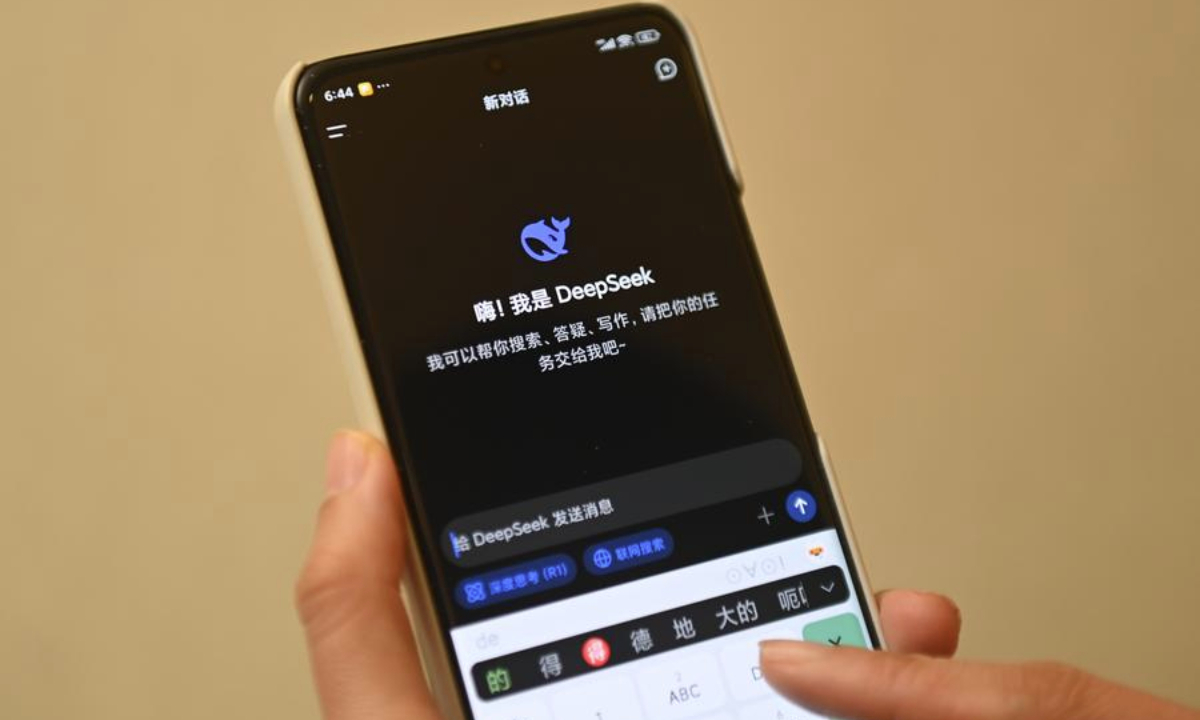
A person uses DeepSeek app on a mobile phone on Feb. 17, 2025. (Xinhua/Huang Zongzhi)
Some US lawmakers this week targeted Chinese technology companies over allegations of assisting the Chinese military, a move that an industry analyst said was driven by political posturing and a hegemonic mindset rather than fact-based, rational judgment, and one that will further destabilize global industrial and supply chains.
A group of nine US lawmakers sent a letter to US Secretary of Defense Pete Hegseth this week, urging the Pentagon to add a slew of Chinese technology firms to a list of entities allegedly assisting the Chinese military, Reuters reported on Sunday.
The letter, sent late on Thursday after US President Donald Trump signed a $1 trillion must-pass military spending bill into law, asks Hegseth to place AI firm DeepSeek, smartphone maker Xiaomi and electronic display maker BOE Technology Group on what is known as the Section 1260H list.
Revisiting and amplifying such accusations once again represents a politicized maneuver under Washington's long-standing strategy to contain China's technological development, Ma Jihua, a veteran telecom industry analyst and founder of Beijing-based Darui Management Consulting Co, told the Global Times on Sunday.
US politicians are attempting to showcase their "tough stance on China" to domestic audiences by targeting Chinese companies, rather than making decisions based on industrial realities, facts or professional judgment, Ma said.
"This proposal also reflects deep-seated anxiety among US politicians over the rapid upgrading of China's manufacturing capabilities," Ma added, noting that such discriminatory practices will fail to curb China's development and instead disrupt global industrial and supply chains, ultimately harming US companies and industries themselves.
The move added to a series of suppressive actions already imposed by the US government on Chinese tech firms. In January this year, the US Department of Defense placed some major Chinese companies, including tech giant Tencent Holdings and CATL, a leading battery manufacturer in the electric vehicle sector, on the same list.
Reuters noted in Sunday's report that while the 1260H list does not formally sanction Chinese firms, it sends a message to suppliers to the Department of Defense and other US government agencies about the US military's opinion of the firms.
Ma cautioned that many of the named or potentially targeted Chinese companies are important clients, partners or upstream and downstream collaborators of US technology companies. "Once discriminatory measures are imposed, global industrial and supply chains will be further disrupted, with the first impact often falling on US companies' own operational efficiency and cost structures," he said.
Ma noted that the US finds it difficult to achieve substantive results through direct sanctions on China's military enterprises, as China's technological progress is increasingly driven by rapid advances in indigenous innovation. He warned that excessive administrative restrictions would weaken US' own innovation ecosystem and, in the long run, undermine the vitality of both its military and civilian technological development.
In January, several Chinese companies accused by the US of "assisting the Chinese military" rejected the claims behind their inclusion on the list. Companies such as Tencent, CATL and Quectel Wireless Solutions said the decision lacked any factual basis and was "entirely erroneous," according to a Global Times report.
China firmly opposes the US practice of overstretching the concept of national security, making discriminatory lists under various pretexts and targeting Chinese companies to contain China's high-quality development, Foreign Ministry spokesperson Guo Jiakun said in January when commenting on the US blacklisting of Tencent and CATL.
The spokesperson urged the US to immediately correct its wrongdoings and end illegal unilateral sanctions and long-arm jurisdiction over Chinese companies, stressing that "China will take all necessary measures to firmly safeguard the lawful rights and interests of Chinese companies and uphold its legitimate right to development," Guo said.
In a separate statement responding to media inquiries, China's Ministry of Commerce criticized the US for disregarding World Trade Organization rules and market principles, and for continuously abusing the concept of national security and misusing state power. "The US actions seriously undermine the international economic and trade order and jeopardize the stability of global industrial and supply chains," the statement said.
China urges the US to respect facts and rules, immediately stop its erroneous practices, and provide Chinese companies with fair, just and non-discriminatory treatment, according to the ministry.
RELATED ARTICLES