ARTS / CULTURE & LEISURE
Mountain villages rising above ravines alive with enduring heritage
‘Dwelling in the sky’
Editor's Note:
China's traditional villages have become the largest group of protected agricultural civilization heritage sites in the world. Rural civilization is the mainstay of the history of Chinese civilization, and villages are carriers of that civilization. These ancient villages, based on diverse styles of dwellings and scattered throughout the country, have developed their own unique character under the nurturing influence of local environments and culture. The wisdom of the harmonious coexistence between humanity and nature, passed down for centuries, has in turn supported the lives of those who call these lands home, ultimately becoming a spiritual haven for villagers. In this series, the Global Times explores five types of unique and representative traditional villages around China to discover the secrets of their unceasing vitality. This is the fifth and final installment.
These stone-slab houses have endured centuries of wind, rain and time, forming rare, intact architectural clusters that still shelter daily life today.
Listed as China's nationally protected traditional villages, the two settlements are carved from the very slopes of the Taihang Mountains, embodying a deep connection between people and the land.
Today, they remain more than just shelters as each stone holds the memory of those who came before and the life still unfolding around them.
Settlement of stone
The drive from the expressway toward Shibanyan town, where Chaoyang village is located, is brief, but the terrain quickly shifts. Asphalt gives way to winding mountain roads, and traffic thins as the village comes into view. Chang Mingchang, Party secretary of the village, explained to the Global Times that the paved road stops after a while and vehicles are not allowed to pass.
The Taihang Sky Road cuts straight through the settlement, threading stone houses, ravines and sheer drops into a singular landscape. Locals like to joke that "after seeing Chaoyang, even the Wuyue, or Five Great Mountains, lose their pull."
Nestled against the Taihang Mountains, the village has preserved an intact cluster of 129 stone-built dwellings, complete with stone foundations, walls and everyday tools such as stone mills. Together, they form a distinctive mountain settlement shaped entirely by stone and terrain. The village now comprises 126 households, 302 residents and 14 natural hamlets, according to Chang.
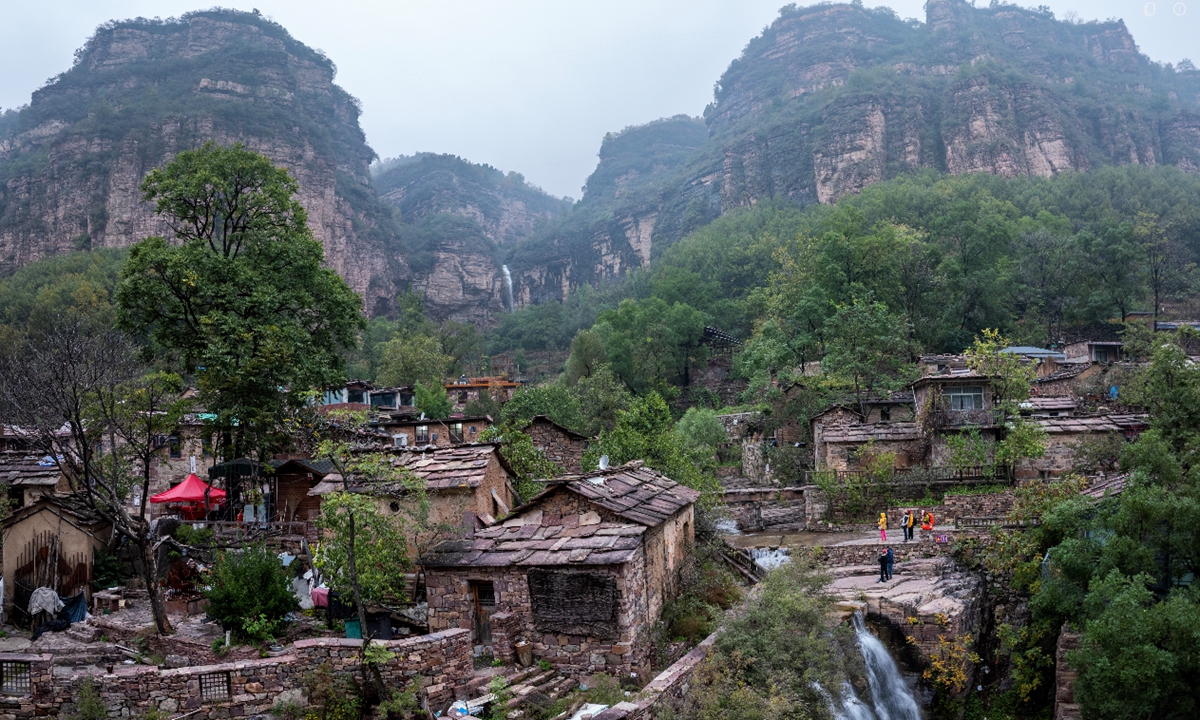
What unfolds on the western slope of the canyon is more than a mountain village. Chaoyang village sits high along the Taihang ridgeline, where ravines crisscross and cliffs fall away sharply. Here, every house is built of stone. Visitors often describe it as an "earthly dwelling in the sky."
Inside the village, narrow stone alleys connect one courtyard to another, bending and unfolding in unexpected turns. Stone lanes, stone walls, stone gateways and stone courtyards define the entire settlement. Tables and stools carved from rock sit at the entrances of homes, alongside large stone blocks polished smooth by decades of use. Life here, villagers say, has always been inseparable from stone - walking on it, living with it, and shaping it into something both practical and enduring.
Fifty-seven-year-old stonemason Yang Tianshu from Chaoyang village has worked with stone for four decades. Yang told the Global Times that nearly every house in the village follows the same principle: stone foundations, stone walls, stone pillars and stone lintels. Daily life was equally shaped by stone - beds made of slabs, stone vats, mills, grinding wheels and hammers, many of which remain in use today. Across 129 historic dwellings, most structures have retained their original appearance and remain habitable.
"Stone houses are sturdier than timber structures," Yang said. "They resist fire and offered protection against bandits in the past. The stones are stacked using gravity and careful balance, without much adhesive. If the structure is right, it stands firm."
Even the pathways reflect this logic. Roofs, floors and alleys are paved with stone slabs, forming a maze-like network that once made the village easy to defend and difficult to penetrate. The quartz sandstone used in construction, Yang added, owes its exceptional hardness to millions of years of differential weathering in the Taihang Mountains.
By the Qing Dynasty (1644-1911), stone-paved streets had become standard in the region. Stone was used for eaves, bed rails and grinding tools, valued for its resistance to erosion and longevity that could last for centuries. Houses were built along the slope, following the mountain's contours, enclosing courtyards with stone walls and stone-tiled roofs.
Building such homes required more than strength. "You have to understand the stone," Yang said. "Many villagers here are stonemasons. At one glance, they can tell the grain of a rock. One strike of the hammer, and it breaks exactly where you want it to."
Measurements were often done by eye rather than with a ruler, Chang explained. Stones were cut to fit, stacked row by row, aligned evenly when viewed from the side, and interlocked when seen head-on. Even if a section collapsed, the overall structure would remain intact. One house after another rose this way, angular, solid and dignified, today forming one of the most distinctive sights in the Taihang Grand Canyon.
Shaped by its rugged terrain, the area where Shibanyan town is located has the distinctive climate of high mountain regions. Fortunately, the thick stone walls of these houses can help keep homes warm in winter and cool in summer, providing natural insulation suited to the mountain climate, Zhang Haigen, Party secretary of the Gaojiatai village, told the Global Times.
This architectural tradition of stone houses in the Chaoyang and Gaojiatai villages dates back to the Qing Dynasty. The Taihang Grand Canyon once had only a single outlet. For generations, residents here lived largely cut off from the outside world, turning to the mountain itself for shelter and protection.
With little arable land and long periods of isolation, residents relied on local materials, stacking stone walls and paving stone floors in a practice that reflected both necessity and ingenuity.
Before modern roads and tunnels reached the Taihang Mountains, villagers relied on shoulder poles and manpower to transport daily necessities up steep mountain paths. With no access roads, residents built homes using locally sourced stone, carrying each slab by hand from the mountainsides, according to Zhang.
Over generations, this practice of using materials at hand, shaped by geography and isolation, formed both the region's stone architecture and a resilient, self-reliant way of life often described by locals as the "shoulder-pole spirit," he told the Global Times.
"These stone slab houses were built by our ancestors, who carried the sandstone slabs up from the Taihang Mountains trip by trip. Preserving them serves as a reminder to future generations not to forget the hard-fought path that brought us here," Zhang said. These houses were built entirely with materials sourced locally from the Taihang Mountains, with all construction stone taken from the surrounding area.
Even today, to protect the stone-paved roads, large buses are still prohibited from entering the narrow streets, Chang told the Global Times. Most visitors park along the roadside and walk, suitcases in hand, toward their accommodations.
Sketching hub
In recent years, Chaoyang village has gradually drawn attention for its centuries-old stone houses, while nearby Gaojiatai has emerged as a hub for artists and sketching enthusiasts as the landscape itself serves as an open-air studio.
Before the 1990s, much of the Gaojiatai village remained untouched, preserving its distinctive stone architecture. More than half of its residents left in search of work elsewhere, and tourism was virtually nonexistent.
About 150 stone houses are still preserved in Gaojiatai village to this day. As the local economy develops, efforts focus on keeping them in their original form, with restoration following the principle of preserving the old as it was.
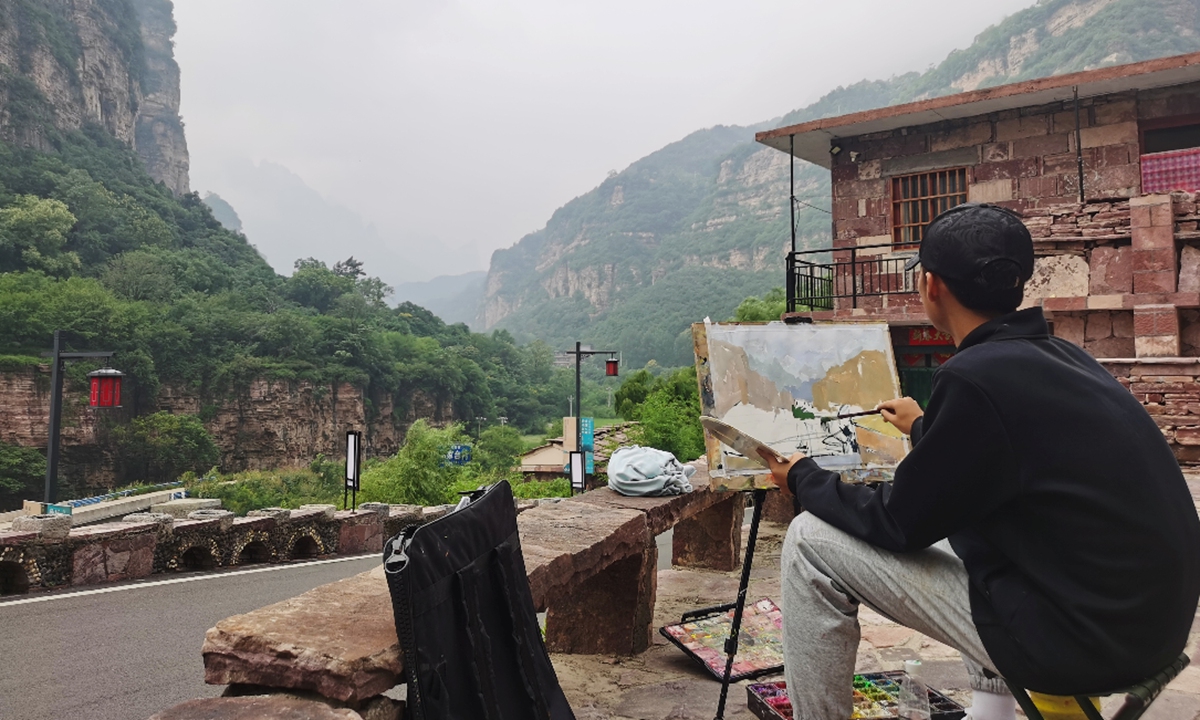
The village's stone houses sit in harmony with its natural surroundings. Under ancient trees at the village entrance, on the balconies of family-run guesthouses, and beside clear mountain streams, easels are a common sight. In Gaojiatai, it takes only a few steps to encounter artists absorbed in sketching.
Charcoal, oil and watercolor - nearly every medium finds a natural stage here. Stone houses cascade down the hillsides, distant peaks rise against the sky, and drifting clouds soften the jagged edges of the cliffs. The interaction of architecture and landscape creates a setting that feels less like a tourist attraction but more like a living canvas.
In 2003, a professor from the Central Academy of Fine Arts brought students to the Taihang Mountains for a field study and stumbled upon Gaojiatai. The dramatic cliffs and rugged peaks complemented the soft lines of the mist-shrouded stone houses, creating a striking interplay of architecture and landscape. Word spread quickly, and the village gradually became known in the art world.
Gaojiatai has become widely known as a "painter village" today. According to Zhang, more than 200 universities, including the Central Academy of Fine Arts and the Academy of Arts and Design at Tsinghua University, have established sketching bases here. The village now receives more than 200,000 visitors annually.
"Every household has a stone house, and no two mountains look the same - that's what really draws sketching enthusiasts," Zhang told the Global Times. But more than any single advantage, he added, what matters most is that the village feels just right.
"It's neither too big nor too small, with natural changes in elevation," Zhang said. "From one viewpoint, artists can capture the distant Taihang Mountains and the nearby stone houses in proper proportion within a single frame. For sketching, it's an ideal creative setting."
China's traditional villages have become the largest group of protected agricultural civilization heritage sites in the world. Rural civilization is the mainstay of the history of Chinese civilization, and villages are carriers of that civilization. These ancient villages, based on diverse styles of dwellings and scattered throughout the country, have developed their own unique character under the nurturing influence of local environments and culture. The wisdom of the harmonious coexistence between humanity and nature, passed down for centuries, has in turn supported the lives of those who call these lands home, ultimately becoming a spiritual haven for villagers. In this series, the Global Times explores five types of unique and representative traditional villages around China to discover the secrets of their unceasing vitality. This is the fifth and final installment.
Gaojiatai village in Shibanyan town, Anyang, Central China's Henan Province Photo: VCG
At the western edge of the Taihang Grand Canyon, the Chaoyang and Gaojiatai villages in Shibanyan town, Anyang, Central China's Henan Province, cling to steep ridges with their stone houses rising sharply from cliffs and ravines. Mist drifts between peaks, and from a distance, the settlements resemble blocks carved directly from the mountains. Life here has long been shaped by stone, from walls and roads to courtyards, all hewn from the Taihang Mountains.These stone-slab houses have endured centuries of wind, rain and time, forming rare, intact architectural clusters that still shelter daily life today.
Listed as China's nationally protected traditional villages, the two settlements are carved from the very slopes of the Taihang Mountains, embodying a deep connection between people and the land.
Today, they remain more than just shelters as each stone holds the memory of those who came before and the life still unfolding around them.
Settlement of stone
The drive from the expressway toward Shibanyan town, where Chaoyang village is located, is brief, but the terrain quickly shifts. Asphalt gives way to winding mountain roads, and traffic thins as the village comes into view. Chang Mingchang, Party secretary of the village, explained to the Global Times that the paved road stops after a while and vehicles are not allowed to pass.
The Taihang Sky Road cuts straight through the settlement, threading stone houses, ravines and sheer drops into a singular landscape. Locals like to joke that "after seeing Chaoyang, even the Wuyue, or Five Great Mountains, lose their pull."
Nestled against the Taihang Mountains, the village has preserved an intact cluster of 129 stone-built dwellings, complete with stone foundations, walls and everyday tools such as stone mills. Together, they form a distinctive mountain settlement shaped entirely by stone and terrain. The village now comprises 126 households, 302 residents and 14 natural hamlets, according to Chang.
What unfolds on the western slope of the canyon is more than a mountain village. Chaoyang village sits high along the Taihang ridgeline, where ravines crisscross and cliffs fall away sharply. Here, every house is built of stone. Visitors often describe it as an "earthly dwelling in the sky."
Inside the village, narrow stone alleys connect one courtyard to another, bending and unfolding in unexpected turns. Stone lanes, stone walls, stone gateways and stone courtyards define the entire settlement. Tables and stools carved from rock sit at the entrances of homes, alongside large stone blocks polished smooth by decades of use. Life here, villagers say, has always been inseparable from stone - walking on it, living with it, and shaping it into something both practical and enduring.
Fifty-seven-year-old stonemason Yang Tianshu from Chaoyang village has worked with stone for four decades. Yang told the Global Times that nearly every house in the village follows the same principle: stone foundations, stone walls, stone pillars and stone lintels. Daily life was equally shaped by stone - beds made of slabs, stone vats, mills, grinding wheels and hammers, many of which remain in use today. Across 129 historic dwellings, most structures have retained their original appearance and remain habitable.
"Stone houses are sturdier than timber structures," Yang said. "They resist fire and offered protection against bandits in the past. The stones are stacked using gravity and careful balance, without much adhesive. If the structure is right, it stands firm."
Even the pathways reflect this logic. Roofs, floors and alleys are paved with stone slabs, forming a maze-like network that once made the village easy to defend and difficult to penetrate. The quartz sandstone used in construction, Yang added, owes its exceptional hardness to millions of years of differential weathering in the Taihang Mountains.
By the Qing Dynasty (1644-1911), stone-paved streets had become standard in the region. Stone was used for eaves, bed rails and grinding tools, valued for its resistance to erosion and longevity that could last for centuries. Houses were built along the slope, following the mountain's contours, enclosing courtyards with stone walls and stone-tiled roofs.
Building such homes required more than strength. "You have to understand the stone," Yang said. "Many villagers here are stonemasons. At one glance, they can tell the grain of a rock. One strike of the hammer, and it breaks exactly where you want it to."
Measurements were often done by eye rather than with a ruler, Chang explained. Stones were cut to fit, stacked row by row, aligned evenly when viewed from the side, and interlocked when seen head-on. Even if a section collapsed, the overall structure would remain intact. One house after another rose this way, angular, solid and dignified, today forming one of the most distinctive sights in the Taihang Grand Canyon.
An artist paints a picture in Shibanyan town, Anyang, Central China's Henan Province. Photo: VCG
Mountain homeShaped by its rugged terrain, the area where Shibanyan town is located has the distinctive climate of high mountain regions. Fortunately, the thick stone walls of these houses can help keep homes warm in winter and cool in summer, providing natural insulation suited to the mountain climate, Zhang Haigen, Party secretary of the Gaojiatai village, told the Global Times.
This architectural tradition of stone houses in the Chaoyang and Gaojiatai villages dates back to the Qing Dynasty. The Taihang Grand Canyon once had only a single outlet. For generations, residents here lived largely cut off from the outside world, turning to the mountain itself for shelter and protection.
With little arable land and long periods of isolation, residents relied on local materials, stacking stone walls and paving stone floors in a practice that reflected both necessity and ingenuity.
Before modern roads and tunnels reached the Taihang Mountains, villagers relied on shoulder poles and manpower to transport daily necessities up steep mountain paths. With no access roads, residents built homes using locally sourced stone, carrying each slab by hand from the mountainsides, according to Zhang.
Over generations, this practice of using materials at hand, shaped by geography and isolation, formed both the region's stone architecture and a resilient, self-reliant way of life often described by locals as the "shoulder-pole spirit," he told the Global Times.
"These stone slab houses were built by our ancestors, who carried the sandstone slabs up from the Taihang Mountains trip by trip. Preserving them serves as a reminder to future generations not to forget the hard-fought path that brought us here," Zhang said. These houses were built entirely with materials sourced locally from the Taihang Mountains, with all construction stone taken from the surrounding area.
Even today, to protect the stone-paved roads, large buses are still prohibited from entering the narrow streets, Chang told the Global Times. Most visitors park along the roadside and walk, suitcases in hand, toward their accommodations.
Sketching hub
In recent years, Chaoyang village has gradually drawn attention for its centuries-old stone houses, while nearby Gaojiatai has emerged as a hub for artists and sketching enthusiasts as the landscape itself serves as an open-air studio.
Before the 1990s, much of the Gaojiatai village remained untouched, preserving its distinctive stone architecture. More than half of its residents left in search of work elsewhere, and tourism was virtually nonexistent.
About 150 stone houses are still preserved in Gaojiatai village to this day. As the local economy develops, efforts focus on keeping them in their original form, with restoration following the principle of preserving the old as it was.
The village's stone houses sit in harmony with its natural surroundings. Under ancient trees at the village entrance, on the balconies of family-run guesthouses, and beside clear mountain streams, easels are a common sight. In Gaojiatai, it takes only a few steps to encounter artists absorbed in sketching.
Charcoal, oil and watercolor - nearly every medium finds a natural stage here. Stone houses cascade down the hillsides, distant peaks rise against the sky, and drifting clouds soften the jagged edges of the cliffs. The interaction of architecture and landscape creates a setting that feels less like a tourist attraction but more like a living canvas.
In 2003, a professor from the Central Academy of Fine Arts brought students to the Taihang Mountains for a field study and stumbled upon Gaojiatai. The dramatic cliffs and rugged peaks complemented the soft lines of the mist-shrouded stone houses, creating a striking interplay of architecture and landscape. Word spread quickly, and the village gradually became known in the art world.
Gaojiatai has become widely known as a "painter village" today. According to Zhang, more than 200 universities, including the Central Academy of Fine Arts and the Academy of Arts and Design at Tsinghua University, have established sketching bases here. The village now receives more than 200,000 visitors annually.
"Every household has a stone house, and no two mountains look the same - that's what really draws sketching enthusiasts," Zhang told the Global Times. But more than any single advantage, he added, what matters most is that the village feels just right.
"It's neither too big nor too small, with natural changes in elevation," Zhang said. "From one viewpoint, artists can capture the distant Taihang Mountains and the nearby stone houses in proper proportion within a single frame. For sketching, it's an ideal creative setting."
RELATED ARTICLES