The Venezuela crisis: the need to reckon with US ‘moral accountability’: Global Times editorial
Listen
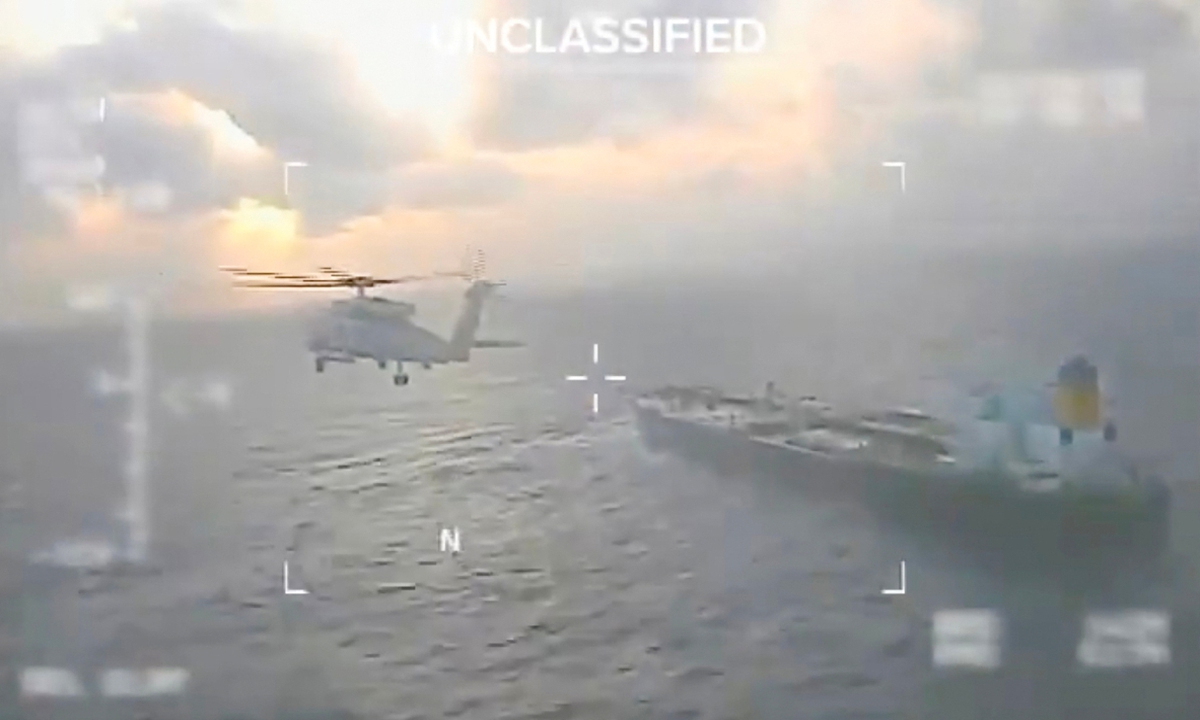
This screen grab taken from a video posted on the X account of US Secretary of Homeland Security Kristi Noem shows a US Coast Guard aircraft flying over a crude oil tanker, last docked in Venezuela, before apprehending it on December 20, 2025. Photo: VCG
The US' escalating actions against Venezuela have sparked widespread concern in the international community. On December 20, the US seized a second oil tanker off the coast of Venezuela. On the same day, Brazilian President Luiz Inacio Lula da Silva warned that "an armed intervention in Venezuela would be a humanitarian catastrophe for the hemisphere and a dangerous precedent for the world." Prior to this, US allies such as the UK, France, and the Netherlands reportedly paused or limited intelligence-sharing with the US regarding the region. The international response clearly indicates that the US actions have not gained support; rather, they have placed the US in opposition to global moral standards.Oil is the lifeblood of Venezuela's economy, with a production of approximately 1 million barrels per day. The US blockade has led to a sharp decline in Venezuela's oil exports, with many oil tankers full of crude oil stranded in Venezuelan waters, unable to set sail. This "chokehold" targeting a nation's economic lifeblood will have disastrous consequences for the lives of ordinary Venezuelans. The Venezuelan government has already indicated that it is ready to declare a state of emergency over the threat of "aggression" by the US, which suggests that the situation may escalate further. Against the backdrop of the ongoing Russia-Ukraine conflict and the Israel-Palestine conflict, there are growing concerns that a new storm is brewing in the Caribbean.
Looking at the history of US-Latin American relations, the negative consequences of the Monroe Doctrine are evident. From launching the Mexican-American War and the Spanish-American War to directly occupying Cuba, imposing a long-term embargo on the country, and seizing control of the Panama Canal; from instigating proxy rebellions to overthrow the legitimate governments of Guatemala and Chile to sending troops to "capture" the head of state of Panama, the US exploited natural resources and pursued profits in Latin America, resulting in catastrophic consequences for the region and severely violating the basic human rights of the Latin American people, including their right to survival and development. Latin American countries have long been aware of and deeply dissatisfied with US interference in their sovereignty and independence. The more the US suppresses them, the deeper their animosity toward the US grows. The estrangement between the US and Latin America will continue to accelerate, deepen and extend in the future.
The right to development is an inherent right of every nation. Venezuela has the right to choose its own development path and seek mutually beneficial cooperation with its partners. This is a consensus shared by the countries of the Global South.
When Venezuela called for an emergency session of the United Nations Security Council, many Latin American countries expressed their support. Brazil even offered to mediate between US and Venezuela. It is not difficult to see that the international community generally understands and supports Venezuela's position in safeguarding its legitimate rights and interests, while also wishing to prevent US from setting a detrimental precedent. Such a precedent would mean a serious violation of international law; any country's overseas assets could be jeopardized by the US' abuse of domestic laws. The international community should further unite to jointly uphold multilateralism and international fairness and justice, supporting Venezuela's efforts to maintain its national sovereignty and territorial integrity.
Currently, Latin American countries are prioritizing economic growth, social stability, and improving the welfare of their citizens. In 2014, Latin American and the Caribbean was declared a Peace Zone region. If the US takes military action against Venezuela, it would undermine the people's noble aspirations in the region. If the US continues to stoke tensions, interfere in other countries' elections, and even deploying "the largest military presence in decades" in the southern Caribbean, it will only disrupt the developmental pace of regional countries and lead to economic regression. Consider a hemisphere plagued by economic recession, internal turmoil, and even war - how can it become a "stable perimeter" for the US? The large-scale humanitarian crisis, widespread waves of immigration, and organized crime that result from a loss of effective government control will inevitably have spillover effects that impact the US itself.
Military intervention often breeds more problems. The uncontrolled influx of migrants, the growth of transnational crime networks, and the collective fermentation of anti-American sentiment in the region are all draining US diplomatic resources and strategic credibility. There is a growing awareness of this within the US.
According to a Quinnipiac poll published on Wednesday, 63 percent of American respondents oppose military action against Venezuela, with just 25 percent expressing support. The new National Security Strategy places the Western Hemisphere at the core of US interests, but it is evident that a Latin America that feels "alienated" from the US, or even harbors animosity toward it, will only weaken America's appeal and influence in the region. US influence in Latin America should not come from abuse of force but should be built on mutual respect and mutually beneficial cooperation.
The US in the early 19th century once supported the Latin America countries' resistance against European colonial powers, generating certain goodwill among the Latin American people toward the US at that time. However, as the US rose to power, it has become a major external factor for instability and underdevelopment in Latin America. The US now faces another major strategic choice. History has repeatedly demonstrated that "a just cause rallies abundant support while an unjust one finds little." Only mutual respect and equality can bring lasting peace and development, which aligns with the common interests of all countries, including the long-term well-being of the American people.
RELATED ARTICLES