German finance minister slams Deutsche Bahn’s Chinese e-bus purchase, sparks protectionism row; experts warn on competitiveness
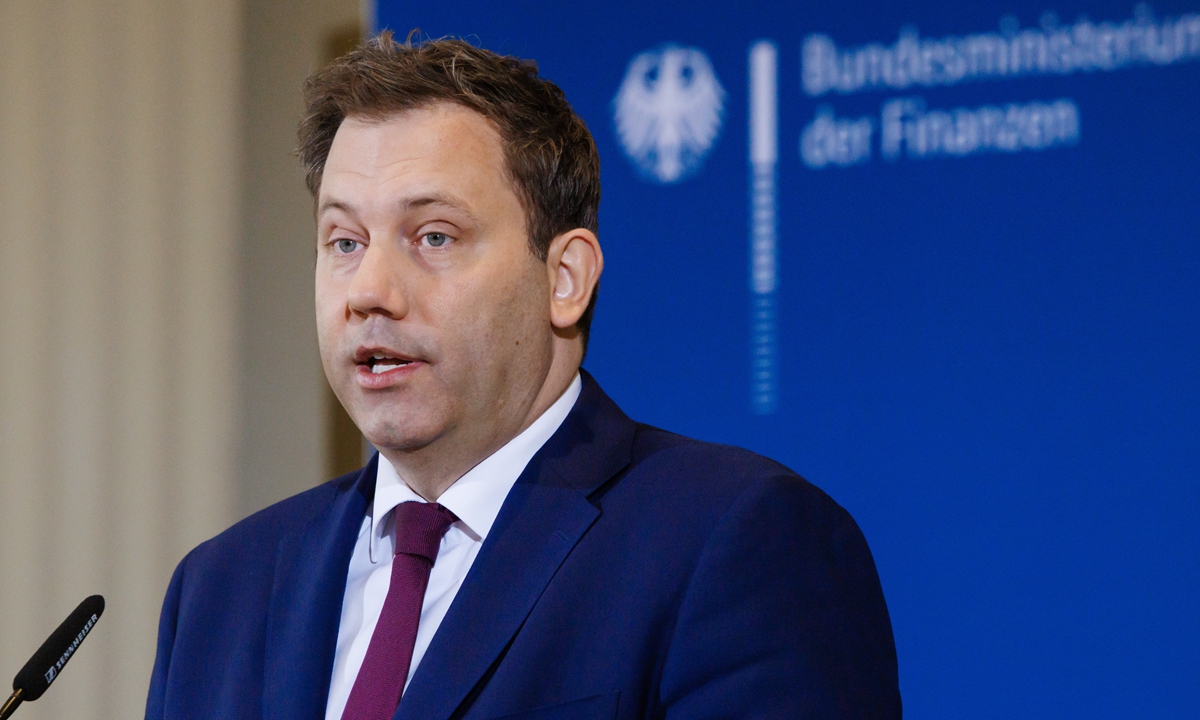
German Finance Minister Lars Klingbeil speaks during a press conference on the 169th tax estimate at the Finance Ministry in Berlin, Germany, 23 October 2025. Photo: VCG
Germany's Finance Minister Lars Klingbeil has expressed frustration with Deutsche Bahn's procurement strategy, which includes a large order from German manufacturer MAN alongside a separate order for 200 electric buses from Chinese automaker BYD. He stated that the move "annoys" him and called for "healthy local patriotism" in such decisions.
In his view, a healthy local patriotism included awarding contracts to German or European manufacturers when the bids were competitive. "Our cities have long been operating excellent electric buses, for example from Mercedes and MAN," the Vice Chancellor told the Neue Osnabrücker Zeitung.
The remarks were made after the state-owned Deutsche Bahn announced the largest bus order in its history a week ago.
The Munich-based company MAN is slated to supply most of the more than 3,300 hybrid and electric buses. However, 200 electric intercity buses were ordered from BYD, which will be produced in Hungary, according to deutschlandfunk.de on Saturday.
The new buses will be used by its regional transport subsidiary, DB Regio AG, throughout Germany, Deutsche Bahn announced.
Chinese experts said the official's remarks are a typical "trade protectionism," which will only create "technology islands," further slowing down German manufacturers in global competition.
This stance is a form of trade protectionism. The BYD buses in question are not imported from China but are manufactured locally in Hungary, a member state of the European Union. Following the German finance minister's logic, does this also constitute discrimination against Chinese corporate investment? Jian Junbo, director of the Center for China-Europe Relations at Fudan University's Institute of International Studies, told the Global Times on Monday.
Currently, the German government faces the dilemma of trade protectionism, especially with declining sales in the Chinese market and the impact of US tariffs, leaving the automotive industry in a slump. Although the government has taken temporary measures to maintain production, its overall competitiveness remains unresolved, echoed Sun Xiaohong, secretary-general of the automotive branch of the China Chamber of Commerce for Import and Export of Machinery and Electronic Products.
In October of this year, at the BusWorld 2025 exhibition in Brussels, Chinese automakers showcased a variety of new energy buses and pure electric component solutions, including batteries, motors, electronic controls, and electric drive axles, attracting widespread attention, according to Sun.
Yutong Bus, BYD, and other automakers won awards, demonstrating that Chinese companies not only possess cost advantages but also independent innovation capabilities and solutions.
Chinese automakers' success is also spurring European manufacturers to increase their innovation efforts. Germany and the EU need to accelerate the introduction of real market competition and expand Sino-European joint ventures and technological cooperation in battery and vehicle manufacturing; this is the only path to rebuilding sustainable competitiveness, Sun said.
Klingel also linked his criticism of Deutsche Bahn to his overall stance on electric mobility. Regarding discussions about the EU potentially easing its ban on diesel and gasoline vehicles, he warned German automakers not to misinterpret signals from Brussels.
Klingbeil also recounted his personal experiences in China, including in cities like Beijing and Shanghai. He said "how far they have already come, also because the government is massively promoting the transition." And "Our car manufacturers have some catching up to do."
Nevertheless, the finance minister described the Brussels' proposal as a viable compromise. Furthermore, it is true that: "If we act pragmatically, then protecting jobs and protecting the climate are not mutually exclusive."
The backdrop to this debate is the European Commission's adjustment to its policy on carbon dioxide emission limits for automobiles. Initially, EU member states and the European Parliament agreed that from 2035 onwards, newly registered cars would no longer be allowed to emit carbon dioxide, which is harmful to the climate.
However, driven by countries such as Germany, the EU plans to relax regulations on gasoline-powered vehicles. Under certain conditions, vehicles equipped with internal combustion engines may still be permitted on the road afterward.
The EU's relaxation on the sale of gasoline-powered vehicles by 2035 due to factors including inadequate charging infrastructure, high transition costs, high local electricity prices, and high energy costs. This move in itself sent a buffer signal to the domestic industry chain, said Sun.
Now, if the government uses administrative means to keep Chinese electric vehicles out, it is tantamount to cutting off the channels for technology spillover. Domestic battery, electric drive and software companies will lose benchmarks, ultimately harming Europe's sustainable development and 2030 carbon neutrality goals, Sun added.
RELATED ARTICLES