DJI vows to safeguard legitimate rights and its global users after US adds DJI, other foreign drones to ‘Covered List’
Company vows to safeguard legitimate rights, interest of firm, global users
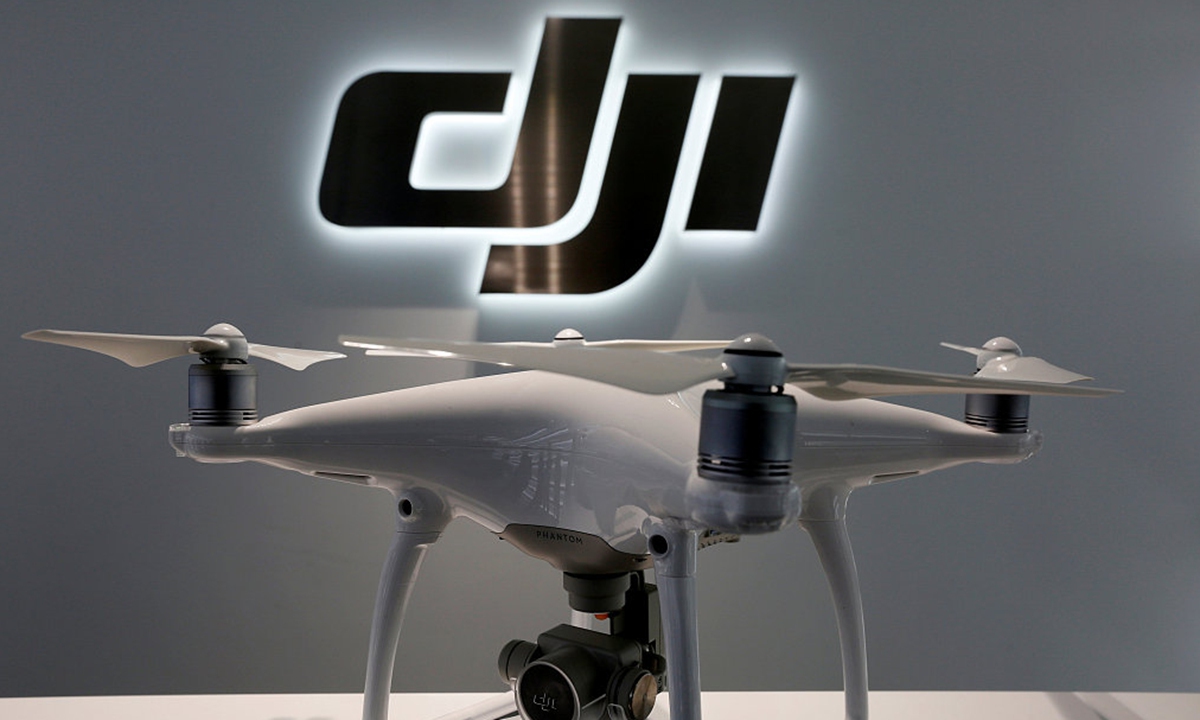
DJI Photo:VCG
China firmly opposes the US side's overstretching the concept of national security and making discriminatory lists to go after Chinese companies, Lin Jian, spokesperson of China's Foreign Ministry, told a press conference on Tuesday.Lin made the remarks while commenting on reports by Reuters and The Hill suggesting that the US Federal Communications Commission (FCC) claimed on Monday that it is adding China's DJI and all foreign-made drones and components to a list of companies "determined to pose unacceptable risks to US national security" and will bar approvals of new types of drones for import or sale in the US.
The US should stop its wrong practice and create a fair, just and non-discriminatory environment for Chinese companies, the spokesperson noted.
In a statement published online on Tuesday night, China's Ministry of Commerce urged the US to cease its erroneous practices and immediately rescind the relevant measures. If the US continues to act unilaterally, China will resolutely take necessary measures to firmly safeguard the legitimate rights and interests of Chinese enterprises, the ministry said.
According to Reuters, the addition to the FCC's "Covered List" means that going forward, DJI and other foreign drone companies will not be able to get FCC approval to sell new models of drones in the US. The FCC's "Covered List" is a list of communications equipment and services that "are deemed to pose an unacceptable risk to the national security of the US or the safety and security of US persons," according to the FCC.
DJI said in a statement sent to the Global Times on Tuesday that "We regret the decision by the FCC to add all non-US-manufactured drones to the 'Covered List'," noting that the move not only restricts the freedom of choice for US consumers and commercial users, but also undermines the principles of an open and fair competitive market.
"We are deeply grateful to users across the country who spoke up to share how DJI technology supports their work and their communities… We will evaluate all feasible paths and firmly safeguard the legitimate rights and interests of the company and its global users," the company said.
"As a pioneer and leader in global consumer drones and aerial photography technology, DJI has always been committed to providing innovative tools and inspiration to image creators worldwide. Our products and technologies are also deeply applied in numerous critical fields such as agriculture, inspection, surveying and mapping, firefighting and rescue, and natural resource conservation, creating irreplaceable value in improving production efficiency, safeguarding lives and ensuring public safety," said the company.
At the same time, the safety and reliability of DJI products have been validated over the years by the global market and numerous authoritative independent third-party organizations. Concerns about DJI's data security have not been grounded in evidence and instead reflect protectionism, contrary to the principles of an open market, it noted.
Today's development will not affect customers who already own DJI products. These existing products can continue to be purchased and operated as usual, according to the enterprise.
"The essence of the US action is another move that overstretches the national security concept and politicizes normal trade relations, openly interfering with free trade and distorting market rules," Li Yong, executive council member at the China Society for WTO Studies, told the Global Times on Tuesday.
Chinese enterprises provide high-quality services in compliance with local laws and regulations. The so-called risks mentioned in the "Covered List" lack sufficient factual basis and do not align with market expectations, said Zhou Mi, a senior researcher at the Chinese Academy of International Trade and Economic Cooperation.
Zhou noted that in the current situation where multiple important public needs in the US - such as forest fire prevention, safety search and rescue, and wildlife protection - rely on DJI-related products, this action will severely harm the actual experience of US users.
Not only Chinese enterprises, but drone products from manufacturers in other countries may also find it difficult to enter the US market for fair competition. By administratively cutting off foreign products from participating in US market competition on the supply side, this will not only weaken the research and development momentum of domestic US products, but also potentially restrict the expansion space of US drone products in overseas markets, Zhou noted.
"Therefore, whether for users, producers, or technological innovation, this move ultimately harms others without benefiting oneself," Zhou warned.
RELATED ARTICLES