Pentagon’s claim of China’s ICBM a pretext for US to upgrade nuclear power: FM
By and Published: Dec 23, 2025 01:41 PM


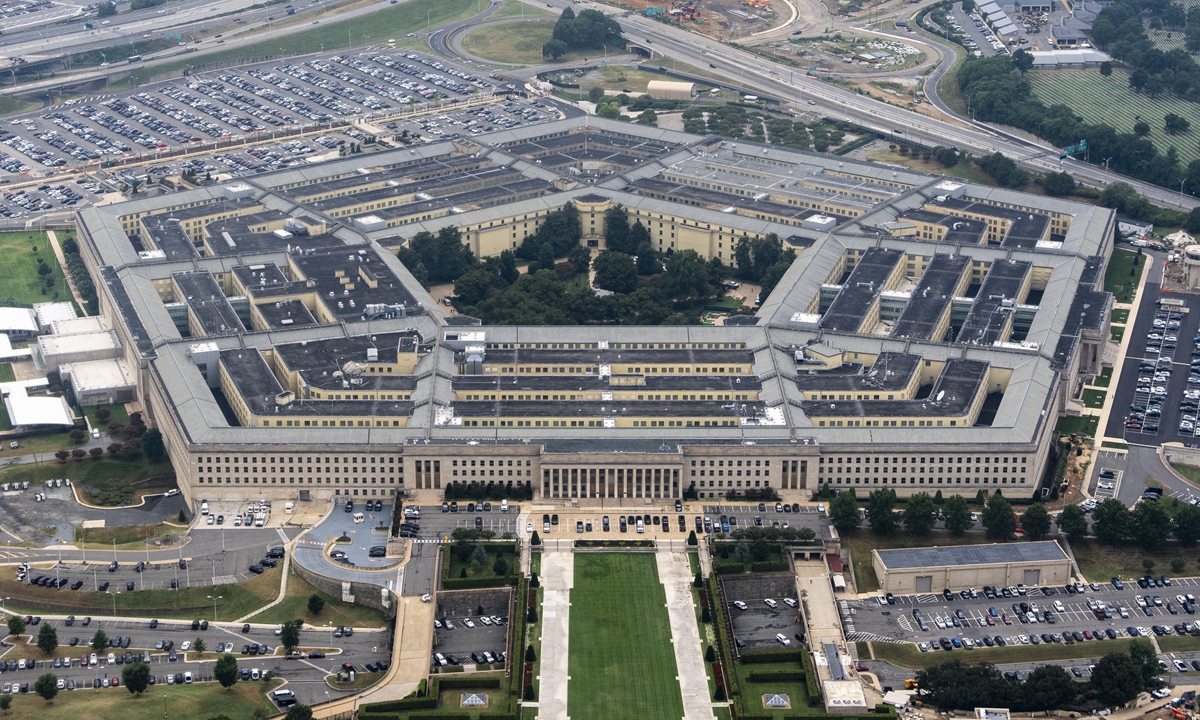
View of Pentagon Photo: VCG
A draft Pentagon report claimed China has likely loaded more than 100 ICBMs in silo fields, Reuters reported on Monday. Chinese military observers noted that the Pentagon's reports are full of speculation and aim to hype up the so-called China threat rhetoric.Citing the draft Pentagon report, Reuters claimed that China has loaded more than 100 intercontinental ballistic missiles into three newly constructed silo fields near its border with Mongolia and showed little interest in arms control talks.
In response, Chinese Foreign Ministry spokesperson Lin Jian stated on Tuesday that "I'm not familiar with what you cited as a US draft report, but we've been hearing the same story told and retold by the US to create pretext for speeding up the upgrade of US nuclear power and disrupting global strategic stability. The international community needs to be soberly aware of that."
"The US, as a nuclear superpower sitting on the world's biggest nuclear arsenal, must fulfill its special and primary responsibility for nuclear disarmament, further make drastic and substantive cut to its nuclear arsenal, and create conditions for other nuclear-weapon states to join the nuclear disarmament process. This should be a high priority for the US," Lin said.
Lin noted that just last month, the Chinese government released a white paper entitled China's Arms Control, Disarmament and Non-Proliferation in the New Era with a full overview of China's nuclear policy and position on nuclear disarmament. China remains firmly committed to the policy of no first use of nuclear weapons and a nuclear strategy that focuses on self-defense.
China keeps its nuclear strength at the minimum level required by national security and does not engage in any nuclear arms race with any country, Lin said, noting that China takes an active part in the review process of the Treaty on the Non-Proliferation of Nuclear Weapons and meetings of the P5 (five nuclear-weapon states) mechanism, and maintains dialogue with various parties on nuclear disarmament.
Song Zhongping, a Chinese military affairs expert, told the Global Times on Tuesday that this report is fundamentally based on subjective speculation by the US and that its assessment is pure hype.
The US, possessing the largest nuclear arsenal, must take the lead in disarmament talks - a step that the country has yet to fulfill. Given that China's nuclear arsenal is only a fraction of the size of America's, there is no justification for China to join such negotiations at this stage, Song added.
Chinese military affairs expert Zhang Junshe told the Global Times that China's nuclear capabilities are maintained at the minimum level necessary for defense, primarily intended for nuclear counterstrikes and retaliatory strikes in response to nuclear attacks. China has continuously and publicly stated its position clearly, which is that it will not be the first to use nuclear weapons.
The significant disparity in scale between China's nuclear capabilities and those of the US and Russia makes it both unfair and unreasonable to demand China's participation in nuclear arms control negotiations at this stage, Zhang said.
"So, by hyping this issue, the US is attempting to pressure China, with the ultimate goal of hindering the normal development of China's national defense capabilities," Zhang said.
Drawing China into arms control negotiations serves as a strategic pretext for the US to assert a balance of power, analysts said.
The US government in October cited Russia's missile tests and China's growing nuclear capabilities as a justification for a decision to resume nuclear weapons testing "immediately," according to a Fox News report.
Last year, also a Pentagon report alleged that China is rapidly growing its nuclear arsenal and likely to have 1,000 nuclear weapons by 2030. It hyped that China has added at least 100 nuclear warheads to its stockpile over the past year and now has more than 600 in its inventory, according to Politico report.
In response, China's Defense Ministry spokesperson Zhang Xiaogang said that the report had misinterpreted China's defense policies, speculated about China's military capacity development, flagrantly interfered in China's domestic affairs, desperately slandered the Chinese military and exaggerated the so-called military threat posed by China.
On China's development of nuclear weapons, Zhang stressed that the intention is to safeguard the country's strategic security.
But the US, which has the largest and most advanced nuclear arsenal in the world, sticks stubbornly to a policy of first use of nuclear weapons, undermining international and regional peace and stability. He called on the US to reduce the role of nuclear weapons in its national and collective security policy to respond responsibly to the international community, the spokesperson said.
RELATED ARTICLES