Beijing relaxes home purchase restrictions to boost stable devt of housing market
By Published: Dec 24, 2025 07:20 PM

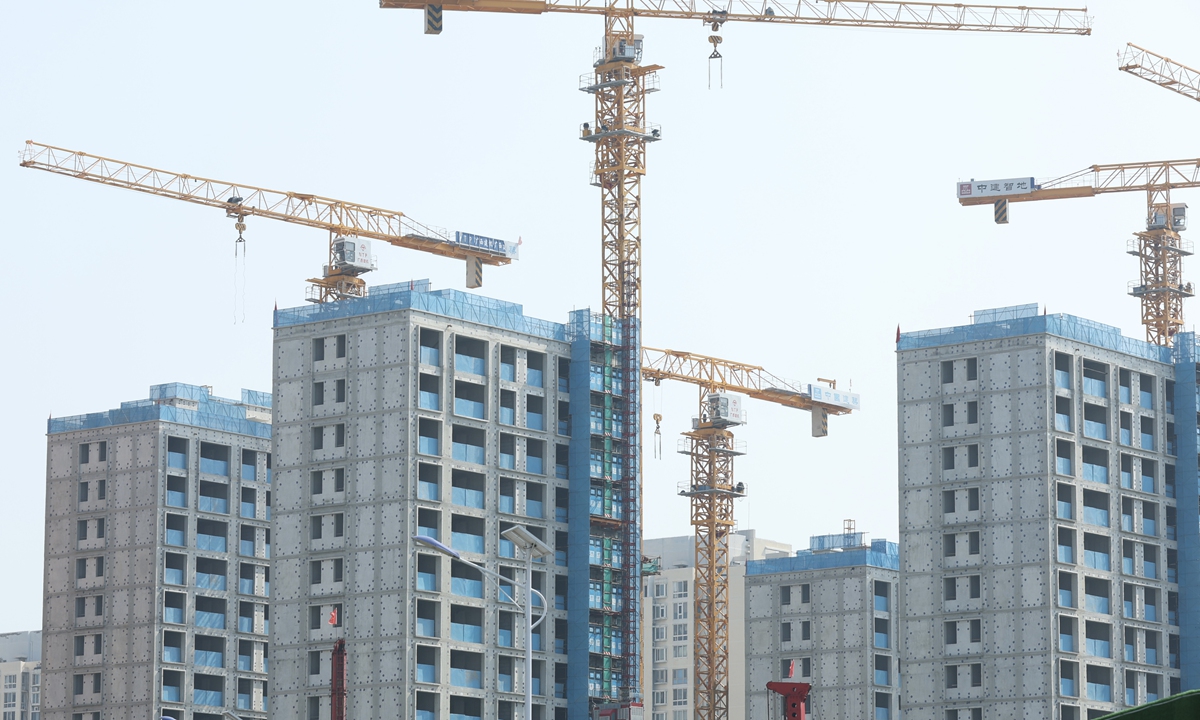
A construction site of a residential complex in Chaoyang district, Beijing on August 1, 2025 Photo: VCG
Beijing's municipal housing authorities on Wednesday announced measures to ease restrictions on home purchases by both local and non‑local households, in a move to support the city's property market.
According to the measures, which took effect immediately,
Non‑Beijing permanent residents, those without a Beijing hukou (household registration) can now buy home within the city's fifth ring road if they have paid social security or individual income tax for two consecutive years, down from the previous three‑year requirement, according to a statement released by Beijing Municipal Commission of Housing and Urban-Rural Development on Wednesday.
For homes outside the city's fifth ring road, the requirement has been lowered from two years to one year.
Families with two or more children will be allowed to purchase an additional unit of commercial housing within the fifth ring road. Specifically, multi-child families with Beijing hukou can purchase up to three units of commercial housing within the fifth ring road. Families with two or more children that don't have Beijing hukou but have paid social insurance or individual income tax in Beijing for two consecutive years can purchase up to two units within the fifth ring road, said the statement.
Financial institutions will no longer differentiate between first and second homes when setting mortgage interest rates, instead basing decisions on market mechanisms, their own operational conditions and risk assessments.
The minimum down payment for second-home buyers using loans from the government-backed housing provident fund has been lowered to 25 percent from 30 percent, according to the statement.
The real estate policies that are being introduced will give full play to the role of the local government in adjusting and optimizing real estate policies, said Yan Yuejin, deputy head of Shanghai-based E-House China R&D Institute, on Wednesday.
Also, these policies will help reduce housing inventory, safeguard the bottom line and better promote activity in the real estate transaction market, Yan added.
China's top housing authority emphasized the need to stabilize the real estate market, with key measures including city-specific policies to control new housing supply, reduce inventory, and optimize supply, according to a post on the ministry's website on Tuesday.
The new measures will be combined with high-quality urban renewal and the renovation of urban villages to revitalize and utilize existing land resources. Efforts will also be made to promote the purchase of existing commercial housing for use as affordable housing, resettlement housing, dormitories, apartments allocated for talent, and other purposes, Minister of Housing and Urban-Rural Development Ni Hong said at a national work conference held in Beijing on Monday and Tuesday.
The adjustment of social insurance payment requirements is a crucial aspect of the ongoing policy changes in the real estate market, Yan explained.
He said that regional market conditions show that easing purchase restrictions typically produces positive outcomes, as these policies directly and significantly influence the market, especially by boosting demand.
In August, Beijing removed limits on the number of home purchases outside the city's fifth ring road.
Starting on August 9, there were no restrictions on the number of homes purchased outside the city's fifth ring road by families with local household registration.
Restrictions were also eliminated for families without local household registration but with at least two years of social insurance or individual income tax payment records in Beijing, the Xinhua News Agency reported.
Home prices in China's 70 large and medium-sized cities generally fell in November from the previous month, data from the National Bureau of Statistics showed recently.
Overall, prices of new homes in the four first-tier cities - Beijing, Shanghai, Guangzhou and Shenzhen - decreased 0.4 percent month-on-month.
RELATED ARTICLES