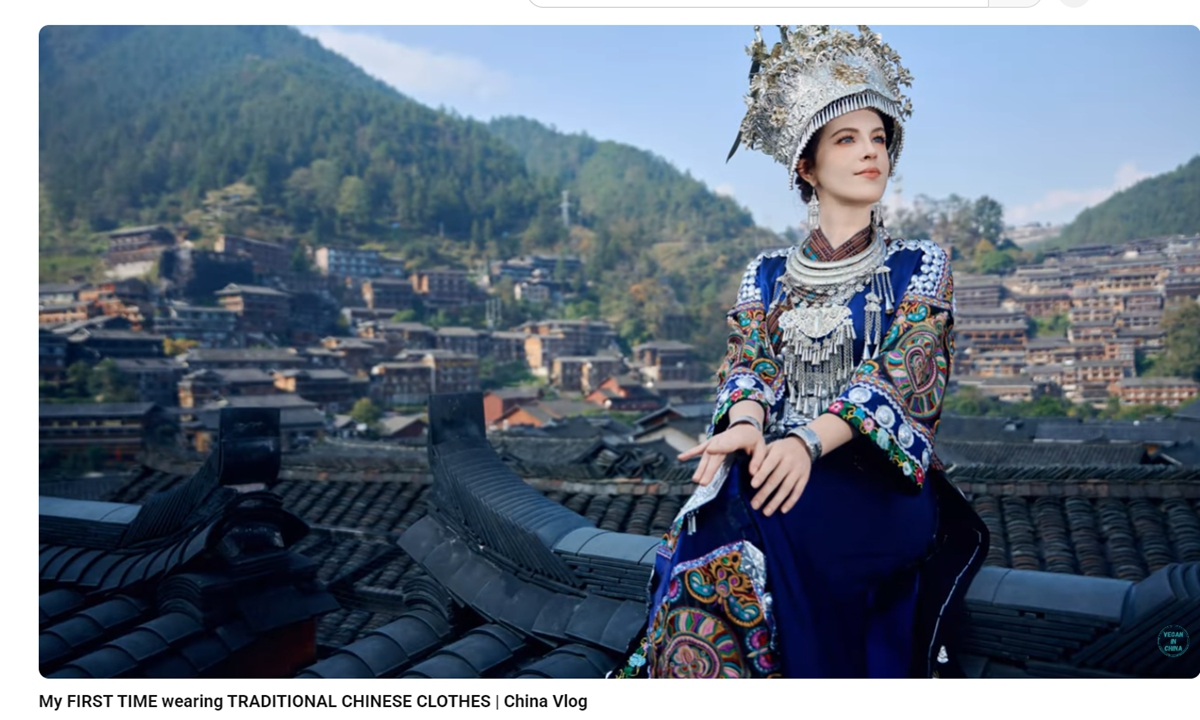
Canadian vlogger Alex shares a video of herself taking portraits in the traditional clothing of the Miao people, an ethnic group in China, in January 2025. Photo: Screenshot from Alex's YouTube account
Editor's Note:
2025 marks the final year of China's 14th Five-Year Plan (2021-2025) and the blueprint for the 15th (2026-2030) is already unfolding. In the Recommendations of the Central Committee of the Communist Party of China (CPC) for Formulating the 15th Five-Year Plan for National Economic and Social Development made public in October, the country has outlined major objectives for high-quality development over the next five years, including significant achievements in high-quality development, substantial improvements in scientific and technological self-reliance and strength, fresh breakthroughs in further deepening comprehensive reform , notable cultural and ethical progress across society, further improvements in quality of life, major new strides in advancing the Beautiful China Initiative, and further advances in strengthening the national security shield. This blueprint not only guides China's own modernization, but also injects tangible certainty into a turbulent world.
Amid the surging "China Travel" boom, more international travelers are visiting China and witnessing real, tangible changes. These firsthand experiences and moments of awe have become, in their eyes, "the future in China's hands." The Global Times is launching a year-end series titled "Trust in China," presenting stories of the "Chinese modernization" through the perspectives of foreign bloggers and ordinary Chinese people, to show how China is fulfilling its promises for the future step by step. The second installment focuses on the cultural and ethical progress in Chinese society.
"Gorgeous traditional costumes." "I am glad to see the combination of traditional culture and the trend of the new era, and these cultural treasures will be inherited." "Each unique and beautiful!"
Recently, some videos showcasing China's traditional ethnic costumes through the "quick change" outfit trend have gone viral on platforms like YouTube and Instagram. In one video, a few young people in everyday clothes spin or step into view and in an instant, their regular clothes are transformed into the dazzling traditional dress of China's many ethnic groups.
With rousing soundtracks and crisp edits, this video opens like a window through which global audiences can get a glimpse of China's varied ethnic garb beyond the more familiar elements like qipao and hanfu - a multi-ethnic sartorial world that is diverse, vibrant, rich, and harmonious.
In the mountains of Menghai count in Xishuangbanna Dai Autonomous Prefecture, Southwest China's Yunnan Province, Er Yan smiled as she scrolled through the effusive comments left under her video by overseas viewers on her phone.
Er is an inheritor of the traditional cloth-making techniques of the Hani ethnic group, which the local government has listed as an intangible cultural heritage. She has spent decades witnessing - and driving - the transformation of her people's clothing traditions from a once nearly forgotten craft practiced only in remote Hani villages, to a cultural calling card on the international stage.
Er's story is not unique. Across China, countless cultural guardians and innovators like her are reworking traditional treasures with unprecedented confidence and energy, bringing them back to life. Their efforts are coalescing into a warm force that lifts the overall cultural and ethical civility of society.
The Fourth Plenary Session of the 20th Central Committee of the CPC placed "notable cultural and ethical progress across society" among the main goals for the 15th Five-Year Plan for National Economic and Social Development (2026-30).
"We should further unleash the vitality of the entire nation for cultural creation and innovation, and enrich the intellectual and cultural lives of our people. There should be a substantial increase in the cohesion of the Chinese nation and the appeal of Chinese culture, and a continued rise in China's soft power," stated the recommendations of the Central Committee of the CPC for formulating the plan.
Fragrant' both inside and out
Under a YouTube video uploaded in November introducing traditional Hani garb, viewers left comments like, "The Hani women's dress is absolutely beautiful!" and "The illustrations capture the culture wonderfully!" The Hani wardrobe is gradually being discovered by a wider global audience.
The Hani are a small ethnic group in China of fewer than two million people, concentrated in the mountainous regions of Yunnan. In previous years, their costumes and related culture were like a hidden treasure tucked away in the highlands - beautiful but mysterious beyond the borders of local villages.
Er experienced that exact village upbringing. Her grandfather and mother both made Hani garments, and she absorbed the craft and its stories from childhood. She learned to embroider the motifs that decorate Hani clothing - a visual language passed down through needle and thread.
In 2018, Er took the leap and started a business, launching a Hani clothing brand. Her entrepreneurial journey coincided with a wave of traditional cultural revival in China at the time. Following the release of Opinions on Implementing the Project to Transmit Outstanding Traditional Chinese Culture in 2017, measures were implemented across the country, creating a strong top-to-bottom atmosphere for preserving and promoting traditional culture.
Hanfu gained nationwide popularity, traditional patterns became a source of inspiration in fashion design, and various intangible cultural heritage skills entered the public eye... An environment encouraging cultural creation and innovation was taking shape across Chinese society.
The sustained development and growing recognition of ethnic cultures is the most vivid and tangible expression of a culturally and ethically advanced society, said Zhang Yiwu, director of Peking University's Cultural Resources Research Center. "Moreover, encouraged at the national level and driven by grassroots momentum, China's ethnic cultures have, in recent years, accelerated their 'going global,' and are winning genuine affection from overseas audiences," Zhang told the Global Times.
Buoyed by this social momentum and government support, Er's venture gained traction. As the stage for Hani dress widens, Er's vision has moved beyond her own village toward a far broader world. She took her Hani designs overseas twice in 2025 with the help of the government, taking part in cultural exchange events in Thailand and Laos. What delighted her was the unexpected stir the distinctive minority costumes caused.
"They crowded around my booth, asking questions non-stop. They praised the embroidery as exquisite and called our modernized designs very creative," Er recalled. Gradually, her clientele has widened from local Hani customers to domestic and international buyers, with orders now coming from South Korea, the US, Myanmar, Thailand, and beyond.
"Blooming at home, fragrant both inside and out" - this phrase vividly captures the current dynamic landscape of China's ethnic cultural heritage. Backed by strong state support and encouragement, inheritors of intangible cultural heritages like Er have increasingly better opportunities to engage directly with the public.
Er, for instance, was invited to start an embroidery club at a local primary school - a class intended for 20 children that saw an overwhelming response. Her lectures at universities and night schools for young people have been packed as well. "Our country gives us good platforms, and the public, especially young people, responds with enthusiasm and affection," Er told the Global Times. "It's a wonderful kind of two-way commitment."
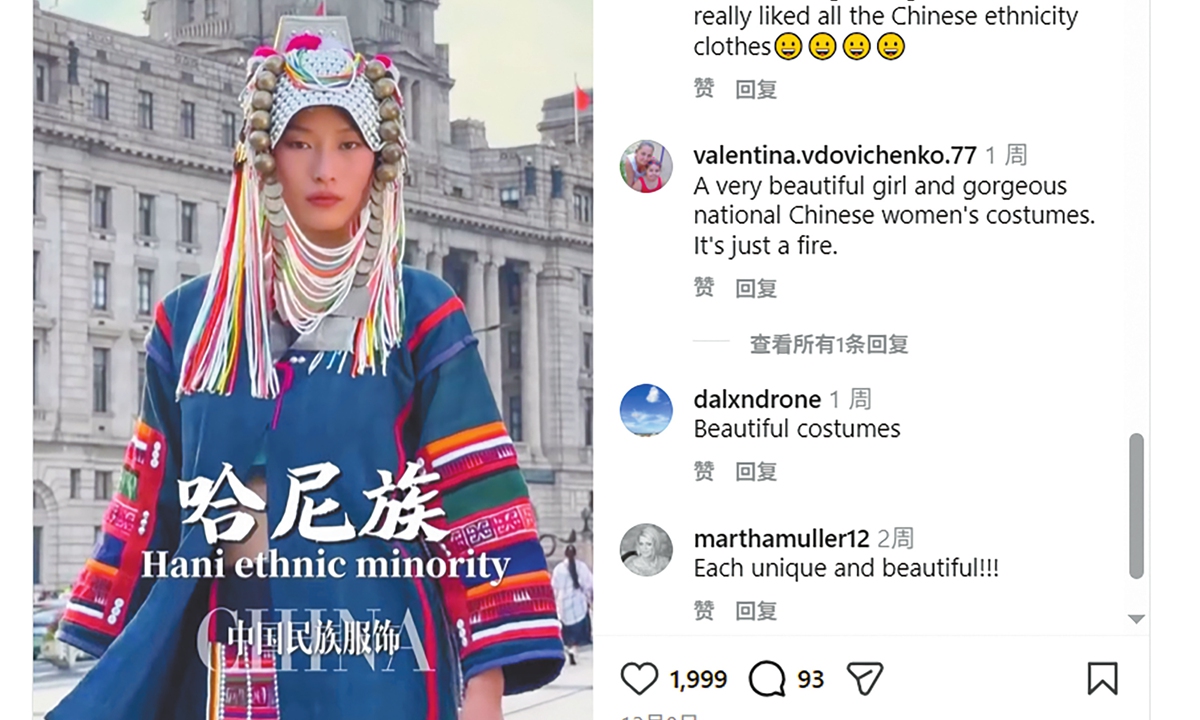
Vlogger Xiao Xiao shares a video of a woman wearing the traditional ethnic costume of the Hani people in December 2025. Photo: Screenshot from Xiao Xiao's Instagram account
An innovative, confident answer to the world
The Recommendations of the Central Committee of the CPC for formulating the 15th Five-Year Plan contained a dedicated chapter on "inspiring the cultural creativity of our entire nation and fostering a thriving socialist culture." "...we should develop a socialist culture with Chinese characteristics for the new era - a culture that has the power to guide, unite, and inspire our people and enjoys strong international appeal," the recommendations noted.
"China's practice shows that, cultural inheritance is not a museum‑style, static preservation, but can be woven into modern life, power economic development, and foster social harmony," Zhang told the Global Times.
"On this point, the world can not only trust China's capacity and commitment to protecting cultural diversity, but also regard China's exploration as a valuable model for cross-cultural exchange," he said.
Data from the Chinese Ministry of Culture and Tourism show that, during the 14th Five-Year Plan period (2021-25), China achieved significant progress in intangible cultural heritage preservation. The country now has 44 items inscribed on UNESCO's Intangible Cultural Heritage lists, ranking first in the world. During this period, more than 12,900 intangible cultural heritage workshops were established nationwide, providing employment and income for over 1.2 million people.
Behind the data, more vivid stories of cultural inheritance are blossoming across the country. In Hanzhong, Northwest China's Shaanxi Province, traditional crafts such as rattan weaving have been industrialized, allowing villagers to turn an age‑old skill into steady income - with products now sold overseas; in Suzhou, East China's Jiangsu Province, classical gardens and historic neighborhoods have been carefully conserved and restored, giving a major lift to cultural tourism; and in Beijing, the "Beijing Central Axis: A Building Ensemble Exhibiting the Ideal Order of the Chinese Capital" was successfully inscribed on the UNESCO World Heritage List in 2024, underscoring its world‑class cultural value.
As China's visa-free travel policy continues to expand to more countries, "China travel" is gaining global popularity, with an increasing number of foreign visitors enjoying the opportunity to closely experience the country's rich cultural tapestry. On YouTube, a Canadian vlogger with the screen name Alex, in early 2025, shared a video of her trying on the traditional clothing of the Miao people, an ethnic group in China. "This was my first time trying the full outfit and make-up experience, and I really didn't expect to enjoy it so much!" she wrote under the video, saying it was a great way to participate in cultural exchange and connect with locals.
From the minutes of "quick change" outfit trend videos, to immersive cultural journeys offline, China's 56 ethnic groups are collectively presenting to the world an innovative and confident answer to how the cultural and ethical civility of a society can be sustained and advanced - through diversity, richness, and harmonious coexistence of ethnic cultures.
At the end of a busy day, Er scrolls through comments left by overseas viewers under videos introducing China's ethnic clothing and smiles. She said that, if she were to reply to the enthusiastic strangers, she would invite them: Come to China, see and try on these beautiful costumes, and feel the stories behind them.
Facing the coming 15th Five‑Year period, Er has her own plans: To continue running her brand steadily, and gradually expand onto wider international stages. "Cultural confidence is not an empty slogan - we are increasingly willing to do, to wear, and to innovate," she told the Global Times. "If ethnic culture keeps pace with the times, it will travel further."
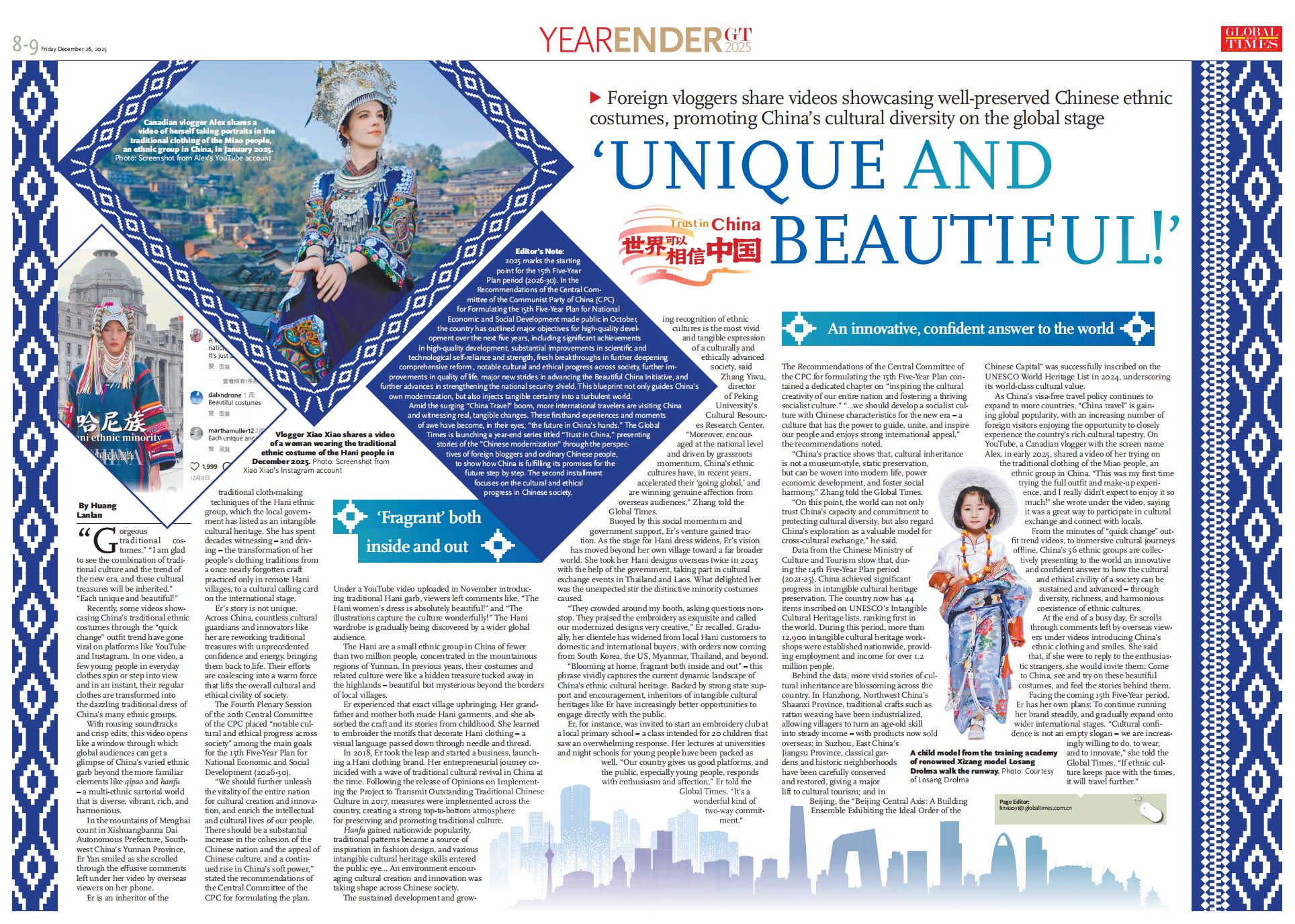
'Unique and beautiful!'