Offshore yuan breaks 7.0 level, hits strongest point since September 2024 as fundamentals underpin rally
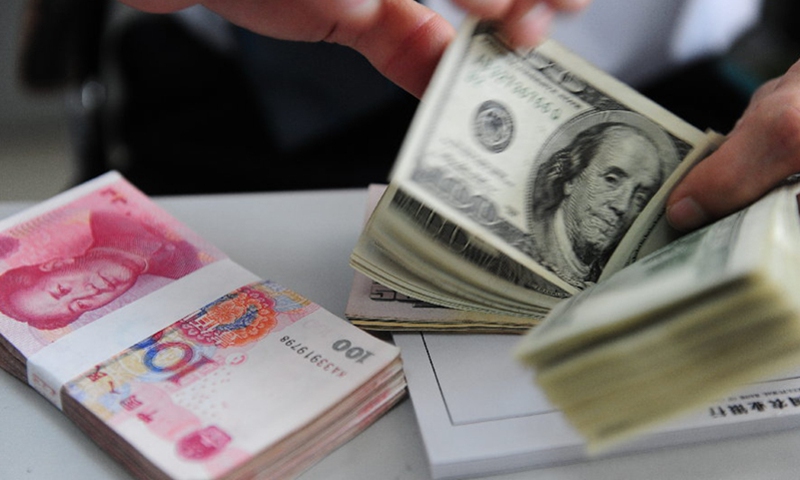
A teller counts U.S. dollar bills at a bank in Qionghai, south China's Hainan Province.Photo:Xinhua
The offshore yuan strengthened against the US dollar on Thursday, moving through the key 7.0000 mark and touching 6.9965 at 3:19 pm, its strongest level since September 2024.
The offshore yuan broke through the key 7.0 threshold in morning trading for the first time since September 2024, according to media reports.
Notably, the offshore yuan has gained about 4.0 percent so far this year, China Fund reported on Thursday.
Since November 21, the yuan has strengthened steadily from about 7.1050 against the US dollar, with market expectations of a break below 7.0 continuing to build.
Chinese experts said that the currency's recent appreciation has been pronounced, but it is not a short-term or isolated development. Rather, the trend reflects a combination of factors, including shifts in US monetary policy and the underlying resilience and attractiveness of the Chinese economy, which together provide fundamental support for the currency.
Earlier this month, the Federal Reserve delivered its third interest rate cut of the year, lowering the target range for the federal funds rate to 3.50 percent to 3.75 percent, the Xinhua News Agency reported.
This is the result of multiple factors working in tandem, and a critical and direct driver has been the shift in US monetary policy, Zhao Xijun, co-president of the China Capital Market Research Institute at Renmin University of China, told the Global Times on Thursday.
"As the US Federal Reserve has sent clear signals at recent public meetings that its policy focus is moving from fighting inflation toward an easing cycle, the pivot has reshaped the broader trajectory of the US dollar, in turn lending support to the yuan," Zhao noted.
From a broader international perspective, the expanding US government debt burden and elevated equity valuations intensified concerns about potential financial risks, prompting a pickup in risk aversion, according to Zhao. He further noted that the Federal Reserve has pivoted its policy stance, and these dynamics have together accelerated shifts in global asset allocation, adding pressure to the US dollar.
"China's economic fundamentals remain an indispensable core underpinning the yuan's ability to move into a strengthening trend," said Bian Yongzu, a senior researcher at the China Institutes of Contemporary International Relations.
Bian said that against a backdrop of sluggish global growth and rising uncertainty, the relative certainty of China's economic performance has become more pronounced, emerging as a key driver of the currency's resilience and appreciation.
The yuan's recent appreciation remains relatively moderate, reflecting policymakers' preference to avoid an overly rapid rise that could weigh on export-oriented businesses, Bian said. He added that overall, a stronger yuan is a medium- to long-term trend, though the pace of appreciation is expected to remain broadly manageable.
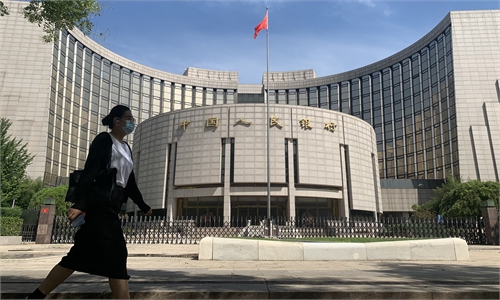
The foreign exchange market this year has seen broadly balanced supply and demand, ample foreign exchange reserves, and two-way fluctuations in the yuan, which has remained basically stable at a reasonable and balanced level, according to a statement about a meeting brief posted on the website of the People's Bank of China, the central bank, on Thursday.
The meeting also stressed the need to enhance the resilience of the foreign exchange market, stabilize market expectations, guard against the risk of exchange-rate overshooting, and keep the yuan basically stable at a reasonable and balanced level, read the statement.
The yuan's recent appreciation reflects both shifting external cyclical factors and policy efforts to maintain exchange-rate stability and a favorable external environment. The currency is expected to remain broadly stable around a reasonable and balanced level, rather than move in a one-way trend, according to Zhao.
Some market participants believe that the yuan is likely to sustain its proactive appreciation in the period ahead.
Further breakthroughs in key technologies, particularly in areas such as semiconductors that face strong external constraints, could become an important turning point for the yuan, Bian noted.
He said that substantive progress in these fields would significantly bolster global investor confidence in China's economy and could usher the currency into a more pronounced appreciation phase. Ultimately, he added, the pace and magnitude of yuan gains will hinge on the depth of China's economic transformation and advances in new growth drivers.
RELATED ARTICLES