Chinese beef industry urges immediate safeguard measures against imported beef amid pressure from surging imports
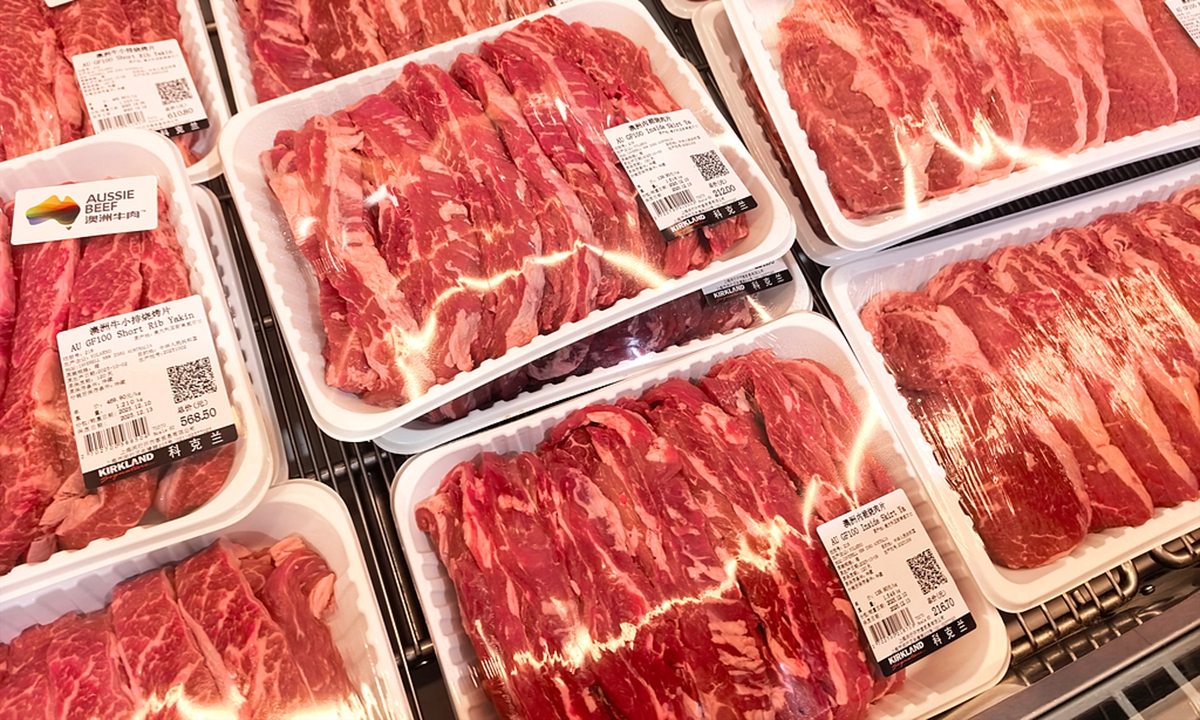
Imported Australian beef in a supermarket in Shanghai Photo: VCG
Multiple Chinese beef industry insiders, including cattle breeders, industry associations and industry observers told the Global Times on Thursday that China's beef industry is under pressure resulting from expanding market share of imported beef, calling on relevant authorities to introduce immediate safeguard measures by the year-end to stabilize market expectation and safeguard the domestic industry and breeders' livelihood.
China's beef breeding industry has suffered losses across the board since 2023 due to multiple factors including pressure from imports, with many breeders being forced to slaughter breeding cattle to reduce costs, Liu Qiangde, deputy secretary-general of the China Animal Agriculture Association (CAAA), told the Global Times on Thursday.
Despite the ongoing safeguard investigation against imported beef, the volume of imported beef from January to October 2025 continued to rise, with inventory reaching 1 million tons, according to Liu. With imports still high, the entire supply chain—including feed, animal health products, and downstream beef processing—is affected, making safeguard measures crucial, he said.
The association [CAAA] strongly urges authorities to implement beef safeguard measures such as import quotas by the end of 2025 and enforce them immediately, Liu said.
Challenges to domestic industry
Some breeders also said that as imported beef captures a growing share of the market, declining calf prices are squeezing profit margins in mother cattle breeding, forcing some breeders to slaughter their breeding cattle to ease financial pressures.
A cattle breeder in Tacheng, Northwest China's Xinjiang Uygur Autonomous Region, told the Global Times that after a brief market recovery in the spring of 2025, market prices for calves quickly fell. Currently, heifer calves fetch only 3,000 to 4,000 yuan. Many breeders have shifted to short-term fattening to mitigate risk, but the mass abandonment of breeding cattle is undermining the industry's foundation.
The breeder said his family has long relied on cattle breeding for their livelihood and lacks the capacity to switch to fattening operations. He cannot bear the losses from continuously falling calf prices; even high-quality breeds like Simmental cattle are being sold at prices comparable to ordinary beef cattle. Rising feed costs before winter forced him to attempt to sell cattle, but the low market prices made transactions impossible, he said.
He stated that some breeders have lost confidence, are no longer restocking cattle, and are even accelerating herd reductions, calling for prompt safeguard measures.
In recent years, China's beef imports have surged sharply, rising by 73.2 percent from 2019 to 2024. Import prices have been more than 50 percent lower than those of domestically produced beef, data showed.
Data also shows that the number of China's breeding cattle fell by 3 percent in 2024, severely undermining the domestic industry's foundation, according to Liu.
Domestic beef slaughtering enterprises have also experienced widespread losses, with some reporting a loss of 500 to 1,000 yuan per head of cattle slaughtered. Liu said that without safeguard measures, many breeders would lose market confidence, potentially triggering further mass slaughter of breeding cattle.
Zhu Zengyong, a research fellow of the Institute of Animal Science of Chinese Academy of Agricultural Sciences, told the Global Times on Thursday that breeding cattle are the backbone of the industry, noting that if their productivity declines, it could cause the entire domestic beef industry to shrink, or even contract significantly.
Compared to pigs and poultry, beef cattle have longer production cycles, higher investment, and slower turnover, according to Zhu, "cattle have a gestation period of around 10 months and cannot breed until 18 months of age, followed by a two-year raising cycle."
Sustained low prices lead to minimal profit or losses, prompting breeders to cull breeding cows and exit breeding. Any reduction in breeding cattle productivity will result in at least four years of decreased domestic production capacity and supply, Zhu added.
Notably, China's beef industry sustains the livelihoods of tens of millions of rural households, mainly in the southwest, northwest, and northeast regions. Zhu said that cattle breeding has been a key pillar of China's rural revitalization and poverty alleviation. "Continued losses without effective safeguard measures and alternative income sources could drive families back into poverty, making the industry vital to rural development," he said.
Safeguard probe
Under the circumstances, China's Ministry of Commerce (MOFCOM) announced on December 27, 2024, that it would launch a safeguard investigation into imported beef after receiving an application from 10 domestic associations, covering the period from January 1, 2019, to June 30, 2024.
On August 6, 2025, the ministry decided to extend the investigation deadline to November 26, 2025, and on November 25, given the complexity of the case, MOFCOM decided to further extend the deadline of the probe to January 26, 2026.
"Even though the MOFCOM has extended the deadline of the investigation twice, and we fully understand the prudence as well as careful technical considerations by the investigation authorities, industry participants have high expectations for action," said Liu.
Zhu also emphasized that under the current circumstances, introducing beef safeguard measures is highly significant. "Establishing 'red lines' and regulating imports can ensure adequate beef supply. Managing beef imports is the most direct and effective way to help the domestic industry recover, stabilize breeding cow numbers, and maintain core production capacity," he noted.
Aligning with rules
According to the website of WTO, a WTO member may take a "safeguard" action, such as restrict imports of a product temporarily, under the WTO Agreement on Safeguards to protect a specific domestic industry from an increase in imports of any product which is causing, or which is threatening to cause, serious injury to the industry.
According to international practice, a safeguard investigation examines import trends and whether they cause or threaten serious harm to domestic producers. Liu said the industry's application for safeguard measures submitted on November 22, 2024, was consistent with WTO rules, and the investigation also aligns with relevant regulations and laws.
Liu said the CAAA has received the disclosure of basic facts of the finding. "If measures are implemented by year-end, this would send a positive signal, allowing breeding cow numbers—the backbone of the industry—to recover and restoring confidence among stakeholders," he said.
RELATED ARTICLES