top news
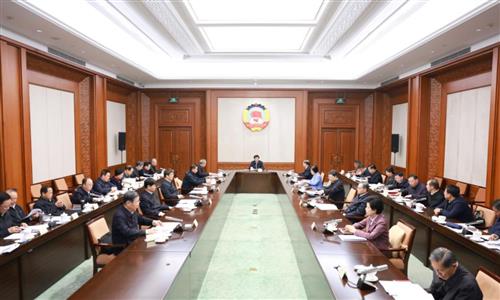
The Political Bureau of the Communist Party of China (CPC) Central Committee convened a meeting on Thursday to discuss and plan the Party's efforts to improve conduct, build integrity, and combat corruption for the year 2026, according to the Xinhua News Agency.
Xi Jinping, general secretary of the CPC Central Committee, presided over the meeting.
In 2025, under the strong leadership of the CPC Central Committee with Xi at its core, discipline inspection and supervision authorities at all levels intensified their efforts to improve conduct, build integrity, and combat corruption, maintaining a tough stance against corruption, said the meeting, noting that new progress and results had been achieved, according to Xinhua.
The meeting said discipline inspection and supervision bodies in 2026 must advance full and rigorous Party self-governance with higher standards and more effective measures, to provide a strong guarantee for the economic and social development during the 15th Five-Year Plan period (2026-2030).
Prior to the meeting, Xi presided over a meeting of the Standing Committee of the Political Bureau of the CPC Central Committee, where reports were heard on the work of the CPC Central Commission for Discipline Inspection and the National Commission of Supervision for 2025, as well as preparations for the Fifth Plenary Session of the 20th CPC Central Commission for Discipline Inspection.
The session is scheduled for January 12 to 14, 2026.
The Thursday meeting underscores the CPC leadership's unwavering determination to press ahead with the anti-corruption campaign. As the fight against corruption in the new era remains complex and challenging, the continued crackdown on corruption sends a clear message that the high-pressure anti-corruption approach will remain firmly in place, said some experts reached by the Global Times on Thursday.
Continuous efforts
According to data from the website of China's top anti-graft body, in the first half of 2025, discipline inspection and supervisory bodies across China imposed disciplinary or administrative penalties on 420,000 individuals, including 313,000 Party disciplinary sanctions and 136,000 administrative punishments. Those sanctioned included 30 provincial- and ministerial-level officials and 1,876 officials at the department or bureau level, per the CPC Central Commission for Discipline Inspection and the National Commission of Supervision.
Authorities continued to investigate both bribe-takers and bribe-givers, opening cases against 16,000 people involved in bribery and transferring 1,990 cases to procuratorial authorities.
The fight against corruption has been maintained at a high pressure. Anti-graft authorities have continued efforts to "take down both tigers and flies", removing corrupt officials at all levels and further purifying Party organizations, Zhi Zhenfeng, a research fellow with the Institute of Law at the Chinese Academy of Social Sciences, told the Global Times on Thursday.
This underscores that anti-corruption is not a short-term campaign, but a serious and institutionalized effort pursued with consistency and resolve, said Zhi.
"Another notable feature of 2025 has been the continued and deeper implementation of the spirit of the eight-point decisions. The effort is widely viewed as an important step in improving Party conduct in the new era and strengthening public trust," Zhi said, adding that Party discipline can lead to better social norms and help address challenges unique to a century-old governing party.
The Communist Party of China Central Commission for Discipline Inspection and the National Supervisory Commission regularly releases monthly data on violations of the eight-point decisions. In November, 31,754 cases were investigated nationwide, with 40,306 people receiving criticism, education, or other forms of handling, including 29,184 who were given Party disciplinary or administrative sanctions. The November report marked the 147th consecutive month that such data have been publicly released.
Profound influence
China's persistent anti-corruption efforts can help foster sustained improvement in the overall social ethos. These changes will benefit China at this critical stage of advancing socialist modernization during the 15th Five-Year Plan period (2026-2030), creating a more stable, transparent, and orderly environment for high-quality development, and releasing long-term, solid impetus for economic and social progress, Fan Peng, a research fellow at the Chinese Academy of Social Sciences' Institute of Political Sciences, told the Global Times.
Fan noted that pressing ahead with anti-corruption efforts reflects both respect for the principles of effective governance and a clear-eyed reading of political realities. Anti-corruption is not simply about rooting out graft; it is a systematic undertaking aimed at improving the overall political ecosystem and advancing social and political civilization. It addresses the practical demands of better governing a major country while responding to public expectations.
China's anti-corruption efforts have also drawn global attention. In a previous interview with the Global Times, Hodan Osman Abdi, the Somali Ambassador to China, who previously worked in Zhejiang, said that the CPC's adherence to the principle of "improving Party conduct as an ongoing task" shows that governance is not about perfect procedures or well-written documents, but about action.
It is about the courage to correct course, the discipline to stay grounded, and the humility to recognize that no system, however powerful, is immune to complacency unless it is constantly renewed, she said, adding that this is precisely what Somalia's leadership and government institutions are focusing on, and that meaningful progress has been made in this regard. She noted that the CPC's approach to Party governance - centered on meeting the aspirations of ordinary people - offers a powerful lesson for countries seeking to build sustainable governance rooted in public trust.
Marcos Cordeiro Pires, professor at the Department of Political and Economic Sciences of São Paulo State University in Brazil, told the Global Times previously that "the general guidelines of the eight-point decision hold universal relevance, as they could help address sensitive challenges faced by political parties worldwide."
Pires also noted that China's governance model could offer valuable lessons for other developing nations. This is evident in its achievements in social stability, political predictability, well-being and technological progress.
RELATED ARTICLES