2nd humanoid robot half-marathon to be held in Beijing in April, eyeing more tech breakthrough
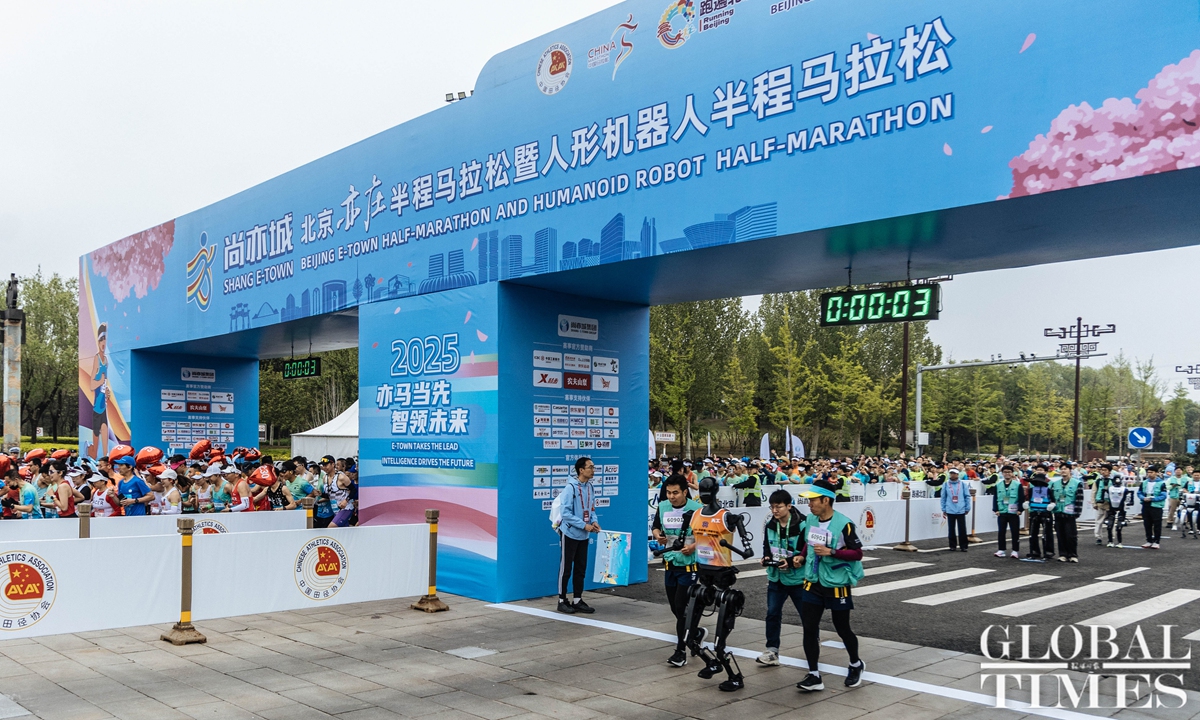
A humanoid robot is running in a half-marathon competition in Beijing on April 19, 2025. Photo: Li Hao/GT
The 2026 Humanoid Robot Half-Marathon will be held in Beijing on April 19, 2026, following the world's first edition in 2025, running concurrently with the Beijing E-Town Half-Marathon, with humanoid robot competitors racing alongside human runners on the same day, an official of the Beijing municipal government told a press conference on Thursday.
Under the competition rules, human runners and humanoid robots will start simultaneously and share the same course, while being separated by barriers or green belts to ensure safety. The humanoid robot race will feature both autonomous navigation and remote-controlled categories, with a hybrid timing system used for on-site competition, according to the conference.
Notably, winning teams will gain fast access from the competition to the commercial market, receiving support including research and development subsidies, project incubation space and access to application scenarios, and the champion team will also be eligible for industrial orders worth more than 1 million yuan ($142,278).
The world's inaugural humanoid robot half-marathon was held in Beijing on April 19, 2025, when the Tien Kung Ultra robot, developed by China's National and Local Co-built Embodied AI Robotics Innovation Center, crossed the finish line first with a time of 2 hours 40 minutes and 42 seconds. Other advanced humanoid robots, including Unitree's G1, Leju Robotics' Kuavo and NOETIX's N2, also took part. Analysts said that the event served as a comprehensive technological validation platform, testing the robots' performance while showcasing their potential for industrial-scale applications.
A Beijing government official said at the press conference that the 2026 event aims to drive higher-level technological breakthroughs of humanoid robots, enabling humanoid robots to achieve greater autonomy, longer battery endurance, more human-like running forms and movements, and stronger adaptability to complex environments. Special awards such as Best Endurance, Best Gait, Best Design and Best Perception will be introduced to encourage innovation, said the official.
Compared with the inaugural event, the 2026 edition will have higher standards for autonomous navigation, long endurance, and dynamic stability, reflecting significant progress in China's humanoid robot technology in just one year, Wang Peng, an associate researcher at the Beijing Academy of Social Sciences, told the Global Times on Thursday.
To support participating teams, the event organizers will launch a robot secondary development community covering more than 10,000 square meters, offering full-chain support including shared robot bodies, free workspace, inclusive computing power and development tools. A "robot marathon training camp" will also be organized to assist teams with targeted development ahead of the competition, according to the conference.
Alongside the race, a new emergency rescue-themed competition will be held, simulating multiple rescue scenarios to test humanoid robots' autonomous decision-making, precise control and sustained operation in complex real-world environments. The official said that the format will provide a high-intensity testing ground for core technologies and help build a normalized, professional platform for translating technological achievements into real-world applications.
Wang noted that the autonomous navigation, long endurance, and environmental perception capabilities showcased in the event are expected to be first applied in scenarios requiring high autonomy and complex environment adaptability, such as industrial inspection, emergency rescue, and logistics, where robots must operate continuously, make rapid decisions, and maintain stable performance.
Global Times
RELATED ARTICLES