Taiwan lawmakers vote to pass impeachment proposal against Lai ching-te, announce full timetable
Move reflects public sentiment, serves as a grave warning to Lai and DPP: expert
By Published: Dec 26, 2025 03:15 PM


latest news
With 60 votes in favor and 51 against, the legislative body in China's Taiwan region approved an impeachment proposal from opposition parties against regional leader Lai Ching-te on Friday. Following the formal initiation of the case against Lai, opposition parties in Taiwan also announced their planned timetable for the impeachment proceedings on the same day, according to Taiwan-based media reports.
The latest move came a week after lawmakers from the Chinese Kuomintang party (KMT) and Taiwan People's Party (TPP) announced a plan to impeach the region's leader Lai at a press conference held in Taipei on December 19, along with an online petition to impeach Lai launched by Taiwan people that has already gathered more than eight million signatures as of Friday.
Based on the schedule for the impeachment case set on Friday, Lai is required to visit the legislative body on January 21 and 22, 2026, to give an explanation and be questioned by lawmakers, according to island-based udn.com.
On May 13 and 14, 2026, the legislative body will convene its second full committee meeting of the impeachment proceedings, requiring Lai to appear for a second time to provide an explanation and respond to legislators' inquiries. The final vote on the impeachment case is scheduled for May 19, 2026, on the eve of the second year since Lai office, the udn.com reported.
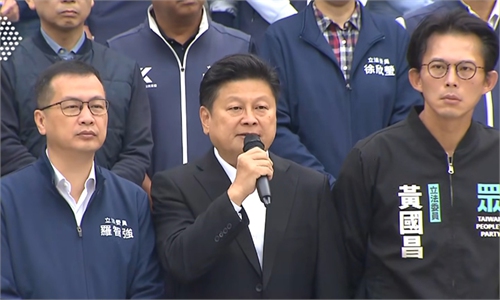
Speaking on Friday, KMT's legislative caucus whip Fu Kun-chi slammed Lai and Democratic Progressive Party for "causing political chaos and engaging in terror rule." While the TPP's caucus whip Huang Kuo‑chang blasted Lai for "trampling on the laws of the legislature and trampling on judicial power," which he said made the impeachment necessary, per Taiwan-based media reports.
The impeachment plan, which also targets Cho Jung-tai, head of the island's executive body, came amid a stand‑off sparked by the refusal of the executive body to amendments to a revenue allocation law, passed by the legislature earlier.
According to Taiwan media reports, under the relevant regulations in the Taiwan region, for the legislative body to propose an impeachment case against the regional leader or deputy leader of the Taiwan authorities, it requires a proposal by one-half of the lawmakers, a resolution by more than two-thirds of lawmakers, followed by review by the "grand justices". The impeachment is established only after obtaining agreement from more than two-thirds of the "grand justices," with the number of agreeing justices being no less than 9, after which the impeached official is removed from office.
Wang Jianmin, a research fellow at the Institute of Taiwan Studies under the Chinese Academy of Social Sciences, told the Global Times that under the current legal framework in Taiwan region, successfully impeaching and removing Lai would be extremely difficult. However, the very act of launching an impeachment procedure as a political maneuver reflects public sentiment and also serves as a grave warning to Lai authorities and the DPP.
According to the expert, there is currently considerable dissatisfaction with Lai among the public on the island: besides Lai's arbitrary and dictatorial practices, the Lai authorities persist on secessionist provocations and belligerent acts, which have severely undermined cross-Straits exchanges.
The impeachment case against Lai came about 5 months after DPP's recall campaign against 24 KMT lawmakers, which ended with the KMT's overwhelming victory with none of the proposals receiving more votes in favor of the recall than against it, Xinhua reported.
It has also been timed to coincide with 2026, when campaigns for local elections in Taiwan's cities and counties will intensify. Currently, the KMT holds a substantial lead in local leadership, with 15 incumbents from the blue camp compared to just 5 from the DPP.
Zhang Wensheng, deputy dean and professor at the Taiwan Research Institute of Xiamen University, told the Global Times on Friday that Lai is unlikely to comply with the impeachment inquiry at Taiwan's legislative body, and he may adopt an even more confrontational stance.
The confrontations surrounding the impeachment case highlight the escalating struggle between the opposition parties and the DPP on the island. Furthermore, the intensifying contradictions between the executive body and legislature in the Taiwan region are making their cooperation increasingly difficult.
"Political polarization on the island is set to deepen further, which may lead to growing social unrest and instability," said Zhang, "Ultimately, this will harm the interests of the people of Taiwan."
Li Weilin contributed to the story
RELATED ARTICLES