China launches national venture capital guidance fund to back long-term innovation: NDRC

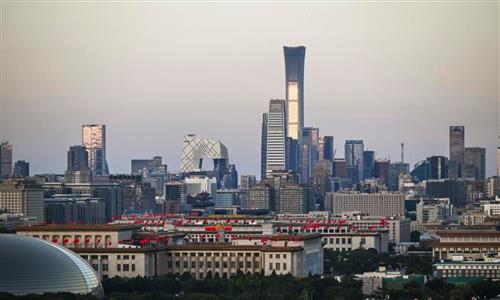
A city view of Guangzhou in South China's Guangdong Province Photo: VCG
China on Friday officially launched the national venture capital guidance fund, a move aimed at expanding patient capital and steering financial investment toward early-stage, small-scale, long-term and hard-tech ventures, according to the National Development and Reform Commission (NDRC), China Media Group (CMG) reported.
The fund operates under a three-tier structure comprising a guidance fund company, regional funds and sub-funds, with authorities accelerating the establishment of regional funds in the Beijing-Tianjin-Hebei region, the Yangtze River Delta and the Guangdong-Hong Kong-Macao Greater Bay Area, according to an NDRC press release.
Huo Fupeng, chairman of the National Venture Capital Guidance Fund Co, said that funding arrangements for the first batch of three regional funds, each with a scale of more than 50 billion yuan ($7 billion), have been finalized. All three funds have signed investment agreements, completed business registration and secured an initial portfolio of 49 sub-funds and 27 investment projects, according to CMG.
At the launch ceremony of the fund, an official from the Ministry of Finance said the fund is distinguished by stronger fiscal support and a more focused investment mandate. Guided by the principle of "investing early in small, long term and hard technology ventures," it will focus on frontier fields such as artificial intelligence, biopharmaceuticals, quantum technology and 6G, with a 15-20 year lifespan tailored to match the long R&D cycles of these fields.
The official said the fund is structured to maximize capital leverage through a three-tier system consisting of a guidance fund, regional funds and sub-funds. The fund is designed to pool hundreds of billions of yuan in fiscal capital from local governments, financial institutions, state-owned and private enterprises, with the goal of mobilizing trillions of yuan in social investment.
Bai Jingyu, head of the Innovation and High-Tech Development Department of the NDRC, said that to address issues such as herd behavior, cherry-picking and short-termism in the current venture capital market, the fund will prioritize early-stage investment, with a particular focus on seed-stage and startup firms. At least 70 percent of the fund's capital will be allocated to such companies.
He added that the fund will also target small enterprises, stipulating that investee companies must have a valuation under 500 million yuan, with any single investment limited to a maximum of 50 million yuan. This ensures capital flows to the forefront of industrial chains and the grassroots of the real economy.
Bai said the national venture capital guidance fund is positioned as an early-stage fund. He noted that today's technology leaders may have been seed or startup firms with high growth potential, but they also carried high risks and uncertainty, which has made private investors cautious. To address this, the fund will prioritize investment in seed-stage, startup and early-to-mid-stage enterprises, supporting original and potentially disruptive technological breakthroughs in frontier fields.
The national venture capital guidance fund is also designed as a patient capital fund. The growth of innovative firms is a long-term process that requires sustained capital support, Bai said. The fund has a 20-year lifespan, spanning a 10-year investment period followed by a 10-year exit phase, providing long-term funding and more flexible exit arrangements to support enterprises' growth.
Bai said the fund will operate on market-oriented principles, balancing policy objectives with market discipline, while also serving as a benchmark for the venture capital sector. He noted that it will avoid repetitive investments and direct competition with market players, focusing instead on addressing the long-standing shortage of long-term capital in the venture capital industry.
Guo Fangming, head of the Economic Construction Department of the Ministry of Finance, said the ministry will actively fulfill its responsibilities as a state investor by strengthening performance evaluation of the guidance fund. He noted that the assessment system will be scientifically designed to focus on the achievement of key policy objectives, rather than simply on the three-year profit or losses of individual projects.
Guo added that oversight will be improved to guide the fund in building full-lifecycle risk controls across investment, management and exit, boosting the efficiency of fund use.
This is a strategic push to guide patient capital toward hard tech and long-term innovation, Bian Yongzu, a senior researcher at the China Institutes of Contemporary International Relations, told the Global Times on Friday, noting that China is at a pivotal stage of economic restructuring, where the development of "new quality productive forces" depends on the continuous emergence of new technologies, business models and industries. Such innovation, he said, is largely driven by start-ups, making entrepreneurship a core engine of economic upgrading.
He noted that the importance of innovation and entrepreneurship extends beyond technology to talent. Entrepreneurial talent — combining expertise, resilience and creativity — is a scarce and highly valued resource globally. Against this backdrop, the launch of a large-scale innovation and entrepreneurship fund is intended to support high-risk start-ups and accelerate China's progress toward technological catch-up and leadership.
Bian added that the fund's rollout in the Beijing-Tianjin-Hebei region, the Yangtze River Delta and the Guangdong-Hong Kong-Macao Greater Bay Area reflects their strong innovation ecosystems and active young entrepreneurs. Promoting entrepreneurship, especially in service sectors such as culture, healthcare and education, will help boost economic growth, ease employment pressure and support coordinated regional development over the long term.
RELATED ARTICLES