Chinese experts rebut EU criticism of China’s dairy countervailing determination, citing compliance with law and WTO rules
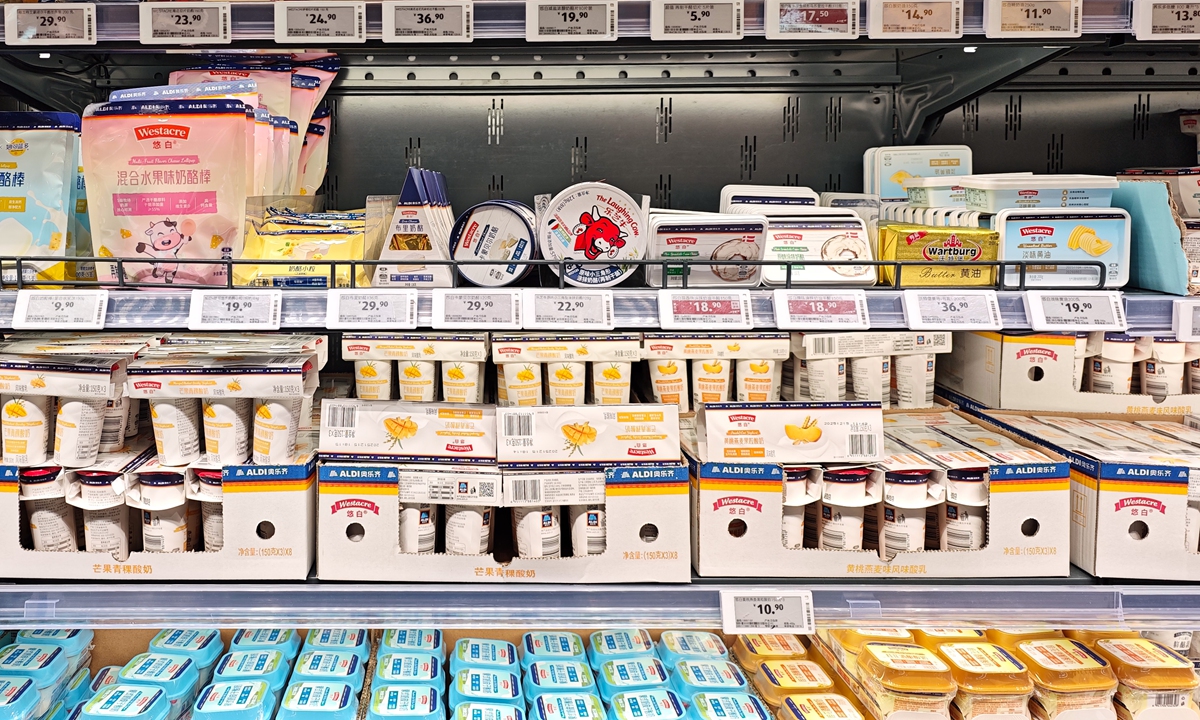
Various imported and domestic dairy products display on the shelves of a European-brand supermarket in Shanghai, on December 26, 2025. Photo: VCG
China's preliminary determination in a countervailing investigation into certain dairy products originating in the EU has drawn widespread attention. Industry sources and experts in China described the determination as fair, lawful, and in line with WTO rules, saying it responds to mounting difficulties faced by China's domestic dairy sector due to subsidized EU imports.
As price pressure from EU imports intensifies, China's dairy sector has entered what many describe as its most challenging period to date, making protection of the domestic industry imperative, sources said. Meanwhile, experts familiar with the case noted that China has fully taken into account the concerns of EU companies to ensure an objective and impartial determination.
On Monday, the Ministry of Commerce (MOFCOM) said it would impose temporary countervailing measure on certain EU-origin dairy products starting the following day, with ad valorem countervailing duty rates ranging from 21.9 to 42.7 percent, citing findings that subsidized imports had caused material injury to China's domestic industry.
The move has raised concerns within the EU, with some officials and industry groups claiming the duties were "unjustified." But Chinese experts refuted such arguments as a "double standard," saying they downplay the bloc's extensive agricultural subsidy system and misrepresent the nature of China's investigation.
Industry injury
China's preliminary determination is fair, lawful, and compliant with WTO rules, because it is based on objective and verifiable facts - namely, the EU's long-standing and substantial agricultural subsidies, said Liu Changquan, head of the Rural Industry Economics Division at the Rural Development Institute of the Chinese Academy of Social Sciences.
The bloc's subsidies are particularly pronounced in the dairy sector and confer price advantages on products exported to China, Liu told the Global Times on Friday.
Zhang Xiaopeng, from Shanghai Institute of Open Economy(Shanghai WTO Affairs Consultation Center), told the Global Times that the EU provides massive subsidies to its dairy industry through schemes such as the Common Agricultural Policy (CAP), which has caused shocks and injury to the domestic industry.
Financed through the EU budget, the CAP supports farmers, stabilizes agricultural markets and safeguards farm incomes through systematic public funding, including direct payments, market measures and rural development programs, according to the European Commission.
Official EU expenditure data show that direct payments under the CAP made up a significant share of farm income, accounting for about 23 percent of agricultural factor income on average across the bloc between 2018 and 2022, rising to around 33 percent when all subsidies are included.
In the dairy sector, Liu's institute analyzed income structures of professional dairy farmers across the EU's 27 member states using official EU statistics. The findings show that subsidies account for a large share of farm income, exceeding 20 percent even in lower-support countries and reaching as much as 70 to 80 percent in others.
Such subsidies not only raise farmers' incomes but also distort production incentives, encouraging output beyond the bloc's internal demand, Liu said. "The surplus is then channeled into international markets, depressing prices and intensifying pressure on importing countries, including China."
China's overall agricultural support remains low by global standards, with the dairy sector characterized by an open market and production largely driven by free competition. By contrast, the EU dairy industry relies heavily on subsidies, which, Liu said, makes China's response reasonable and justified.
This disparity has translated into growing pressure on China's domestic dairy industry. A veteran industry insider told the Global Times on Friday that the sector is under severe strain, with import shocks significantly reducing scope for transformation and upgrading. Subsidized imports have taken comparatively large market share - imported cream accounts for nearly 25 percent of the domestic market, while cheese accounts for about 11 percent, directly suppressing domestic output and profit margins, the insider noted.
"Chinese dairy industry is being consistently impacted by unfair trade practices from the EU," said Liu. He added that it is both necessary and timely for Chinese authorities to introduce provisional countervailing measures, as doing so helps give domestic producers a clear sense that there is a pathway out of the current difficulties.
The preliminary measures may help ease pressure to some extent, but they still fall short given the scale of the injury, the insider said, calling for stronger protection if the situation fails to improve.
Procedural prudence
The countervailing investigation into EU dairy imports was launched on August 21, 2024, following applications from the Dairy Association of China and the China Dairy Industry Association, after the Global Times learned exclusively in June 2024 that such a move was under consideration.
Since the case was formally launched, MOFCOM has conducted the investigation in strict accordance with Chinese laws and regulations as well as WTO rules, while fully safeguarding the rights of all interested parties, the Ministry said.
Monday's preliminary measure also narrowly target deep-processed dairy products such as cheese and cream, which experts said align the scope of the determination with areas where injury has been identified and reflects a targeted, proportionate approach.
"From the start, MOFCOM has emphasized a clear legal basis and strict compliance with WTO rules," Zhang said, noting that the more than year-long investigation shows the case was a routine, law-based exercise carried out with prudence and restraint -standing in sharp contrast to the EU's recent wave of frequent trade barriers against China.
Chinese authorities ensured broad participation by all stakeholders through measures such as hearings and public comment solicitation, and reached an objective and impartial determination based on the evidence collected, according to the MOFCOM.
MOFCOM's determination has received strong backing from domestic industry associations and enterprises. The China Dairy Industry Association said on Monday the preliminary measure is in line with WTO rules and Chinese law, help defend unfair trade practices, and contribute to a fairer, more transparent and predictable market environment for domestic dairy companies.
The Dairy Association of China said that MOFCOM's law-based investigation and countervailing measures effectively safeguard fair competition and domestic industry interests, help ease import pressure and boost industry confidence.
Stark contrast to EU
China has consistently exercised prudence and restraint in using trade remedy tools, a practice that fundamentally differs from the EU's abuse of unilateral investigations and sanctions without industry petitions, Chinese experts said.
Official data show that since the beginning of 2025, the EU has imposed preliminary duties in 18 trade remedy cases against China, issued final duties in another 18 cases, and launched 15 new trade remedy investigations. On December 19 alone, the EU initiated 3 anti-dumping investigations into Chinese cranes, sodium benzoate and benzyl alcohol, and issued a final ruling in the choline chloride case, imposing duties of up to 115.9 percent in that case.
"On trade policy issues involving China, the EU has long applied double standards," Zhang said, "China's decision to initiate the countervailing investigation rests on an indisputable legal basis and is fair, lawful and fully compliant, with due procedures, solid evidence and safeguards for transparency.
"The investigation was conducted in strict accordance with the WTO Agreement on Subsidies and Countervailing Measures," Zhang added.
The final determination is scheduled to be released before February 21, 2026. China will make the final determination based on the principles of fairness, impartiality, openness and transparency, while fully safeguarding the rights of all interested parties, head of the Trade Remedy Investigation Bureau of MOFCOM said in a statement on Monday.
China's position opposing the abuse of trade remedy measures remains unchanged, and it stands ready to work with the EU to properly handle trade frictions through dialogue and consultation, in a joint effort to safeguard the overall China-EU economic and trade relationship, the head said.
RELATED ARTICLES