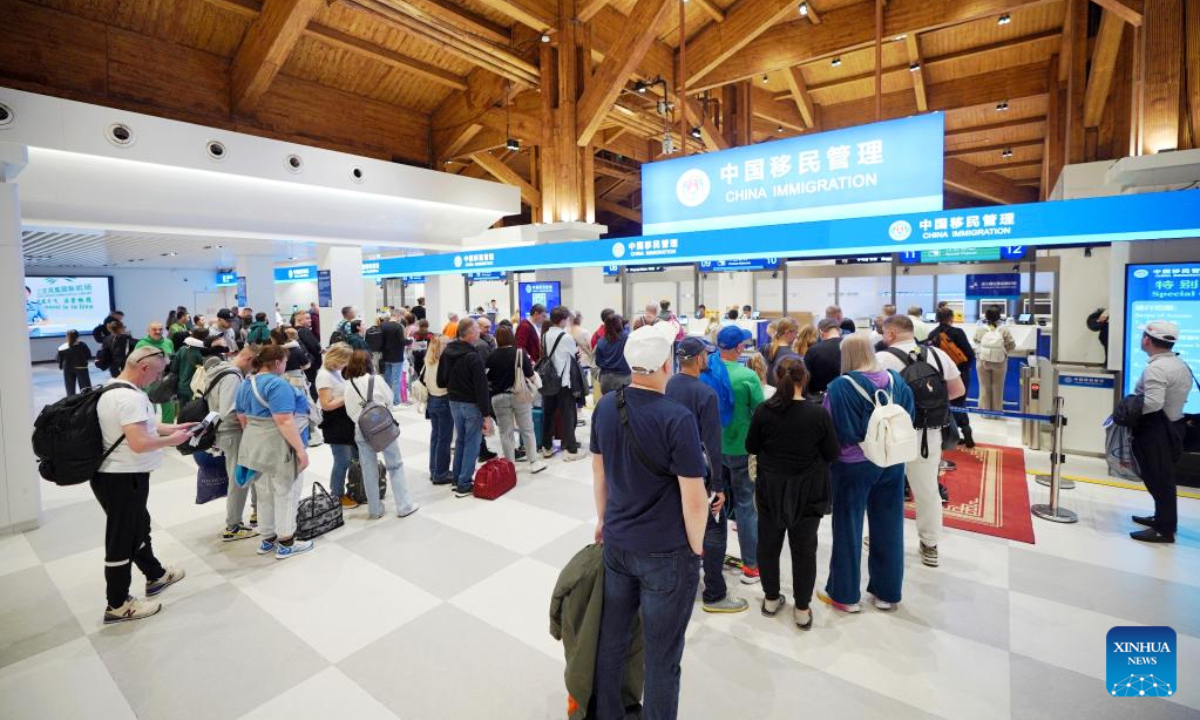
Inbound passengers line up for border procedures at Sanya Phoenix International Airport in Sanya, south China's Hainan Province, Dec. 18, 2025. China on Thursday launched island-wide special customs operations in the Hainan Free Trade Port (FTP). (Photo:Xinhua)
Since the launch of island-wide special customs operations in South China's Hainan Province, the policy has not only unlocked sizable consumption opportunities for the region but also triggered a notable surge in tourism demand, according to data obtained by the Global Times on Friday.
In the first week after the Hainan officially launched island-wide special customs operations on December 18, hotel bookings in Hainan rose by more than 20 percent month on month, the fastest growth nationwide, Chinese travel platform Tongcheng Travel told the Global Times in a statement on Friday.
Bookings for high-end hotels jumped by more than 30 percent, the statement said.
Air travel data pointed to similarly strong momentum. Over the past week, domestic flight bookings to Hainan's Sanya and Haikou climbed by more than 10 percent compared with the same period last month. The source markets of passengers flying to Hainan showed a clear pattern of strong demand from eastern regions and faster growth from western regions, according to the statement.
As the world's largest free trade port (FTP) by area, Hainan has allowed freer entry of overseas goods, expanded zero-tariff coverage and introduced more business-friendly measures, according to the Xinhua News Agency.
Beyond robust domestic demand, inbound tourism has also recorded solid gains.
Data from travel platform Qunar showed that international flight bookings to Haikou have risen by more than 40 percent in recent weeks. As of Friday, the latest figures indicated that international air tickets booked to Haikou for the 2026 Spring Festival holidays had more than doubled year on year, with major source markets including Russia, Singapore, Australia, Malaysia, South Korea and Thailand, the company told the Global Times in a statement on Friday.
Consumption incentives can shift from a supplementary factor to a core consideration in travel decisions, and the interaction between policy support and tourism enthusiasm is more likely to generate sustained consumption momentum, a Chinese expert noted.
This consumption appeal is sustainable, underpinned by the long-term institutional design of the FTP, with policy dividends continuing to unfold through tax reforms and trade facilitation, Wang Peng, an associate researcher at the Beijing Academy of Social Sciences, told the Global Times on Friday. He said policy-driven "shopping plus tourism" models align closely with upgrading consumer demand, helping generate steady and resilient consumption momentum.
From December 18 to December 25, imports of goods benefiting from zero tariffs exceeded 400 million yuan ($57 million), according to statistics from Hainan's Haikou Customs on Thursday.
During the same period, duty-free goods sold to customers in the Chinese mainland through the "second line," under a policy allowing products with an added value of 30 percent or more during local processing, surpassed 20 million yuan, customs data showed.
Wang said the special customs operations are reshaping Hainan's tourism consumption structure in a fundamental way. Deeper integration of tourism with related industries has extended visitor stays, while a rising share of high-end consumption has lifted per capita spending. At the same time, consumption has expanded beyond traditional duty-free goods to include cross-border value-added processing products, premium services and culture-tourism integration.
He noted that these shifts are accelerating Hainan's transition from a conventional sightseeing destination to a high-value, long-stay international tourism consumption hub.
"By enhancing its ability to attract global consumption resources and fostering stronger linkages between industry and consumption, the policy is helping build a more sustainable ecosystem and lay a solid structural foundation for the development of an international tourism consumption center," Wang said.
RELATED ARTICLES