China launches new Southwest-to-East gas pipeline linking to boost energy security
By Published: Dec 29, 2025 09:22 PM

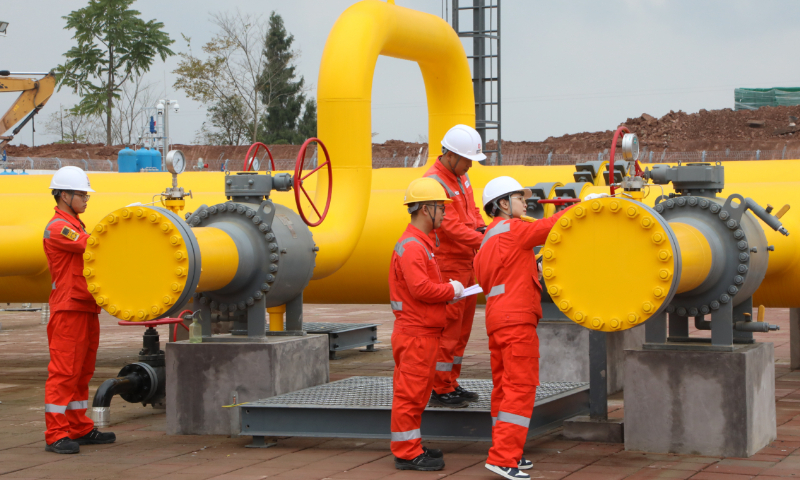
Workers inspect a gas hub along the Sichuan-to-East natural gas pipeline. File photo: Courtesy of PipeChina
A new section of the second Sichuan-to-East natural gas pipeline, a key energy infrastructure project in China, began operations on Monday, boosting the country's natural gas transmission capacity and marking a milestone in the pipeline spanning across western and eastern provinces, according to state-owned gas pipeline operator PipeChina Co.
The newly operational segment is located in the western part of the project. The new section, measuring 190 kilometers in length, has a designed annual transmission capacity of 20 billion cubic meters.
On Monday, gas from the Weiyuan and Luxian fields in Sichuan Province was injected into the major national pipeline networks, connecting natural gas producing regions with consumption regions, promoting the country's energy structure transformation and injecting new momentum into high-quality socioeconomic development, according to a press release that PipeChina sent to the Global Times on Monday.
Lin Boqiang, director of the China Center for Energy Economics Research at Xiamen University, told the Global Times on Monday that along with the successful ramping up of production of natural gas in China's western provinces, the added capacity in pipeline gas transmission will channel the added gas output to eastern provinces where demand for natural gas is high.
"Domestically produced pipeline gas is also cheaper than, and is set to substitute for some of the seaborne liquefied natural gas currently used by Chinese coastal cities, resulting in reduced overall costs for the national economy," Lin said.
Stretching 4,269 kilometers, the pipeline starts in Luxian county, Southwest China's Sichuan Province, and ends in Wenzhou, East China's Zhejiang Province.
The pipeline, expected to be completed in 2027, is being constructed in two phases, the western section (Sichuan-Chongqing-Hubei) and the eastern section (Hubei-Henan-Jiangxi-Anhui-Zhejiang-Fujian).
The pipeline is designed to connect with major national pipeline networks, ensuring efficient transportation of natural gas from the Sichuan Basin, serving as an important energy channel supporting the development of the Yangtze River Economic Belt, and significantly enhancing the country's natural gas supply and emergency capabilities to address demand peaks, according to the PipeChina press release.
Following a fruitful seven-year-long action plan to ramp up domestic oil and gas production, China's oil and gas production reached new highs in 2025, with crude oil production potentially hitting a record high of 215 million tons, and natural gas production reaching 260 billion cubic meters, the Xinhua News Agency reported on December 15, citing data from the National Energy Administration.
The natural gas production figure is estimated to have increased by 35 percent from the end of 2020, according to the People's Daily.
China's main oil and gas pipelines extend more than 200,000 kilometers, strengthening the country's capacity to ensure stable oil and gas supplies, according to Xinhua.
RELATED ARTICLES