ARTS / CULTURE & LEISURE
'Robotic Quidditch' enters mainstream
Drone football takes flight
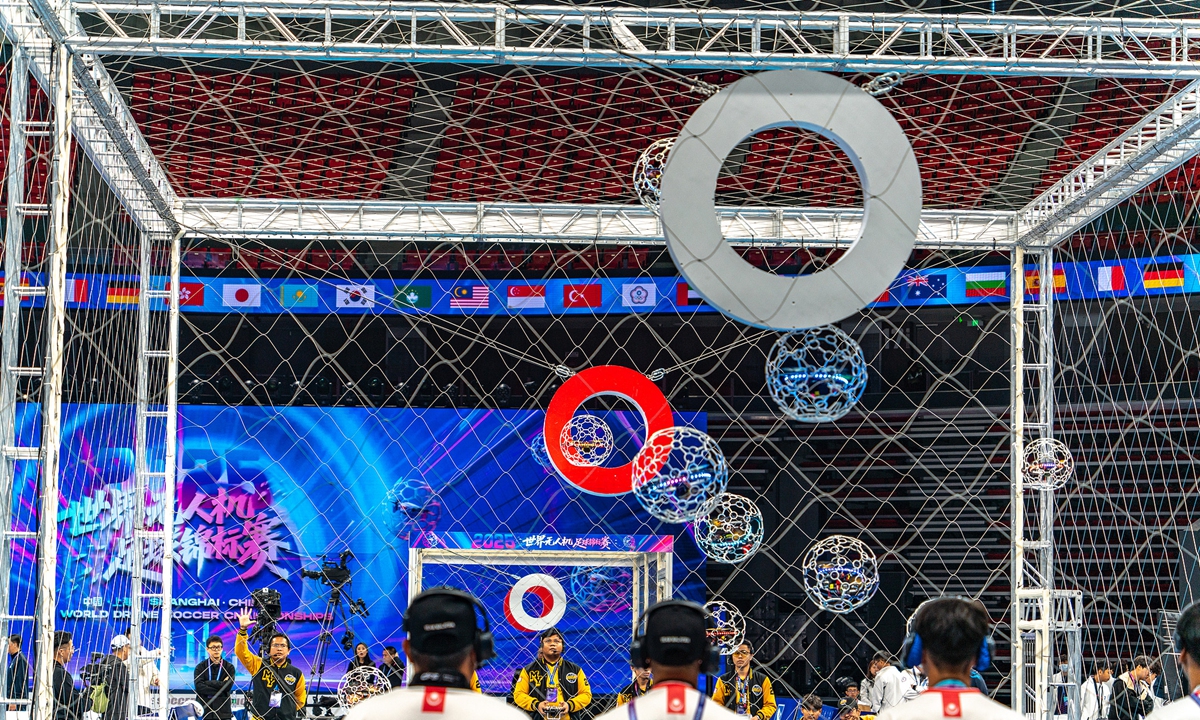
Players compete at the 2025 World Drone Soccer Championships in Shanghai on November 16, 2025. Photo: VCG
At a sports hall in Shanghai, several middle school students stood at the sidelines, controllers in hand, their eyes fixed on the spherical drones hovering above. At the referee's whistle, five drones took off almost simultaneously, performing sudden stops, sharp turns and midair collisions.After one head-on clash, a drone briefly lost balance and fell out of the offensive-defensive rhythm, prompting a burst of gasps from the crowd.
Professional drone football coach Sun Mingyuan stood nearby, offering guidance to the players. For him, such scenes have become increasingly common over the past year.
"If drone racing is more like a personal time-trial challenge, drone football is about real-time team competition," Sun told the Global Times.
"Victory isn't determined by who flies faster, but by who can maneuver the ball into the opponent's goal more times in three-dimensional space. It is a true test of players' spatial awareness and reaction skills," he noted.
A flying competition
In a drone football match, the sport combines drone technology with traditional football. Participants operate drones equipped with spherical protective frames within a controlled low-altitude environment, aiming to score by sending the drone "football" into the opponent's goal, according to the General Administration of Sport of China.
With its spherical "ball," aerial maneuvers and three-dimensional goals, drone football has drawn comparisons to Quidditch, the fictional flying sport from the Harry Potter series, for its visual similarity, though it is played not by magic but with real machines and real tactics.
The 2025 World Drone Soccer Championships, an international A-level event sanctioned by the World Air Sports Federation (FAI), recently concluded in Shanghai. The innovative sport, which blends competition with technology, is rapidly expanding from professional arenas into school campuses across China.
In recent years, drone football has developed rapidly in China. In cities such as Beijing, Shanghai, and South China's Guangdong Province, some schools have already begun offering drone football training programs.
After attending the 2025 World Drone Soccer Championships as a coach and broadcasting the event live, Sun noted that the sport can quickly capture children's interest, a feat many traditional sports struggle to achieve.
"Drone football has a well-structured competition system, giving children a clear platform to showcase their skills while also allowing parents to see the tangible results from their investment," he said.
According to Sun, the sport's intuitive and visually striking three-dimensional confrontations make matches fast-paced and thrilling, helping drone football rapidly form vibrant campus communities.
During matches, players often need to accurately track a ball barely 20 centimeters in diameter from distances of six to ten meters, reacting swiftly amid constantly changing situations.
"Drone football naturally draws people in; it is easy for spectators to understand and become captivated," Sun said.
"The pace of the game is intense, and it challenges athletes to communicate tactics clearly and coordinate under pressure."
Echoing Sun's view, 17-year-old Kong Yiming, a drone football player from Southeast China's Fujian Province, told the Global Times that a drone football match is far from a solo performance, but instead depends on the teamwork of players.
"In one match I played, a teammate miscontrolled the drone ... We quickly covered for each other and it unexpectedly led to a beautiful counterattack goal," she recalled.
Kong said that in that moment, the entire team cheered almost simultaneously, and it felt as if each of them had completed a perfect collaboration in midair.
She added that this three-dimensional competition helps team members understand the mechanical and technological principles behind every operation.
This makes the match not just a sporting contest but also gives participants an intuitive understanding of drone technology.

A Chinese player operates the drones at the worlds Photo: courtesy of Sun Mingyuan
Beyond the fieldDrone football matches showcase precision flight and coordinated tactics through real team competition, combining the competitive excitement of sports with the innovative edge of cutting-edge technology, according to Xinhua News Agency.
In the world of drone football, competition doesn't only take place on the field. Sun noted that the true "technology" often comes into play before and after the match.
"Players can optimize their drones by selecting propellers, motors, batteries, flight controllers, or even by designing the frame and ball cage from scratch," he said. "Within strict weight and size limits, finding the right balance between stability, speed and durability is itself a practical exercise in engineering."
Sun explained that for this reason, drone football has increasingly become a key feature in school clubs as well as aeromodelling and technology competitions, serving as an important entry point for students to engage in engineering thinking.
Guo Ai, a sports commentator based in Beijing, told the Global Times that drone football is called a "tech sport" not just because it uses advanced equipment.
"The sport's competitive peak often occurs between ages of 10 and 13," Guo noted.
"It's not uncommon for young players to compete alongside adults, and sometimes even beat them. This low-age threshold and long development period give drone football strong vitality."
According to Guo, in the future, the sport may not only thrive on school fields but also extend into home entertainment, technology experience centers, gaming arcades, and even become a new event at sports meets.
"More importantly, this sport allows people to experience the appeal of science, technology, and teamwork through play and competition at the same time," Guo said.
RELATED ARTICLES