A survey reveals the compelling appeal of contemporary China: Global Times editorial
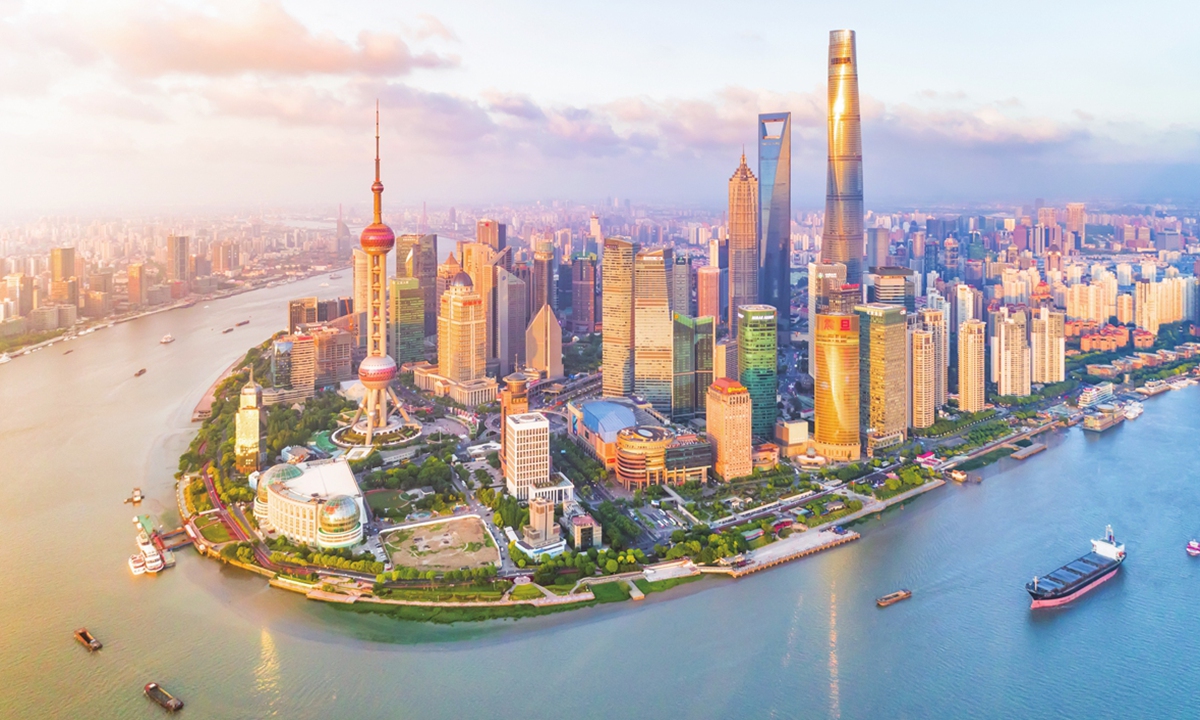
A view of Shanghai Photo: VCG
The 2025 "Global Survey on Impression and Understanding of China," covering 46 countries and about 51,700 respondents and released by the Global Times Institute on Monday, reveals that Xi Jinping Thought on Socialism with Chinese Characteristics for a New Era receives high international recognition. "Building a community with a shared future for humanity" and "lucid waters and lush mountains are invaluable assets" received approval from nearly 80 percent of international respondents, while "advancing full and rigorous Party self-governance," "further deepening reform comprehensively," and "people-centered development philosophy" each receives over 70 percent recognition. The approval rate for the above five concepts exceeds 80 percent among respondents from developing countries, and surpasses 60 percent in developed countries.
This diverse sample - spanning different systems, cultures, and development stages - offers a clearer, more direct mirror for understanding "how the world views China."
The recognition of Chinese ideas reflects international community's shared quest for certainty and sustainability amid global turbulence. Public perceptions of China abroad are forming a clearer, more structured picture: People value China's tangible achievements in development while showing growing interest in understanding its proposed concepts and initiatives. Against a backdrop of rising protectionism, spilling conflict risks, and widening development gaps, more and more countries are eagerly expecting to balance security and development, integrate growth and equity, and better manage the relationship between humanity and nature. The broader resonance of these Chinese ideas stems from their grounding in pressing contemporary challenges - peace, security, development, and governance - offering problem-driven, practice-backed pathways that are replicable and scalable.
The profound and widespread international dissemination of Chinese ideas and solutions is fundamentally rooted in the Communist Party of China's institutionalized delivery of long-term goals and its self-restraint in the exercise of power. The international recognition of China's implementation of the spirit of central Party leadership's eight-point decision and its practices related to exercising full and rigorous Party self-governance, as shown in the survey, also reflect expectations for clean, efficient, and accountable governance. Positive evaluations of the five-year plans signify acknowledgment of "long-termism."
For the outside world, the ability to genuinely translate institutional strengths into governance effectiveness, and governance effectiveness into tangible benefits for the people means more stable expectations, more sustainable growth, and governance experience worthy of reference.
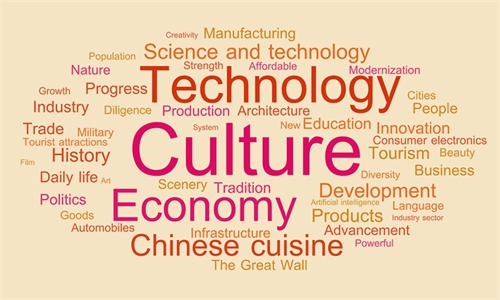
The global acceptance of China's image rests on a deeper foundation: the sense of gain and the incremental development brought about by cooperation. The survey shows that the keywords most frequently associated with China by foreign respondents in 2025 include: economy, technology, science, development, strength, good, culture, advancement, and innovation. When respondents praise China's technological capabilities and its spirit of hard work and innovation, they often think of everyday, tangible "China-related" features such as popular short-videos, advanced high-speed rail, and convenient mobile payment systems. The fact that media coverage and social platforms in parallel serve as the main sources of information about China suggests that it is not enough to tell China's stories well; we must also allow the world to see China's development logic, governance resilience, and openness. More importantly, whether individuals have visited China significantly affects their favorability; visa-free facilitation increases the willingness for people-to-people exchanges. Personal experiences brought back to one's home country can generate a "multiplied positive amplification effect," helping to counteract prejudice and information cocoons.
The international community's expectations of China's experience are strongly reflected in the call for genuine multilateralism and a just and equitable international order. The survey shows that more than half of foreign respondents look to the International Organization for Mediation headquartered in Hong Kong to contribute to peaceful dispute resolution and international cooperation, and over 60 percent expect China to play a greater role in promoting the resolution of international hotspot issues such as the Ukraine crisis, the Palestine-Israel conflict, and the Israel-Iran conflict. This clearly indicates that, as global governance faces issues of imbalance, disorder, and ineffectiveness, China is viewed as a credible force for balance and mediation. At the same time, the rising international sentiment against unilateral bullying and the instrumentalization of rules further illustrates that what the world needs is not the zero-sum logic of "power politics," but the "win-win philosophy" of openness, mutual benefit and cooperation.
This survey has measured the appeal of contemporary China, revealing the genuine stories of "seeing China, understanding China, and being willing to cooperate with China" naturally growing worldwide.
Looking ahead, there is a need to continue expanding personnel exchanges and facilitation at a higher level of opening-up, and to provide sustainable cooperative outcomes at a higher quality of development, especially by enhancing exchanges and mutual learning among youth and other groups. The reason why Chinese ideas are more attractive lies in their ability to respond to the common aspirations of a majority of countries for peace, security, development, and dignity, thereby converging into a broader resonance of the era over the long course of history.
RELATED ARTICLES