
This year marks the 80th anniversary of the victory of the Chinese People's War of Resistance against Japanese Aggression (1931-1945) and the World Anti-Fascist War. Winning the war is a great victory of the national spirit with patriotism at its core, a great victory achieved with the Communist Party of China (CPC) fighting as the central pillar, a great victory fought by the whole nation through solidarity and bravery, and a great victory for the Chinese people, anti-fascist allies and people around the world who fought shoulder-to-shoulder.
To commemorate this historic milestone and its lasting impact, the Global Times has launched a themed series revisiting the great significance of the victory through three lenses: The "Guardians of Memory," the "Witnesses of Struggle," and the "Practitioners of Peace." It underscores the importance of "learning from history to build together a brighter future."
This is the third installment under the theme of "Witnesses of Struggle." In this installment, Global Times reporters retrace a little-known World War II crash site along the treacherous Hump Route in Southwest China's Xizang Autonomous Region, uncovering long-buried memories of sacrifice and friendship that continue to echo through the mountains eight decades later.

Located in the Nyingchi region of Xizang, Namcha Barwa rises 7,782 meters and stands as the highest peak on the eastern tip of the Himalayas. Photo: Li Hao/GT
Langgong village, with just over a dozen households, is nestled deep in the Himalayas. Surrounded by mountains and cut off from major roads, villagers have for generations lived closely with the mountains and their livestock, leading a life almost entirely isolated from the outside world.
More than 80 years ago, while much of the world was shrouded in the shadow of war, life in this remote valley in Mainling county, Nyingchi, Southwest China's Xizang Autonomous Region, appeared tranquil and unchanged. The sounds of gunfire and war bulletins seemingly never reached this place.
Or perhaps, that wasn't the case.
In late summer 2002, a joint team of Chinese and American personnel entered Nailung Gully, deep in the mountains near Langgong village, in search of remnants from World War II - specifically, the wreckage of a transport aircraft that had crashed while attempting to cross the Himalayas.
For decades, the aircraft and its crew lay silently in the valley.
In 1941, the American Volunteer Group, famously known as the Flying Tigers for its winged-tiger emblem, was formed to assist the Chinese Air Force. With a 2,000-plus death toll, these pilots shot down over 2,600 Japanese fighter planes and opened up the Hump Route for transporting emergency supplies, according to the Xinhua News Agency.
However, the cost was staggering. More than 1,500 American aircraft were lost on this route, and nearly 3,000 airmen were killed - a loss rate exceeding 80 percent. Of the 100 aircraft once owned by China National Aviation Corporation, 48 were lost and 168 crew members perished, with a loss rate exceeding 50 percent.
After the war, these crash sites were buried by mountains and snow, gradually fading from public memory. But history was never truly forgotten. Especially since the 1990s, Chinese and US teams have made multiple joint expeditions into remote mountains and forests, seeking wreckage and remains of lost airmen - in hopes of identifying those who perished and offering them a final resting place.
Recently, Global Times reporters trekked into Nailung Gully, retracing the mountain path taken by the 2002 search team, arrived at Langgong village in an attempt to reconstruct this history long buried under time.
Fading memories
Sonam, a herdsman in Barang village near Langgong, seldom brings up the mountain expedition on his own. In fact, his memory of the search mission has grown hazy with time.
To him, it was simply a job - an ordinary task that had long passed. He had been summoned to assist in a joint operation, with little explanation, only knowing that he needed to head into the mountains.
Around the year 2000, after the discovery of WWII aircraft wreckage near Langgong village, several Chinese and US search teams were dispatched into the mountains to investigate and confirm the site. At the time, Sonam, then 41, worked in Nailung township and was familiar with the terrain. He was assigned to join the operation.
He recalled when the Global Times visited him that there were three separate expeditions: the first involved Chinese personnel verifying the crash site; the second was the formal China-US joint search in August 2002; and the third took place after the main operation, when Sonam returned alone to retrieve symbolic parts of the aircraft that had been left behind by the Americans.
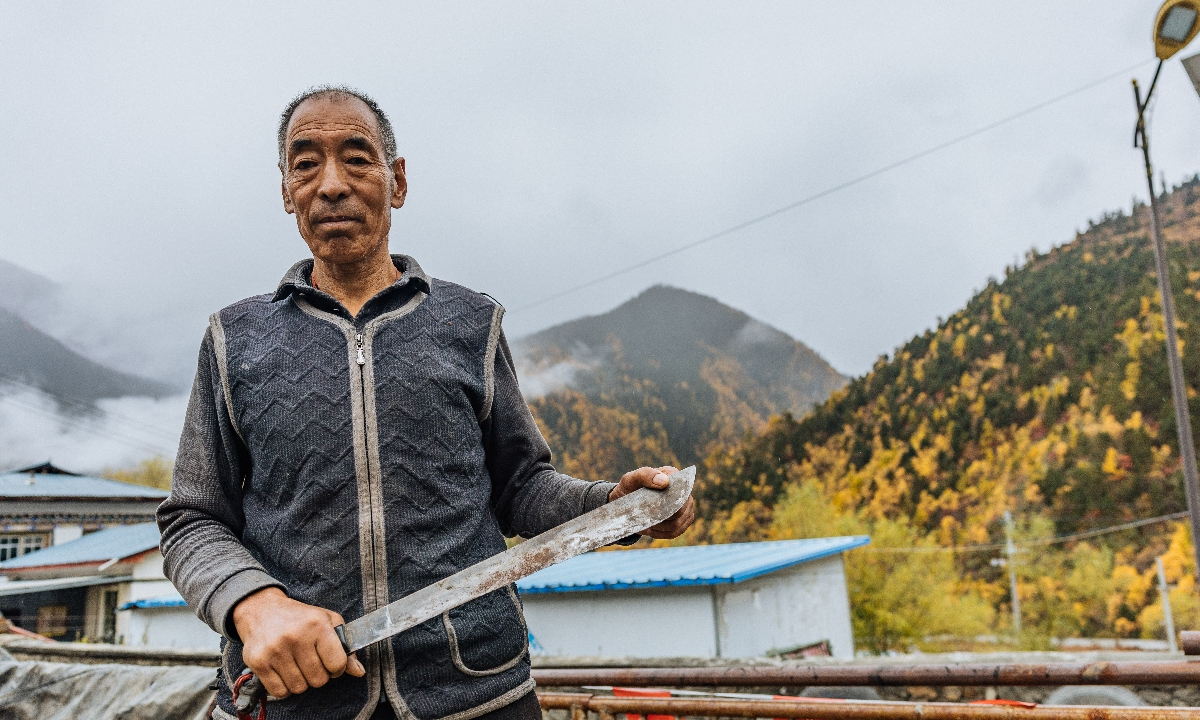
Sonam holds a souvenir knife gifted by the US for his contribution during the China-US joint expedition to search for World War II plane wrecks while standing in his home in Barang village, Nyingchi, Southwest China's Xizang Autonomous Region, in November 2025. Photo: Li Hao/GT
During the joint search from late August to September 2002, Sonam, as a local participant, remained at the site throughout. As he remembered, he was joined by a public security officer from Lhasa, a mountaineer, and a doctor from the Chinese side."There was no road to Langgong back then," Sonam told the Global Times. "Just dirt paths. On the way, we had to cross two wooden bridges. One had been washed away by floods, so we tied ropes across and crawled over where the bridge used to be. It took us three days to reach the crash site."
Sonam said that when they first arrived, the aircraft was mostly intact, with its parts largely preserved. Some human remains were also found at the site. In one case, it reportedly took nearly a week to locate a single tooth among the remains.
There were four crew members on board, and their names and life stories were introduced during the operation. Sonam does not remember all the details, but he remembered that the youngest was probably only around 20 years old.
According to an October 2002 report by Xinhua, the remains of WWII US airmen were discovered in Langgong village, Mainling County, in Southwest China's Xizang Autonomous Region. A total of 112 fragments of remains were found, all believed to be from Hump Route airmen.
On October 27 that year, a formal handover ceremony for the remains was held in Lhasa between Chinese and US representatives.
According to the US-based Flight Safety Foundation's Aviation Safety Network, the aircraft was likely a Curtiss Commando, registration number 41-24688, which went missing on March 27, 1944, during a flight from Wujiaba Airport in Kunming, Southwest China's Yunnan Province to Sookerating Air Base in India.
At the end of the mission, both sides took a commemorative photo. "The Americans were very grateful. I held the Chinese national flag, and they raised the US flag below it - arranged vertically in symmetry - for the photo," Sonam told the Global Times.
"They even invited me to visit the US, but my children were young and my wife didn't support the idea, so I didn't go," he added.
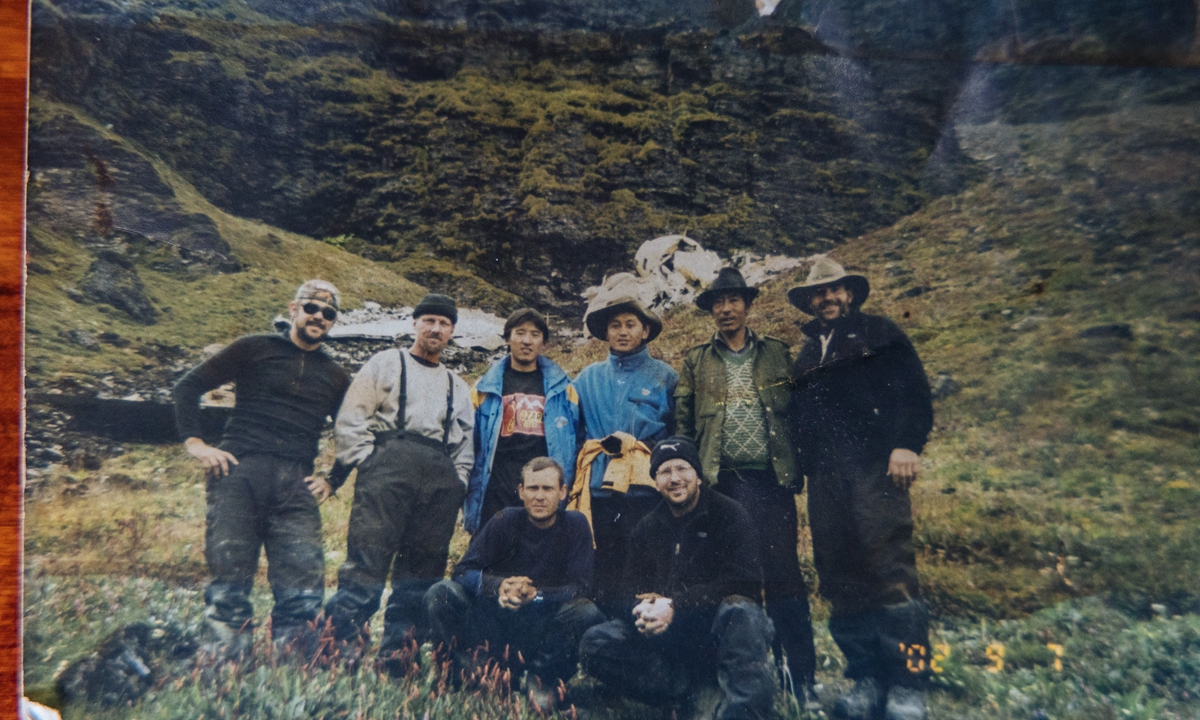
Sonam (second from the right, back row) and members of the China-US joint expedition team pose in a mountainous area with the wreckage of a US transport aircraft from World War II in the background, in Langgong village, Nyingchi, Southwest China's Xizang Autonomous Region, in September 2002. Photo: Courtesy of Sonam
After the operation, Sonam returned to his life as a herdsman. But he carefully kept some of the photos. In one of them, a younger Sonam stands with Chinese and foreign experts in two rows, behind them the wreckage of the crashed plane, now just twisted metal. Snowcapped peaks stretch out in the background.
Retelling the story
Ma Chuanqiu first learned about the expedition years after the joint search mission, during his tenure as a civil servant stationed in Langgong village.
A native of East China's Shandong Province and a retired veteran, Ma had been working in Nyingchi for over a decade. Out of personal interest, he began researching the incident online and found that information on the Hump Route crashes in Xizang was scattered and unorganized, mostly buried in early reports. He realized this was a story not yet fully told.
Why continue pursuing it? Ma's answer was simple: He had always been interested in wartime history, especially stories of the Flying Tigers he had learned about through films and TV shows as a child. To him, history wasn't just grand narratives - it was about real people and real sacrifices.
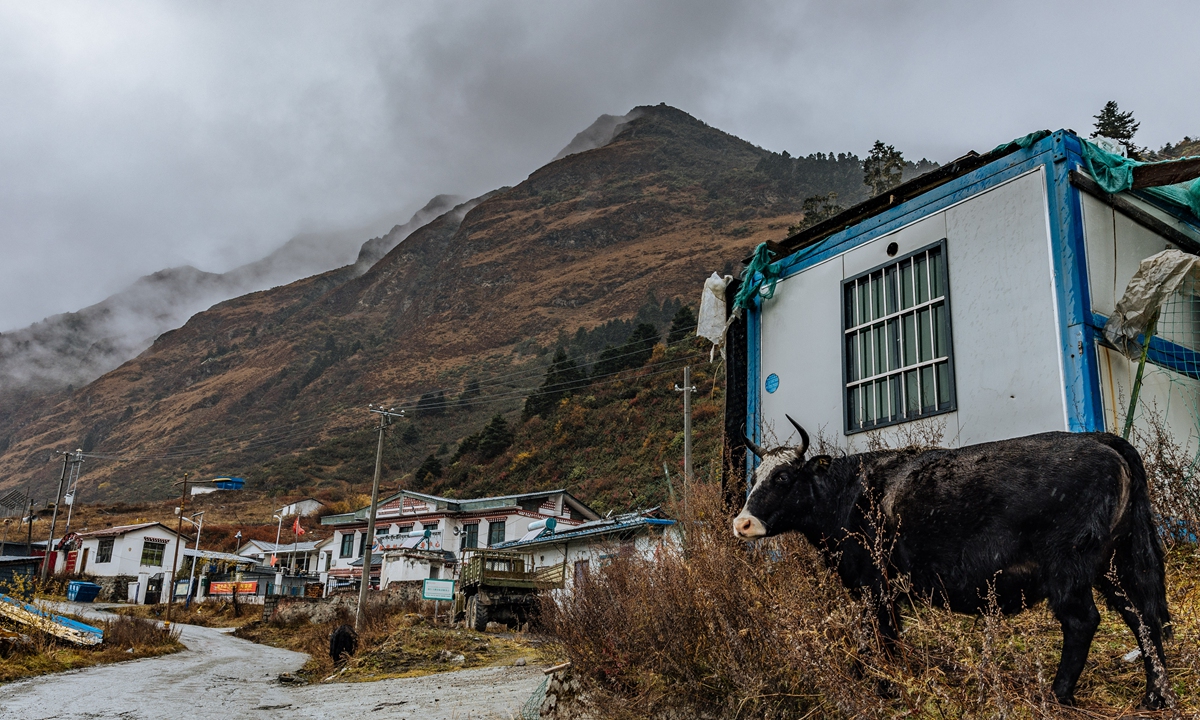
The crashed World War II American transport plane is located in the mountains behind Langgong Village, Nyingchi, Southwest China's Xizang Autonomous Region. Photo: Li Hao/GT
He and Wang Xiaoguang, then deputy village leader in nearby Barang village, once attempted to reach the crash site. But lacking a local guide and facing harsh physical challenges at high altitudes, they failed to find the precise location, only hiking in the general direction for several hours before turning back.Driven by a shared sense of duty, Ma and Wang picked up fragments of the story from local residents, gathered information and submitted proposals to authorities, calling for more historical research on the Hump Route in Nyingchi and even suggesting innovative ideas such as establishing a themed memorial museum - potentially the first of its kind in the region.
"That was during WWII, when China was still very weak," Ma told the Global Times. "But ordinary people and those involved all made real efforts and sacrifices. These stories deserve to be remembered."
Along the Hump
The discovery of WWII US airmen's remains in Xizang is not unique.
As Time magazine once described, "On clear days, we could navigate by the glint of sun on the wreckage of our comrades' planes. We gave this valley, strewn with the remnants of our fellow pilots' aircraft, a name as cold and metallic as the scene itself - 'The Aluminum Trail.'"
According to a 2006 report by Yangcheng Evening News, in September 1993, residents of Yigong township in Bomi County, Xizang, discovered the wreckage and remains of a WWII US C-46 transport aircraft near Ruoguo Glacier. A China-US joint investigation followed, and by 1994, the identities of five crew members were confirmed. Their remains were returned to the US and buried at Arlington National Cemetery.
During the 2002 Langgong operation, another China-US team also conducted investigations at a separate Hump Route crash site more than 5,000 meters above sea level in Bomi, Nyingchi.
According to Xinhua, in 1999, two hunters from Damnyain township, Mainling County, found aircraft wreckage while hunting. In August 2002, a US team came to search for the lost airmen's remains, assisted by Chinese personnel. After a month-long operation, part of the remains were found. The report noted that deep bonds of friendship formed between Chinese and US investigators during their work in extreme conditions.
Back in Langgong, November snowfall had begun in the high-altitude region. The weather could change suddenly - one snowstorm or thick fog could halt all travel. Even Sonam, who knew the mountains well, rarely returned to the crash site in this season.
Langgong is just one of many coordinates along the Hump Route, but it offers a window into the route's immense risks, sacrifices, and cooperation. The aircraft and crew buried in these mountains were not forgotten. Through painstaking searches, they were remembered again - a reminder of why the war was fought, and the price that was paid.