2025 Yearender: From labs to homes: China’s homegrown innovation injects new impetus into high-quality development
Homegrown innovation injects new impetus into high-quality development
By and Zhang Weilan Published: Dec 30, 2025 10:24 PM

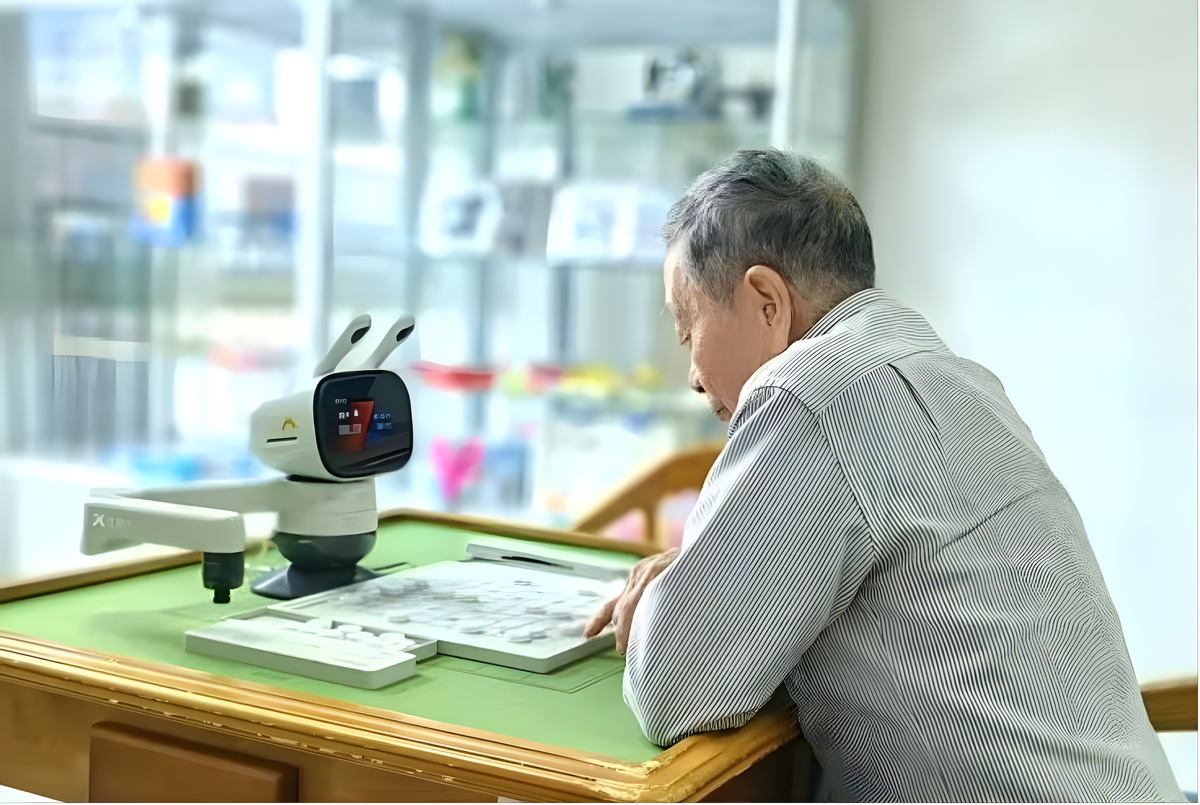
A senior resident plays chess with a robot at the Shenzhen Nursing Home in Shenzhen, South China's Guangdong Province, on January 13, 2025. Photo: Courtesy of Shenzhen Nursing Home
Editor's Note:
As 2025 draws to a close, the Global Times is releasing a series of in-depth reports focusing on China's economic governance. Through concrete case studies and data analysis, the series explores the broader macroeconomic trends reflected in micro-level narratives, showcasing China's new achievements and insights in 2025 under the new development philosophy featuring innovation, coordination, green development, openness and shared benefits. The series reviews key hot-button issues of the year while reflecting on long-term strategic thinking: How China's governance offers the world the solutions and an anchor of stability. This is the final installment of the series.
At dawn in the Shenzhen Nursing Home in Shenzhen, South China's Guangdong Province, several two-wheeled patrol robots glide silently through the corridors. Guided by built-in sensors, they navigate corners with ease and alert staff to any issues.
In her room, an 80-something elderly surnamed Liu starts her day with intense Chinese chess matches against the clever robot "Yuanluobo." Nearby, a folding robot precisely sorts and stacks laundry with gentle arms. Before lunch, she joins the lively "Xialan" for Baduanjin stretches, dances, and interactive games, giggling like exercising with a cheerful friend.
In the afternoon, "Xiaoyong" uses facial recognition to deliver personalized medications with a friendly chime. After napping, Liu enjoys a soothing scalp massage from a hair-washing robot. And as night falls, an AI-powered transfer-assist robot chats gently with her, monitors vital signs and movements, and can smoothly reposition her if needed, ensuring a peaceful sleep.
While some of the robots' applications are still undergoing testing, it is already clear that these scenes - once confined to the sci-fi films - represent yet another major milestone in Chinese innovation, as successive key technological breakthroughs rapidly translate into real-world applications.
The same level of dexterity was showcased throughout 2025, from media reports of Chinese tech's "Sputnik moment" triggered by Deepseek's groundbreaking debut in the beginning of the year that rocked Silicon Valley to the significant strides achieved in the cutting-edge quantum information and technology field. This unprecedented rise underscored China's ascent into the global first-tier across multiple frontier tech fields. It also painted a vivid picture of how the world's second-largest economy is boosting technological innovation and steadfastly advancing the goal of building itself into a sci-tech powerhouse, with its unique whole-nation system advantage serving as the core engine, industry insiders said.
Innovative applications
"We welcome all tech products and are actively embracing the AI-driven wave so as to align our work with the demands of future technological development," Wang Yuanyuan, vice president of Shenzhen Nursing Home, told the Global Times on Tuesday.
According to Wang, these "cyberpunk silver-age companions" have delivered multifaceted improvements to elderly care services. Some have significantly improved management efficiency and reduced operational risks, while others have taken on security duties, significantly lightening the burden on caregivers. Most importantly, they provide something beyond quantification: genuine emotional companionship and a sense of dignity for the elderly.
Wang said the nursing home has partnered with over 100 tech companies since opening in 2019, introducing a wide variety of robotic devices. The trajectory comes as Chinese robotics companies are embarking on a rapid phase of growth, urgently need high-quality geriatric data and in-depth training in real-world scenarios.
"We have also recently expanded and deepened our cooperation with organizations from the Greater Bay Area. In our future plan, we look to integrate AI large language models more deeply into the use of intelligent robots," Wang said, adding that it may take three to seven days to train a robot to perform basic tasks like picking and dispensing medications, and about three months for more complex movements.
Industry insiders told the Global Times that a defining feature of China's robotics development this year has been the rapid mass production of homegrown robots. Riding this momentum, these products are penetrating an ever-wider range of real-world applications through a series of breakthrough advancements.
A report issued by Morgan Stanley suggested that "China is dominating the field of AI-enabled robotics, humanoids or otherwise, and the gap with the US is widening." The report predicted that China is likely to have the highest number of humanoid robots in use by 2050, at 302.3 million, followed by the US at 77.7 million.
As exemplified by the robotics industry, China's technology innovation in 2025 has been marked by a series of compelling "Sputnik moments," said Tian Feng, president of the Fast Think Institute and former dean of SenseTime's Intelligence Industry Research Institute. These milestones, also reflected in leapfrog progress in large-scale AI models, are breaking technological monopolies held by overseas companies and substantially lowering barriers to entry across the industry, Tian told the Global Times.
China's Foreign Ministry spokesperson Lin Jian said at a press briefing in December that in 2025, "Chinese innovation" has become a global buzzword. He noted that China has entered the world's top 10 in innovation rankings for the first time and has led globally in top innovation clusters for three consecutive years, with breakthroughs ranging from large AI models to the deep integration of AI and robotics.
Lin added that innovation has helped keep China's economy on a steady growth path while supporting global recovery and improving people's livelihoods worldwide.
Institutional advantage
The significant progress achieved by the robotics industry is the result of multiple factors working in concert, including accumulated technological innovation, market demand supported by policy incentives, and collaborative efforts across the industrial chain alongside ecosystem development, Shenzhen-based UBTech Robotics told the Global Times.
"For example, accumulated advances and innovations in related fields such as AI and robotics have provided a solid foundation for the development of humanoid robots. As manufacturing undergoes transformation and upgrading, and as demand for intelligent solutions continues to grow, the application of humanoid robots in smart manufacturing has expanded rapidly," the company noted.
China has recently unveiled a pivotal document outlining priorities for its 15th Five-Year Plan (2026-30), which emphasizes "achieving greater self-reliance and strength in science and technology" and "steering the development of new quality productive forces" as key objectives for the coming five years, according to the Xinhua News Agency.
The annual Central Economic Work Conference, which set priorities for economic policies in 2026, also stressed that it will be essential to enhance innovation-driven development to accelerate the cultivation of new growth drivers. Efforts will be made to advance the AI Plus Initiative, improve AI governance and foster innovation in science and technology finance, according to the meeting.
Meanwhile, a series of more detailed and targeted plans have already been unveiled, fully leveraging the country's institutional advantages.
With regard to the development of embodied intelligence, recommendations for the 15th Five-Year Plan (2026-30) noted that China needs to explore diverse technology roadmaps, typical application scenarios, feasible business models, and market regulation rules, and work to foster new drivers of economic growth, such as embodied AI, among other industries.
Across China, local governments have been accelerating the deployment of embodied intelligence. For example, Beijing plans to promote the large-scale rollout of tens of thousands of embodied robots, aiming to foster an industrial cluster valued at over a hundred-billion-yuan. Shenzhen is also expediting core breakthroughs in embodied intelligence and related fields, expanding the development of new artificial intelligence terminal products, and promoting the rapid upgrading of industries toward higher-end, innovative, and optimized directions, according to a report by chinanews.com.
"This whole-nation innovation system plays a decisive role in driving growth by channeling and concentrating resources on making true original innovation and homegrown applications. It helps establish mechanisms that coordinate industrial collaboration and accelerating technological breakthroughs and real-world deployment," Liu Gang, chief economist of the Chinese Institute of New Generation Artificial Intelligence Development Strategies, told the Global Times.
According to analysts, the top-down efforts will effectively strengthen the foundational pillars of China's modern industrial system, thereby injecting new impetus into the cultivation of new quality productive forces and the country's high-quality economic development.
Meanwhile, growth from new quality productive forces has provided Chinese enterprises with greater development opportunities, elevated their position and influence in the global industrial chain, and driven them toward the center of the world stage, said UBTech Robotics.
Tian said that innovation will continue to play a pivotal role in China's growth in 2026, which marks the opening year of China's 15th Five-Year Plan (2026-30). And the explosive development of homegrown innovation will provide strong technological support for the path toward Chinese modernization.
"We could see more 'Deepseek moments' for Chinese industries involving new quality productive forces in 2026 - not only in AI LLM but also across other high-tech industries such as semiconductor and intelligent robotics as China seeks greater self-reliance on core technology," Tian noted.
RELATED ARTICLES