ARTS / CULTURE & LEISURE
Cast shares stories behind shoot on the Roof of the World
‘Puruo Gangri’ captivates audiences nationwide
Promotional material for the film Puruo Gangri Photo: Courtesy of People Cinemas
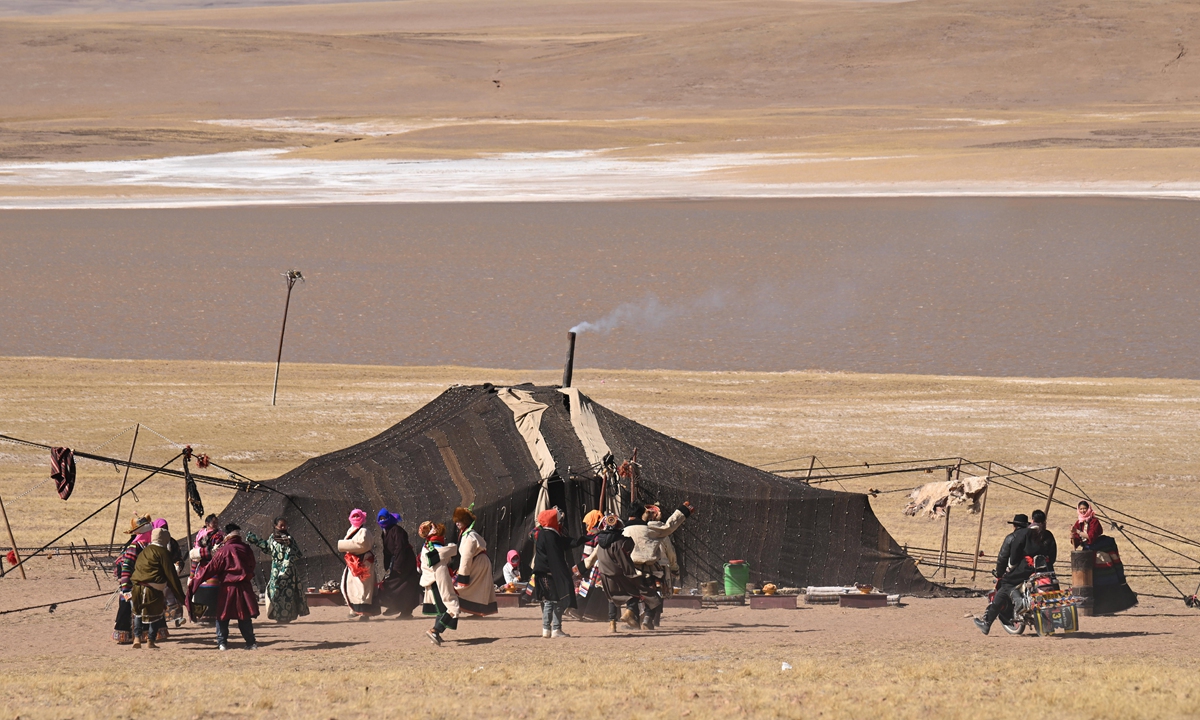
Nestled within the city of Nagchu, Xizang Autonomous Region, Shuanghu stands as China's highest-altitude county, with an average elevation exceeding 5,000 meters. With oxygen level plummeting to a just 40 percent of plain areas, winters dragging on for 10 months, gale-force winds howling across the land for over 200 days a year, and temperatures plunging to -40 C, this place has earned the grim moniker of "testing ground for human physiological limits."
In 2025, a determined group of filmmakers embedded themselves in this unforgiving terrain for 62 grueling days, pushing their physical limits to the brink to complete a filming endeavor described as "borderline insane."
Now, their film, Puruo Gangri, is captivating audiences nationwide. In a recent exclusive with the Global Times, the creators of this film recounted their audacious expansion of cinematic expression.
The film tells the story of Tong Xiaofan, a college graduate who began working in Xizang in 2010. Upon arriving in Shuanghu, Tong underwent remarkable transformation from a fresh graduate into a resilient grassroots official. She worked alongside with local communities to establish cooperatives, battle snowstorms and protect their homeland. Through these shared trials and tribulations, she forged deep, enduring bonds with local officials and residents - ultimately helping them achieve a better life.
Professor Zhang Yiwu from the Peking University commented that the film's touching plot, magnificent natural landscapes and vibrant characters have given it a strong emotional appeal, allowing audiences to appreciate the tremendous progress that Xizang has made in the new era.
To authentically capture the essence of the unique film, its creators chose a path that was both arduous and honest. They told the Global Times that the entire cast shared their experiences in the filming.
When asked about shooting the movie in Shuanghu, many cast members still carry vividly, unforgettable memories.
A member of the cinematography team shared that to capture the first morning light outlining the seracs, the crew jogged in place bundled in heavy gear in temperatures well below -20 C. The actors' reactions in such extreme conditions also became the most precious and irreplaceable part of their performances.
Leading actress Tang Shiyi admitted that altitude sickness and bitter cold posed tremendous challenges, she was so awestruck upon facing the vast Puruo Gangri glacier that she nearly forgot to breathe.
Recalling a scene that requires him to plunge into an icy river, lead actor Awang Renchen said, "The moment I jumped, my mind went blank. That wasn't acting - it was my body battling the freezing water. But that instinct made me completely understand why my character would do this."
From behind the monitor, director Zhao Hantang witnessed reactions that transcended technique - the most primal human responses to extreme cold: Lips instantly turning pale and purple from lost blood flow, muscles stiffening uncontrollably. This seemingly "self-imposed hardship" in filming answers the core driving force behind the movie - Only through genuine experience can genuine emotion be conveyed.
"The film's perspective 'lends the story a grounded warmth,'" said renowned director Chen Guoxing, known for the film Kong Fansen. He noted that this warmth stems from a respect for authentic complexity, rather than a simplified illustration of thematic concepts. Professor Chen Gang from Beijing Normal University noted that the film touches upon a more universal core: "At life's crossroads, how does one make a choice true to their heart?"
"The Puruo Gangri glacier is not merely a breathtakingly beautiful distant land, but the spiritual homeland of their hearts," director Zhao said.
Zhao revealed that, as a tribute film marking the 60th founding anniversary of Xizang Autonomous Region, he hopes the authentic stories originating from this extreme high-altitude area will inspire more people to reflect upon "why we persevere," reminding them of their original aspirations and drawing strength from them.
The immense "hardships" and moving "inspirational moments" depicted in the film are firmly rooted in reality. Around 95 percent of the characters in the movie are based on real individuals, and the stories are entirely drawn from the actual experiences of grassroots officials and residents.
Co-director Cai Yu admitted in an interview that what moved him most during the four years of research and production was precisely this spirit of "humans persevering against the odds, striving and thriving in extreme cold." The greatness of the film's ending, which depicts "leaving the uninhabited area," lies in how, after a tug-of-war between resistance and reconciliation, it ultimately achieves "a reconciliation with the uninhabited zone."
"This reconciliation is one between humans and nature, between tradition and modernity, and between individual destiny and the powerful currents of the era," Cai noted.
RELATED ARTICLES