ARTS / CULTURE & LEISURE
New discoveries confirm prehistoric human activity during early Yangshao period
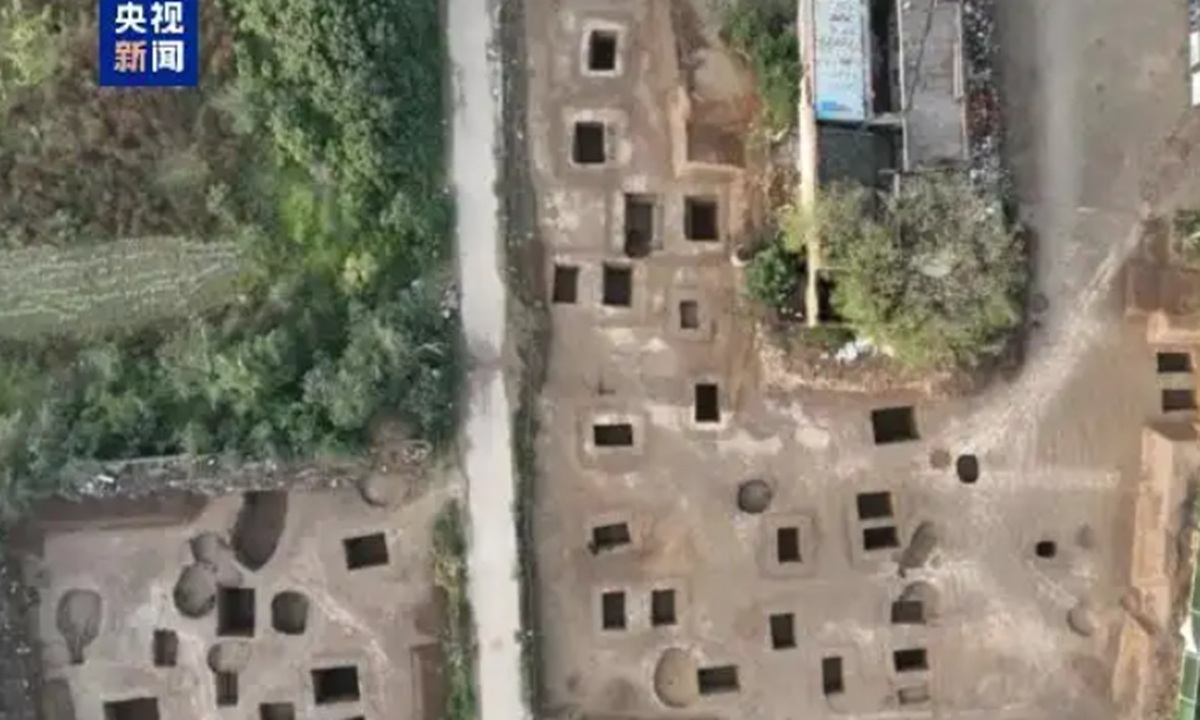
Photo: CCTV
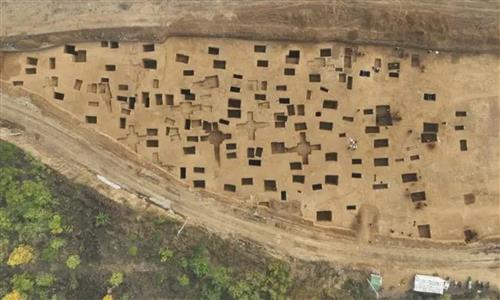
Recent archaeological excavations at the Qishe site in Yongji, North China's Shanxi Province have uncovered remains dating to the middle and late Yangshao culture, the early Shang Dynasty (c.1600BC-1046BC), and the Eastern Zhou Dynasty (770BC-256BC), further expanding the regional scope of prehistoric human activity during the period, the Shanxi Provincial Institute of Archaeology told the Global Times on Tuesday.In recent years, multiple archaeological sites from these same periods have been discovered in Yongji, primarily concentrated west of Wuxing Lake and along both banks of the Suhe River. Sites such as Xiaochaoyang and Xiaozhang form a continuous cultural belt, indicating that prehistoric human activity in the area can be traced back to the early Yangshao period.
Remains from this period are particularly abundant, with relatively rich cultural deposits. These findings suggest that the area may have been a densely populated zone during the pre-Qin period in southwestern Shanxi. The latest excavation provided new materials for in-depth research and further highlights the region's archaeological significance, according to the institute.
From July to December, archaeologists from the institute conducted systematic excavations of cultural remains within a total area of 2,600 square meters at the Qishe site, revealing a variety of remains.
Yangshao cultural remains included 19 ash pits, mostly oval or near-circular. The pits featured straight or curved walls, with flat, shallow rounded or gently sloping bottoms. Artifacts unearthed here were predominantly pottery items, along with a small number of bone and stone tools, archaeologists said.
The pottery assemblage was dominated by red wares, primarily fine clay and fine sand-tempered vessels, with smaller quantities of gray and painted pottery vessels. Vessel forms and decorative techniques revealed that the handicraft was well developed at the time, while bone and stone artifacts were also recovered. Typological characteristics indicate that most of the remains date to the middle phase of the Yangshao culture.
Early Shang Dynasty remains consisted of eight ash pits, distributed mainly in the eastern part of the excavation area. The pits were mostly oval or near-circular, with bag-shaped, straight, or curved walls and predominantly flat bottoms. Artifacts included pottery and stone tools.
Pottery from this phase was largely sand-tempered gray ware, followed by fine clay gray ware, with a small number of sand-tempered red pottery pieces. Decorative patterns were dominated by corded designs, with occasional spiral and applied motifs. Stone tools included perforated stone knives and stone sickles. These remains date to the later phase of the lower Erligang culture.
"The pottery of the Erligang culture was mainly gray, black and white wares, produced largely through coil-building with some wheel-made traces, and decorated with basket, cord, and checker patterns, often featuring fine painted pottery," Liu Zheng, a member of the Chinese Society of Cultural Relics, told the Global Times.
"By combining the characteristics of the newly unearthed artifacts with previous studies of nearby sites, it is relatively straightforward to identify Yangshao period remains," Liu said.
Eastern Zhou remains included 35 tombs, located in the central and eastern parts of the excavation area. None of the tombs were looted, though some were partially disturbed by modern pits. These tombs did not cut into one another and were often found in pairs. All were small- to medium-sized vertical shaft earthen pit tombs with funnel-shaped cross-sections, smooth walls, and no secondary ledges.
Grave goods showed clear variation. Some burials contained pottery assemblages dominated by ritual and daily-use vessels, while others yielded only small personal or functional items, and a number had no burial goods at all. The associated artifacts included bronze, bone and stone objects such as belt hooks, hairpins, rings and arrowheads. Typological analyses indicate that the cemetery dates back to the late Spring and Autumn period to the mid-Warring States period.
RELATED ARTICLES