IN-DEPTH / IN-DEPTH
British vlogger amazed by China’s wind power ubiquity, hails Chinese people’s willingness to embrace changes for greener future
‘Seeing them in person has been crazy’
By Published: Dec 30, 2025 11:14 PM

Editor's Note:
2025 marks the final year of China's 14th Five-Year Plan (2021-2025) and the blueprint for the 15th (2026-2030) is already unfolding. In the Recommendations of the Central Committee of the Communist Party of China (CPC) for Formulating the 15th Five-Year Plan for National Economic and Social Development made public in October, the country has outlined major objectives for high-quality development over the next five years, including significant achievements in high-quality development, substantial improvements in scientific and technological self-reliance and strength, fresh breakthroughs in further deepening comprehensive reform, notable cultural and ethical progress across society, further improvements in quality of life, major new strides in advancing the Beautiful China Initiative, and further advances the strengthening of the national security shield. This blueprint not only guides China's own modernization, but also injects tangible certainty into a turbulent world.
Amid the surging "China Travel" boom, more international travelers are visiting China and witnessing real, tangible changes. These firsthand experiences and moments of awe have become, in their eyes, "the future in China's hands." The Global Times is launching a year-end series titled "The world can trust in China," presenting stories of "Chinese modernization" through the perspectives of foreign vloggers and ordinary Chinese people, to show how China is fulfilling its promises for the future, step by step. The fourth installment focuses on China's push to turn climate commitments into concrete action through its renewable energy drive.
"Can you believe it?" A few months ago, when British vlogger Tim stopped at a highway service area in Northwest China's Gansu Province, he was stunned to see several long-haul trucks carrying enormous wind turbine blades.
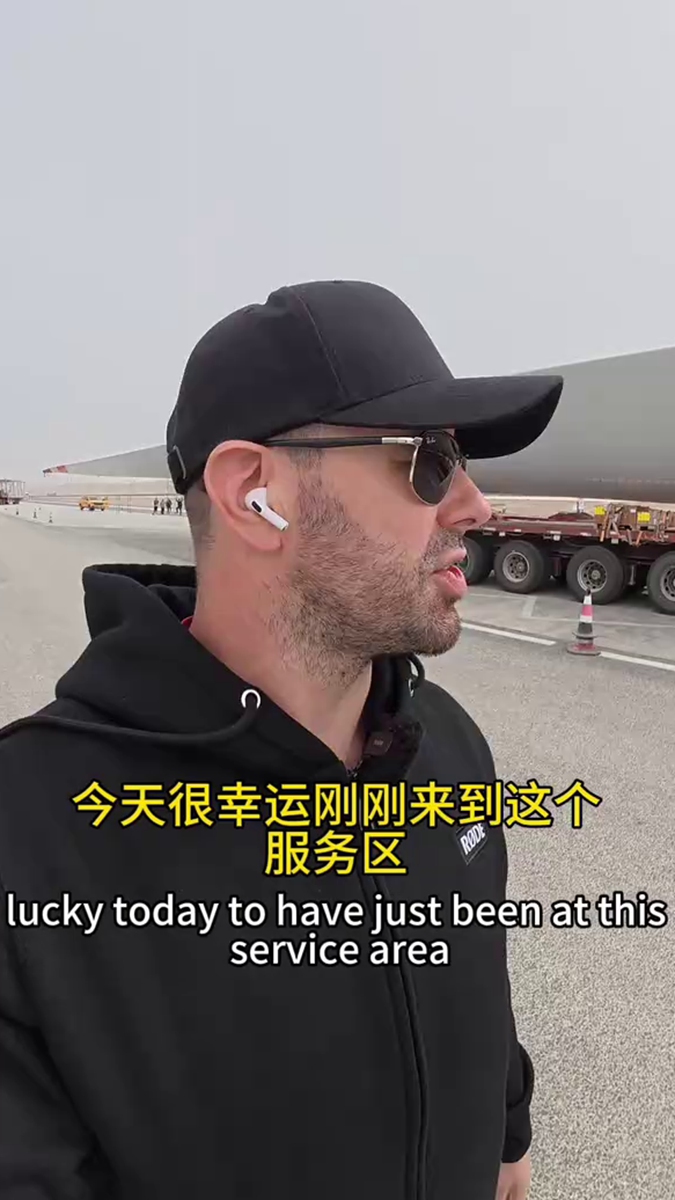
"Seeing them in person has just been crazy," he said in a video posted on social media platforms including BiliBili. Standing beside a blade to show the scale, Tim, who is six feet two inches tall, appeared tiny next to the structure. "I guess they are all gonna be put onto one final constructed wind turbine," he added, noting three trucks parked nearby.
What struck him most, however, was the difference in public perception. "People in my country, the UK… Some people like to say, these [wind turbines] spoil the landscape," he said. "But in China there are just everywhere and people don't take issues with it. They know they are vital for the future."
As of now, China has maintained its position as the global leader in installed wind power capacity for 15 consecutive years, CCTV News reported in October. From the ocean and the Gobi Desert to vast grasslands and winding mountain ridges, the wind is generating electricity for the nation.
China's green transition has entered a critical phase. The recommendations for formulating the 15th Five-Year Plan (2026-30), adopted at the fourth plenary session of the 20th CPC Central Committee, explicitly list "accelerating the green transition across the board and building a beautiful China" as one of the country's strategic tasks over the next five years, according to the Xinhua News Agency.
Eco-friendly ways of work and life should become the norm in society, the goal of peaking carbon emissions before 2030 should be achieved as scheduled, and a new clean, low-carbon, safe, and efficient energy system should take shape, it reads.
The white paper, "Carbon Peaking and Carbon Neutrality China's Plans and Solutions" released by China's State Council Information Office in November, said China has achieved new energy development on the largest scale and at the fastest speed in the world, with the percentage of non-fossil energy consumption increasing from 16.0 percent in 2020 to 19.8 percent in 2024.
The growth of clean electricity has not only helped China cut energy consumption per unit of GDP by 11.6 percent and reduce carbon dioxide emissions by over 1.1 billion tons, but has also offered the world a practical path toward green and low-carbon development, according to Xinhua.
In the mountains, at sea
After seeing the massive turbine blades on the road, Tim could not help but wonder how they were transported. "It must be a real challenge to drive these around," he said.
His question, in fact, points to one of the most demanding, and least visible, aspects of China's wind power development.
In the many regions of China, building wind farms is far more complex than simply installing turbines on flat terrain. In many regions where wind power is being developed, whether in steep mountains, far-offshore waters, or the harsh climates of the Gobi Desert, construction often involves overcoming unimaginable challenges and risks, reflecting China's determination to push forward its energy transition.
Take the Wushan Dafengkou wind power project in Southwest China's Chongqing Municipality as an example. Located on a mountain ridge about 1,800 meters above sea level, it is one of the largest mountain-based wind power projects in the region by single turbine capacity.
The blades used in the project are up to 93 meters long and weigh more than 26 tons each. Starting from Lianyungang in East China's Jiangsu Province, the components travel over 1,200 kilometers across five provinces before reaching the mountainous terrain of Wushan, the Global Times learned from the China Three Gorges Corporation.
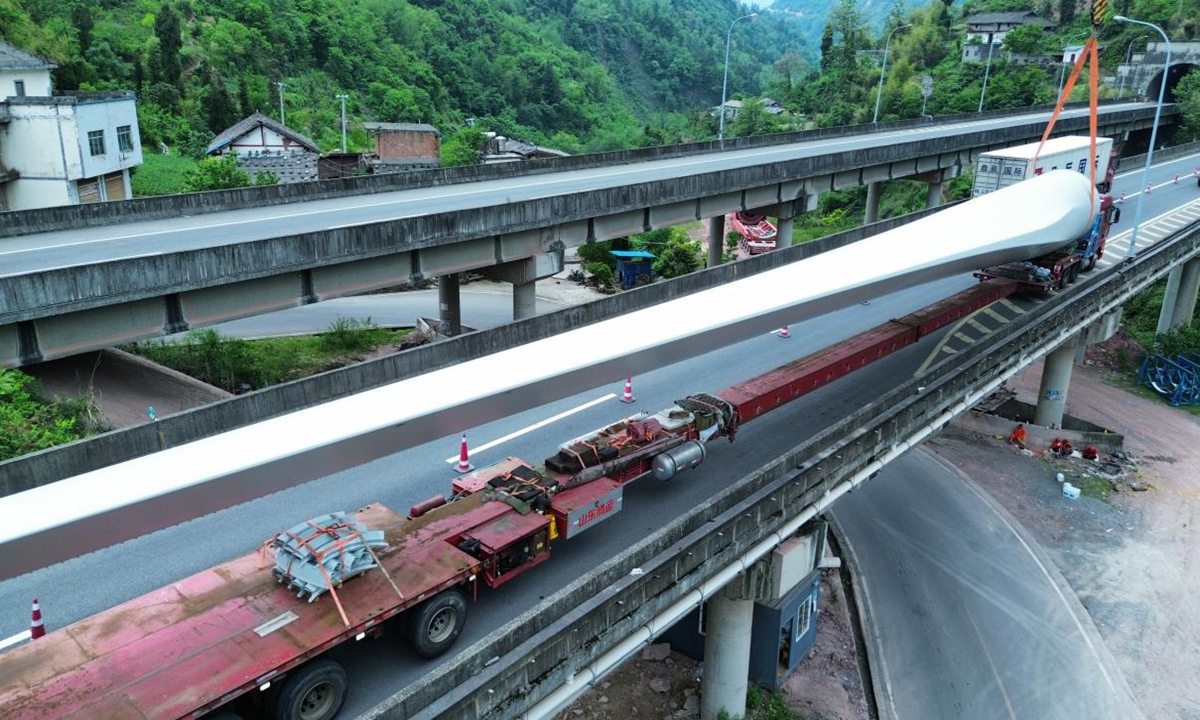
The real challenge lies in the final stretch. From the highway exit to the turbine site, the roughly 50-kilometer transport route spans national highways, township roads, and perilous mountain passes. Some sections are less than 7 meters wide, with continuous sharp turns and steep inclines. To navigate these bottlenecks, the transport team reinforced roadbeds, laid down steel plates, and even used cranes to lift blades over elevated highway bridges and lower them directly onto mountain access roads.
Even after reaching the ridge, the challenges persist. Wushan is known for strong winds and frequent fog, meaning high-altitude hoisting must be completed during brief clear weather windows. At more than 100 meters in the air, the 93-meter-long blade must be slowly maneuvered into position and connected to the hub with millimeter precision - a process local workers liken to "threading a needle in the clouds."
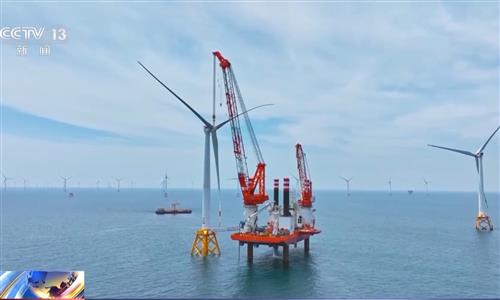
If mountain wind power is about the difficulty of getting massive equipment up, offshore wind power is about sending it farther. Along China's coastline, wind power development is steadily advancing into deeper waters.
According to the People's Daily Overseas Edition, China has ranked first in the world in cumulative offshore wind power installed capacity for four consecutive years (2021-24), and has led the world in newly installed capacity for seven straight years (2018-24). By the end of 2024, the country's total grid-connected offshore wind capacity had reached 41.27 million kilowatts, accounting for 49.6 percent of the global total.
In total, China's installed wind power generation capacity has consistently ranked first in the world for an impressive 15-year streak, according to the latest data released by the China Electricity Council, CCTV News reported in October.
So far, China's newly added grid-connected wind power generation capacity has exceeded 57.84 million kilowatts, and the cumulative wind power grid-connected capacity has reached 580 million kilowatts, accounting for 15.7 percent of the country's installed generation capacity, according to the latest data, the report noted.
In October 2025, more than 1,000 wind energy companies proposed an annual addition of at least 120 million kilowatts during the 15th Five-Year Plan period, including 15 million kilowatts offshore. The declaration sets targets of 1.3 billion kilowatts by 2030 and 5 billion by 2060, according to the Economic Information Daily.
A pivotal phase
From heavy-duty trucks at highway rest stops to turbines on mountain ridges and in deep-sea waters, the growing visibility of China's wind power reflects a clear timeline behind the scenes.
In 2020, China announced that it would strive to reach peak carbon dioxide emissions before 2030 and carbon neutrality before 2060.
Under such guidance, China is continuing to push the boundaries of renewable energy development, taking on ever higher, harsher and more complex environments to bring green growth to every corner of the country.
In Baxoi county, Southwest China's Xizang Autonomous Region, an ultra-high-altitude wind power project built at elevations exceeding 5,300 meters has not only set a new record for wind power development, but has also tangibly improved local livelihoods, according to a Xinhua report in December 2024.
The wind turbines were specially designed to withstand extreme environments and weather conditions, including extremely low temperatures, strong ultraviolet radiation, and frequent thunderstorms at ultra-high altitudes, explained Losum Tsering, a technical worker at the wind farm.
Losum Tsering, a local resident, expressed his gratitude for the improvements in the power grid in recent years as villagers like him now no longer face extended power blackouts lasting several consecutive days.
China's advances in new energy are also drawing growing attention from audiences around the world.
On YouTube, a short video showing robots cleaning photovoltaic panels in China's desert solar farms has attracted more than 8 million views. Meanwhile, a BBC video released in June on the rapid growth of China's new energy vehicle sector sparked lively discussion in the comments section. One viewer wrote, "Nowadays a $20,000 EV taxi in China is much better equipped than a $50,000 car in the USA." Another commented more bluntly: "Result of spending resources on development rather than wars."
On September 24, 2025, at the United Nations Climate Summit, China clarified its 2035 Nationally Determined Contributions, or NDCs, - thereby injecting fresh momentum and certainty into global climate governance and demonstrating China's stance as a responsible major country that champions integrity.
As part of its new NDCs, China will reduce economy-wide net greenhouse gas emissions from peak levels by 7 percent to 10 percent by 2035, while striving to do better. China also announced the goals to increase the share of non-fossil fuels to over 30 percent of its total energy consumption, and expand its installed wind and solar power capacity to more than six times the 2020 level by 2035 - working hard to elevate this capacity to 3,600 gigawatts.
When viewed through this broader lens, the trucks captured in Tim's short roadside video are not a random sight - they are part of a larger national effort. As Tim observed on camera, the reason people in China are willing to embrace such "massive changes" is simple: "They know they are vital for the future." From mountains to sea, and from blueprint to reality, wind power is becoming a key force in realizing that future.
2025 marks the final year of China's 14th Five-Year Plan (2021-2025) and the blueprint for the 15th (2026-2030) is already unfolding. In the Recommendations of the Central Committee of the Communist Party of China (CPC) for Formulating the 15th Five-Year Plan for National Economic and Social Development made public in October, the country has outlined major objectives for high-quality development over the next five years, including significant achievements in high-quality development, substantial improvements in scientific and technological self-reliance and strength, fresh breakthroughs in further deepening comprehensive reform, notable cultural and ethical progress across society, further improvements in quality of life, major new strides in advancing the Beautiful China Initiative, and further advances the strengthening of the national security shield. This blueprint not only guides China's own modernization, but also injects tangible certainty into a turbulent world.
Amid the surging "China Travel" boom, more international travelers are visiting China and witnessing real, tangible changes. These firsthand experiences and moments of awe have become, in their eyes, "the future in China's hands." The Global Times is launching a year-end series titled "The world can trust in China," presenting stories of "Chinese modernization" through the perspectives of foreign vloggers and ordinary Chinese people, to show how China is fulfilling its promises for the future, step by step. The fourth installment focuses on China's push to turn climate commitments into concrete action through its renewable energy drive.
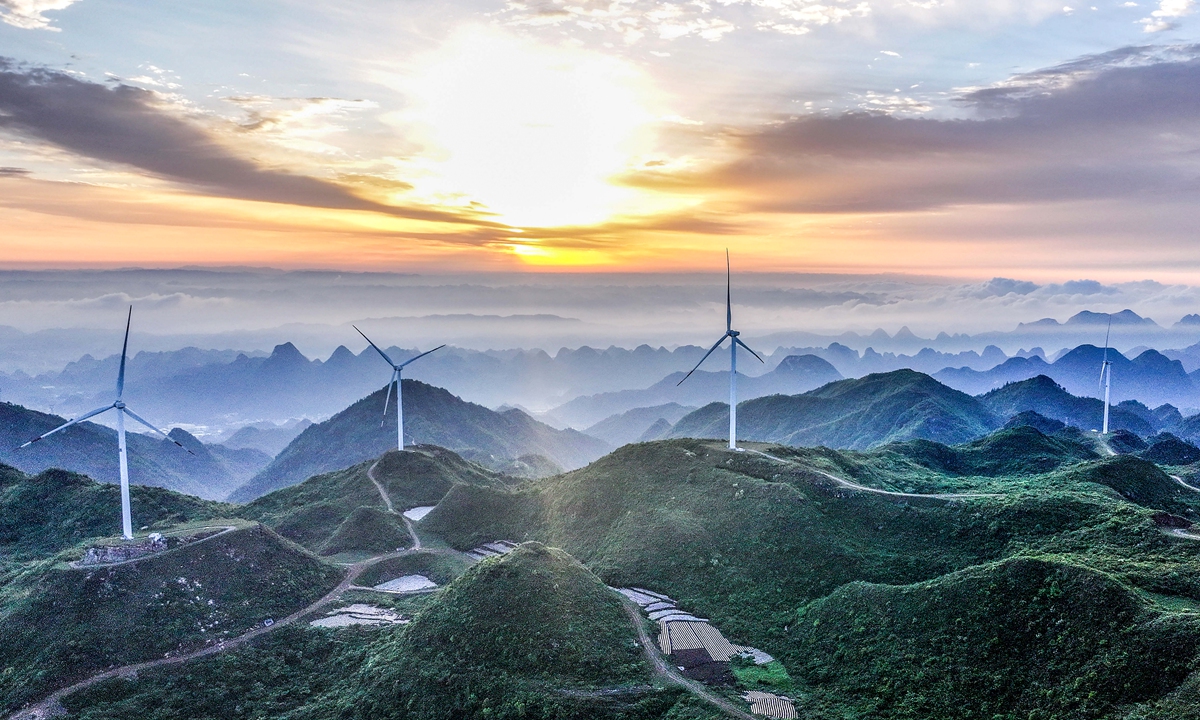
Wind turbines stand tall across the mountainous terrain at a wind farm in Qianxinan, Southwest China's Guizhou Province, as the sun rises on May 11, 2025. Photo: VCG
"Can you believe it?" A few months ago, when British vlogger Tim stopped at a highway service area in Northwest China's Gansu Province, he was stunned to see several long-haul trucks carrying enormous wind turbine blades.
"Seeing them in person has just been crazy," he said in a video posted on social media platforms including BiliBili. Standing beside a blade to show the scale, Tim, who is six feet two inches tall, appeared tiny next to the structure. "I guess they are all gonna be put onto one final constructed wind turbine," he added, noting three trucks parked nearby.
What struck him most, however, was the difference in public perception. "People in my country, the UK… Some people like to say, these [wind turbines] spoil the landscape," he said. "But in China there are just everywhere and people don't take issues with it. They know they are vital for the future."
As of now, China has maintained its position as the global leader in installed wind power capacity for 15 consecutive years, CCTV News reported in October. From the ocean and the Gobi Desert to vast grasslands and winding mountain ridges, the wind is generating electricity for the nation.
China's green transition has entered a critical phase. The recommendations for formulating the 15th Five-Year Plan (2026-30), adopted at the fourth plenary session of the 20th CPC Central Committee, explicitly list "accelerating the green transition across the board and building a beautiful China" as one of the country's strategic tasks over the next five years, according to the Xinhua News Agency.
Eco-friendly ways of work and life should become the norm in society, the goal of peaking carbon emissions before 2030 should be achieved as scheduled, and a new clean, low-carbon, safe, and efficient energy system should take shape, it reads.
The white paper, "Carbon Peaking and Carbon Neutrality China's Plans and Solutions" released by China's State Council Information Office in November, said China has achieved new energy development on the largest scale and at the fastest speed in the world, with the percentage of non-fossil energy consumption increasing from 16.0 percent in 2020 to 19.8 percent in 2024.
The growth of clean electricity has not only helped China cut energy consumption per unit of GDP by 11.6 percent and reduce carbon dioxide emissions by over 1.1 billion tons, but has also offered the world a practical path toward green and low-carbon development, according to Xinhua.
British influencer Tim introduces the massive wind turbine blades he encounters on the expressway in Northwest China's Gansu Province. Photo: Screenshot of the Tim's vlog.
In the mountains, at sea
After seeing the massive turbine blades on the road, Tim could not help but wonder how they were transported. "It must be a real challenge to drive these around," he said.
His question, in fact, points to one of the most demanding, and least visible, aspects of China's wind power development.
In the many regions of China, building wind farms is far more complex than simply installing turbines on flat terrain. In many regions where wind power is being developed, whether in steep mountains, far-offshore waters, or the harsh climates of the Gobi Desert, construction often involves overcoming unimaginable challenges and risks, reflecting China's determination to push forward its energy transition.
Take the Wushan Dafengkou wind power project in Southwest China's Chongqing Municipality as an example. Located on a mountain ridge about 1,800 meters above sea level, it is one of the largest mountain-based wind power projects in the region by single turbine capacity.
The blades used in the project are up to 93 meters long and weigh more than 26 tons each. Starting from Lianyungang in East China's Jiangsu Province, the components travel over 1,200 kilometers across five provinces before reaching the mountainous terrain of Wushan, the Global Times learned from the China Three Gorges Corporation.
The real challenge lies in the final stretch. From the highway exit to the turbine site, the roughly 50-kilometer transport route spans national highways, township roads, and perilous mountain passes. Some sections are less than 7 meters wide, with continuous sharp turns and steep inclines. To navigate these bottlenecks, the transport team reinforced roadbeds, laid down steel plates, and even used cranes to lift blades over elevated highway bridges and lower them directly onto mountain access roads.
Even after reaching the ridge, the challenges persist. Wushan is known for strong winds and frequent fog, meaning high-altitude hoisting must be completed during brief clear weather windows. At more than 100 meters in the air, the 93-meter-long blade must be slowly maneuvered into position and connected to the hub with millimeter precision - a process local workers liken to "threading a needle in the clouds."
If mountain wind power is about the difficulty of getting massive equipment up, offshore wind power is about sending it farther. Along China's coastline, wind power development is steadily advancing into deeper waters.
According to the People's Daily Overseas Edition, China has ranked first in the world in cumulative offshore wind power installed capacity for four consecutive years (2021-24), and has led the world in newly installed capacity for seven straight years (2018-24). By the end of 2024, the country's total grid-connected offshore wind capacity had reached 41.27 million kilowatts, accounting for 49.6 percent of the global total.
In total, China's installed wind power generation capacity has consistently ranked first in the world for an impressive 15-year streak, according to the latest data released by the China Electricity Council, CCTV News reported in October.
So far, China's newly added grid-connected wind power generation capacity has exceeded 57.84 million kilowatts, and the cumulative wind power grid-connected capacity has reached 580 million kilowatts, accounting for 15.7 percent of the country's installed generation capacity, according to the latest data, the report noted.
In October 2025, more than 1,000 wind energy companies proposed an annual addition of at least 120 million kilowatts during the 15th Five-Year Plan period, including 15 million kilowatts offshore. The declaration sets targets of 1.3 billion kilowatts by 2030 and 5 billion by 2060, according to the Economic Information Daily.
Blades for the Wushan Dafengkou wind power project are hoisted and transported from an expressway viaduct. Photo: Courtesy of China Three Gorges Corporation
A pivotal phase
From heavy-duty trucks at highway rest stops to turbines on mountain ridges and in deep-sea waters, the growing visibility of China's wind power reflects a clear timeline behind the scenes.
In 2020, China announced that it would strive to reach peak carbon dioxide emissions before 2030 and carbon neutrality before 2060.
Under such guidance, China is continuing to push the boundaries of renewable energy development, taking on ever higher, harsher and more complex environments to bring green growth to every corner of the country.
In Baxoi county, Southwest China's Xizang Autonomous Region, an ultra-high-altitude wind power project built at elevations exceeding 5,300 meters has not only set a new record for wind power development, but has also tangibly improved local livelihoods, according to a Xinhua report in December 2024.
The wind turbines were specially designed to withstand extreme environments and weather conditions, including extremely low temperatures, strong ultraviolet radiation, and frequent thunderstorms at ultra-high altitudes, explained Losum Tsering, a technical worker at the wind farm.
Losum Tsering, a local resident, expressed his gratitude for the improvements in the power grid in recent years as villagers like him now no longer face extended power blackouts lasting several consecutive days.
China's advances in new energy are also drawing growing attention from audiences around the world.
On YouTube, a short video showing robots cleaning photovoltaic panels in China's desert solar farms has attracted more than 8 million views. Meanwhile, a BBC video released in June on the rapid growth of China's new energy vehicle sector sparked lively discussion in the comments section. One viewer wrote, "Nowadays a $20,000 EV taxi in China is much better equipped than a $50,000 car in the USA." Another commented more bluntly: "Result of spending resources on development rather than wars."
On September 24, 2025, at the United Nations Climate Summit, China clarified its 2035 Nationally Determined Contributions, or NDCs, - thereby injecting fresh momentum and certainty into global climate governance and demonstrating China's stance as a responsible major country that champions integrity.
As part of its new NDCs, China will reduce economy-wide net greenhouse gas emissions from peak levels by 7 percent to 10 percent by 2035, while striving to do better. China also announced the goals to increase the share of non-fossil fuels to over 30 percent of its total energy consumption, and expand its installed wind and solar power capacity to more than six times the 2020 level by 2035 - working hard to elevate this capacity to 3,600 gigawatts.
When viewed through this broader lens, the trucks captured in Tim's short roadside video are not a random sight - they are part of a larger national effort. As Tim observed on camera, the reason people in China are willing to embrace such "massive changes" is simple: "They know they are vital for the future." From mountains to sea, and from blueprint to reality, wind power is becoming a key force in realizing that future.
RELATED ARTICLES