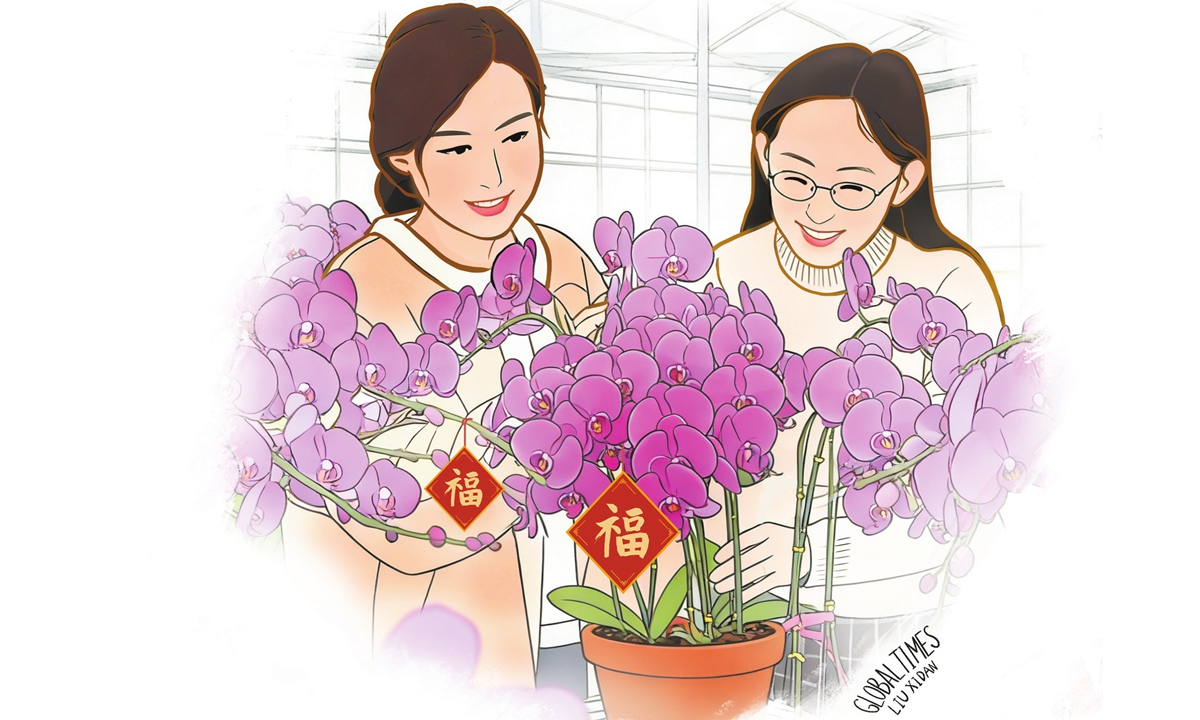
Illustration: Liu Xidan/GT
As the New Year holiday approaches, China's festive flower markets are beginning to show signs of renewed activity. CCTV.com reported on Tuesday that in Zhouning county, East China's Fujian Province, orders for locally grown specialty flowers have risen. A manager at a local flower-growing base was quoted as saying that orders are being placed from across China, as well as from overseas markets including Malaysia, Singapore and Vietnam. The story is small in scale and seasonal, but it offers a revealing glimpse into how parts of China's consumer economy are adjusting as the new year draws nearer.In China, flowers used to decorate homes and public spaces during the Spring Festival are sometimes referred to as nianxiao flowers, or Spring Festival flowers. This year, according to media reports, demand for these festive flowers has begun to rise even ahead of the New Year holiday. The trend can be seen as a form of "ritual-oriented consumption" - purchases driven less by necessity than by a desire to enhance the festive atmosphere and satisfy emotional needs.
China's economy is vast, and headline consumption figures can sometimes obscure the finer details of how spending is evolving. Turning the lens to something as unassuming as a bouquet of festive flowers reveals subtle shifts: consumers are increasingly spending on items that reflect ritual and emotional priorities, bringing into focus trends that aggregate figures tend to overlook.
These micro-level observations point to a more nuanced picture of Chinese consumption than some Western media outlets might suggest. Far from being sluggish, consumer spending continues to demonstrate vitality, increasingly in segmented and adaptive ways.
Within this broader evolution, three trends merit attention. The story of festive flowers helps to illustrate these shifts. First, rising demand is extending beyond first-tier cities into an increasingly diverse set of regions, reflecting the growing prevalence of ritual-oriented consumption. CCTV.com reported on Monday that as the New Year approaches, flower sales in Urumqi, Northwest China's Xinjiang Uygur Autonomous Region, are reaching a seasonal peak.
In the region's largest professional flower market, two categories have emerged as particularly popular this year: nianxiao flowers, carrying the familiar symbols of the Spring Festival, and creatively shaped green plants, both of which have attracted an expanding audience among local consumers.
Second, ritual-oriented consumption, along with broader emotionally driven spending, is increasingly interacting with international markets, creating both export and import opportunities. On the export side, domestic supply is reaching overseas buyers; for instance, flowers from Zhouning county have found markets abroad, illustrating how local production can serve international demand.
On the import side, domestic demand around the New Year and Spring Festival holidays generates opportunities for overseas products. A search on Chinese e-commerce platforms highlights various imported festive flowers; for example, North American holly, prized for its bright red berries, has become popular among consumers during the holiday season.
Third, flowers are highly time-sensitive, and the growth of festive flower markets has benefited from the development of cold-chain logistics, the expansion of e-commerce, and a series of measures to streamline customs procedures. These increasingly sophisticated supply chains have enhanced the accessibility of festive flowers, making them more widely available and popular among consumers during the holiday season.
Beyond festive flowers, similar patterns are emerging across other consumer sectors, from seasonal gifts to home decor and specialty foods. These observations point to the ongoing expansion of emotionally and ritual-driven spending in China, reflecting a market increasingly oriented toward purchases with social or emotional significance.
The upcoming New Year and Spring Festival holidays offer a useful lens through which to view China's economy in 2026. Sales of festive flowers, though relatively limited, provide insight into evolving consumer preferences and behaviors. They reveal not only what people buy, but why, indicating a broader shift toward spending that carries cultural and emotional meaning.
These trends are also interacting with international markets. Export opportunities continue to grow, while rising domestic demand supports a broader range of imported products and specialty offerings. With a population of about 1.4 billion, the scale of domestic demand is substantial and merits attention from both domestic and international producers.
Emotionally driven consumption is expected to continue its expansion in 2026, generating new forms of trade, creating additional opportunities, and reinforcing the increasingly interconnected nature of China's consumer economy.
The author is a reporter with the Global Times. bizopinion@globaltimes.com.cn
RELATED ARTICLES