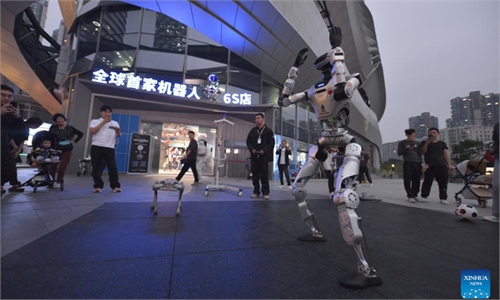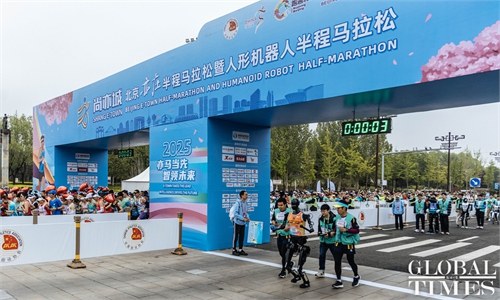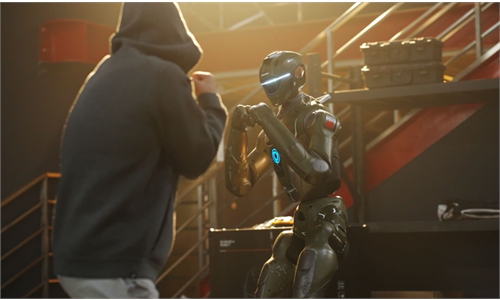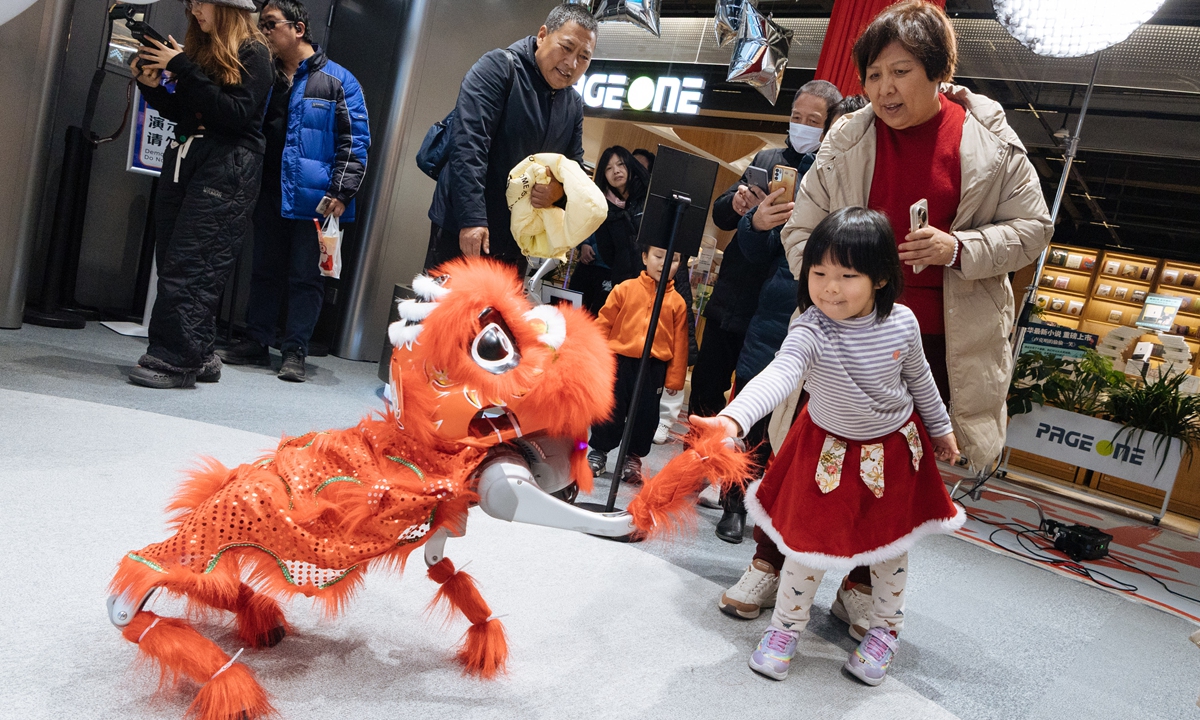
Unitree's first nationwide physical experience store, jointly operated with JD.com, begins trial operations on December 30, 2025 ahead of its official opening on December 31 at JD Mall (Shuangjing) in Beijing. Photo: Li Hao/GT
Unitree's first nationwide physical experience store, jointly operated with JD.com, began trial operations on Tuesday ahead of its official opening on Wednesday at JD Mall (Shuangjing) in Beijing, where Unitree's GO2 robot dog and G1 humanoid robot interacted with visitors, drawing large crowds of onlookers and amateur photographers.
On Tuesday, the store showcased Unitree's GO-series robot dogs, priced at about 10,000 to 20,000 yuan ($1,400 to $2,800), as well as its G1 series humanoid robots, priced at about 80,000 to 100,000 yuan, the Global Times learned.
The store features immersive interactive zones where customers can try the robots and make purchases immediately, employees said. Shoppers can also scan QR codes to place orders via the official mini-program, with options for in-store pickup or JD delivery.
Yao Zaichuan, a sales associate at the store, told reporters that the robot dogs can carry out basic commands through multiple methods, including face-to-face voice interaction, remote control via a handheld controller, and operation through a mobile app.
Yao said that the GO2-series robot dogs on display are more affordable for ordinary consumers than humanoid robots. He added that by installing racks on their backs, the robot dogs can carry loads of about 8 to 10 kilograms.
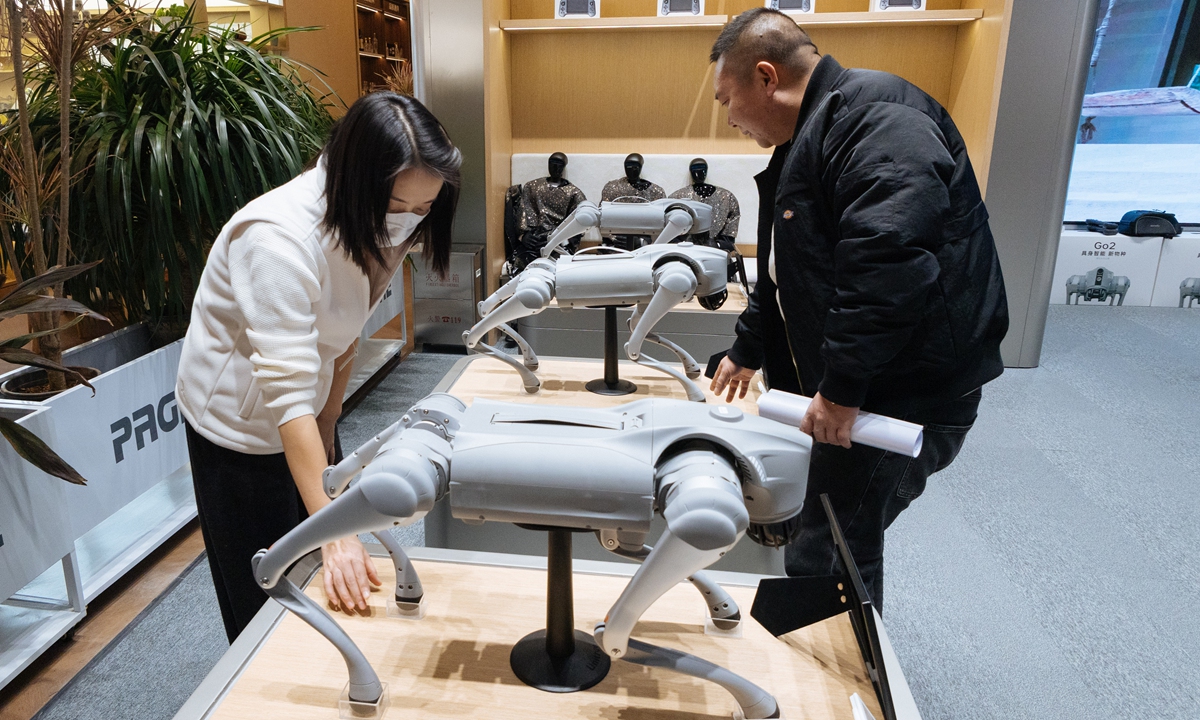
Unitree's first nationwide physical experience store, jointly operated with JD.com, begins trial operations on December 30, 2025 ahead of its official opening on December 31 at JD Mall (Shuangjing) in Beijing. Photo: Li Hao/GT
Among them, the GO2 Pro robot dog is priced at 19,899 yuan, and compared with the base GO2 Air version, it is equipped with a cloud-based large model that enables voice interaction, Yao said.
Store staff told reporters that humanoid robots are currently purchased mainly by research and educational institutions, as well as performance companies, for science education and entertainment. The physical store primarily serves as a showcase to introduce the technology to the public and promote sales through demonstrations, they said.
An elderly Beijing resident surnamed Zhang, who stopped to watch the performance, told the Global Times that rapid technological progress in China has made such developments feel routine, leaving him unsurprised by the opening of a physical robot store.
Asked whether he would consider buying a robot for companionship, Zhang said that he had no such plans for now, but added that robots could be highly valuable if genuinely applied to eldercare and nursing. "If they're used for eldercare, even at a higher price, it would be worth it," he said.
RELATED ARTICLES