GT Voice: Look back at China’s economy in 2025 speaks volumes about its resilience

Lujiazui Photo:VCG
As 2025 draws to a close, it's an opportune time to take a retrospective look at China's economy during a year during which it navigated persistent global uncertainties and domestic challenges to reinforce a sense of stability and predictability, both for itself and for the world at large.The annual Central Economic Work Conference called the year 2025 "a truly extraordinary year," noting that the main targets for economic and social development would be successfully achieved. The term "extraordinary" resonated widely, reflecting the perspectives of many observers toward China's economic performance over the past 12 months.
Indeed, different keywords may emerge to summarize the year, yet together, they converge into a clearer, more complete portrait of an economy that has remained resilient, adaptive, and forward-looking.
To fully understand China's economic trajectory in 2025, one must view it against a volatile global backdrop. The world recovery remained uneven, with several major economies leaning toward inward-looking policies. Lingering trade and investment barriers, compounded by geopolitical tensions, have continued to disrupt global supply chains and energy markets. "Uncertainty" has become the most frequently cited keyword in multinational corporate strategies and financial market sentiment.
It is precisely against this backdrop that China's economy has carved out a distinct path defined by certainty. China has remained committed to high-quality development, transforming pressure into a driving force for deepening reform and opening-up, optimizing the economic structure, and enhancing innovation capacity. This approach reflects strategic patience, institutional confidence, and a resolve to maintain policy consistency over the long term.
The foundations of this certainty are visible in the economy's sustained resilience, despite headwinds such as weaker external demand and persistent trade barriers. With GDP growth of 5.2 percent in the first three quarters, China appears well on course to achieve its annual growth target of about 5 percent. Its GDP is also expected to have hit 140 trillion yuan ($19.87 trillion) this year, further affirming its status as the world's second-largest economy.
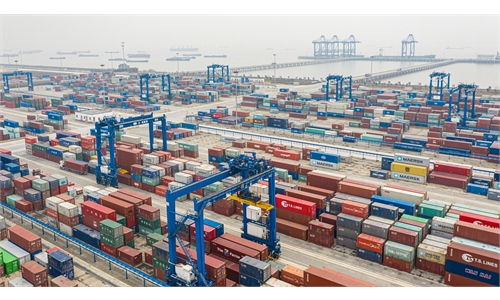
Recent customs data show that China's total goods trade grew 3.6 percent year-on-year in the first 11 months of 2025.
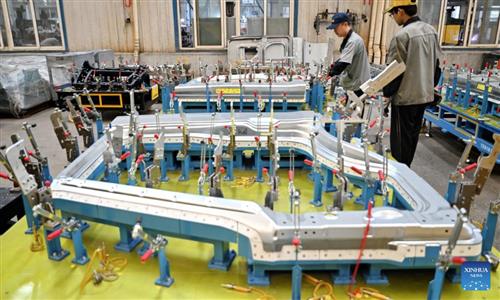
Moreover, the accelerating shift from old to new growth drivers brought China's economic restructuring into focus in 2025. China's tech innovation made headlines throughout the year, with achievements spanning artificial intelligence models, humanoid robots and electric vehicles with longer-range batteries. Their success is not merely a product victory but the result of China's comprehensive industrial system, rapid iterative innovation capability, and vast domestic market.
During the January-November period, the value-added output of the high-tech manufacturing sector rose by 9.2 percent year-on-year, while that of digital products manufacturing went up 9.3 percent. Notably, the production of industrial robots surged 29.2 percent year-on-year, with that of integrated circuits up by 10.6 percent, according to the National Bureau of Statistics.
In 2026, China's economic certainty is poised to be reinforced through continued and institutionalized opening-up. According to recommendations for formulating the 15th Five-Year Plan (2026-30) adopted at the fourth plenary session of the 20th Central Committee of the Communist Party of China in October, China will pursue balanced development of imports and exports.
Concrete steps are being implemented. China will apply provisional import tariff rates lower than the most-favored-nation rates on 935 items starting from January 1, 2026, the Customs Tariff Commission of the State Council announced on Monday. The move aims to enhance synergy between domestic and international markets, and to leverage the resources of both in an improved manner while expanding the supply of high-quality goods. It sends a clear signal to the world of China's unwavering commitment to widening its doors.
Amid rising global trade protectionism, China's concrete action of tariff reductions provides stable market expectations for global businesses, allowing the world to share China's development opportunities. This ongoing advancement of institutional opening-up, resonating with consistent and predictable macro policies, will serve as both the bedrock for China's own stable and long-term growth and a vital source of support for the world economic recovery.
RELATED ARTICLES