Domestic tourism market posts strong start during 2026 New Year holidays as bookings and visitor numbers surge
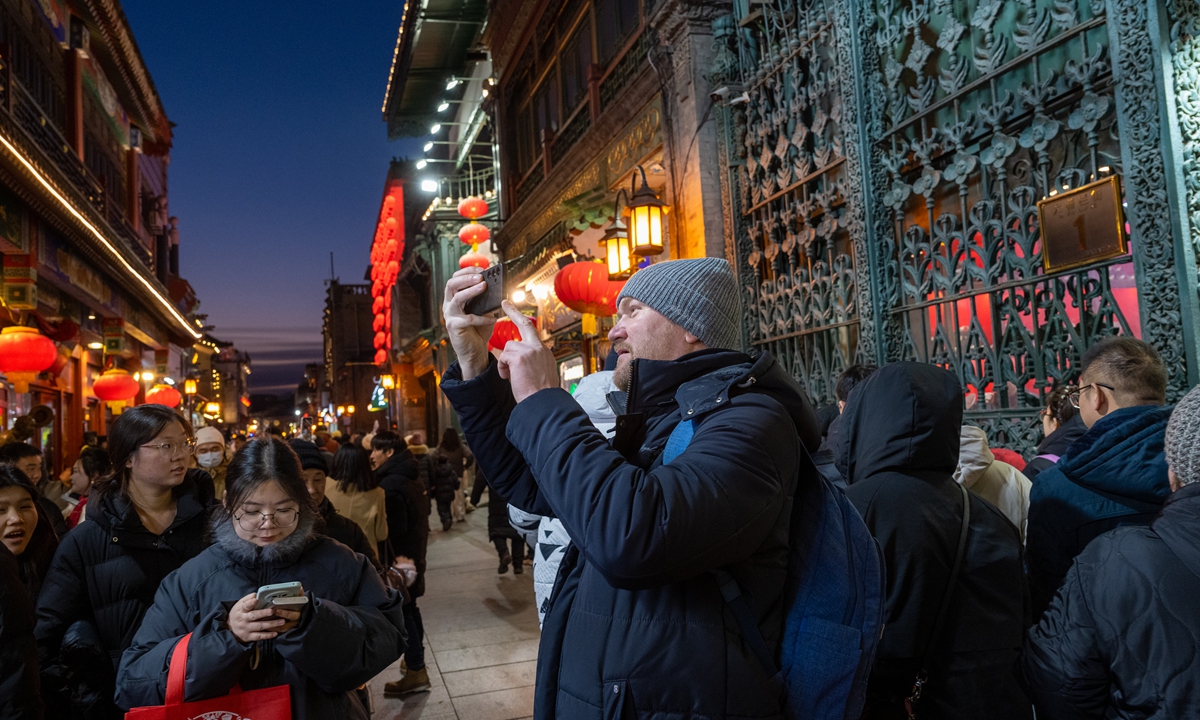
A foreign tourist takes a picture at Qianmen Street in Beijing on January 1, 2026. Photo: VCG
Several provinces and regions in China reported robust tourism growth during the three-day New Year holiday, signaling a strong start to the year's recovery in travel and consumption, according to official data and industry platforms.
According to a report by CCTV News on Sunday, the holiday period saw a surge in diversified cultural and tourism consumption, with visitors enjoying a wide range of experiences. Online travel platforms reported that bookings for domestic scenic spots rose more than fourfold year-on-year, while bookings for inbound experience-oriented leisure products skyrocketed over 30 times, triggering the first consumption wave of the year.
Regional figures further underlined the nationwide rebound.
Shanghai’s municipal culture and tourism bureau said that the city received more than 6.82 million visitors over the holiday period and generated total tourism consumption of 12.271 billion yuan ($1.75 billion). The city staged more than 130 New Year-themed cultural and tourism events and offered over 120 one- to three-day tour routes and 120-plus integrated products combining scenic sites, hotels and rural homestays, according to CCTV News.
South China’s Guangdong Province reported particularly strong tourism activity: Preliminary estimates from the provincial culture and tourism department showed that the province received about 17.875 million visitors during the holiday, a daily average increase of 34.8 percent year-on-year, and generated 9.98 billion yuan in tourism revenue, up39.8 percent on a daily average basis.
Provincial officials noted travel preferences centered on short-and mid-distance, local and nearby trips, with forest wellness, coastal hot springs, rural homestays and family study tours among the most popular themes as cultural-tourism integration deepened, according to CCTV News.
East China’s Jiangsu Province’s monitoring points — including major attractions and museums — recorded more than 19.43 million visits during the holiday, generating 9.61 billion yuan in tourism consumption, with daily year-on-year gains exceeding 15 percent.
The province saw a sharp increase in nonlocal and intercity visitors, whose daily numbers rose about 42.15 percent and helped drive nearly 6.9 billion yuan in out-of-town cultural and tourism spending.
Statistics from Southwest China’s Sichuan Province’s show A-level tourist sites received about 11.04 million visitors over the three days, with ticket revenues of approximately 90.07 million yuan. “Counter-year” and short leisure trips, ice-and-snow activities and museum visits were in high demand, and Chengdu ranked fourth among Chinese cities for inbound tourism during the holiday period, according to Sichuan Daily.
Meanwhile, central China’s Henan Province reported domestic arrivals of about 17.437 million and tourism receipts of 8.99 billion yuan over the holiday period.
On a comparable basis — adjusting for differences in the 2025 holiday length — Henan’s visitor numbers rose 3.2 percent and tourism income grew 4.1 percent year-on-year.
The three-day holiday period, two days longer than that in 2025, created a perfect storm of tourism demand as domestic travelers embraced both short-distance getaways and long-haul vacations, while international visitors seized the opportunity to experience Chinese New Year celebrations.
According to Chengdu Fabu on Saturday, data from platform Qunar have shown that during the New Year holiday travelers using non-Chinese passports booked domestic flights to destinations covering 97 cities nationwide.
Chengdu's immigration authorities reported a remarkable 74.8 percent year-on-year increase in foreign nationals crossing their checkpoints, with over 22,000 international visitors processed between January 1-3. The top three source countries for inbound foreign travelers were Thailand, Malaysia and Australia, according to Chengdu Fabu on Saturday.
Data from Qunar showed that foreign passport holders booked domestic flights to 97 different Chinese cities during the holiday period, indicating widespread international interest in experiencing Chinese New Year celebrations.
Deng Yongsheng, general manager of Chengdu Le Tour International Travel Agency, reported hosting approximately 1,000 foreign visitors during the holiday, primarily from Thailand, Vietnam and Malaysia. "Our Southeast Asian tour groups have increased significantly," Deng noted. "The improved transportation links make flying from Southeast Asia to Chengdu both convenient and affordable."
The strong performance across multiple regions indicates that China's domestic tourism market continues to demonstrate resilience and growth potential.
Analysts said the data point to a broad-based, consumption-driven recovery in domestic tourism at the start of 2026, supported by richer product offerings and a renewed appetite for travel. They attributed the robust figures to extended holiday duration, improved transportation infrastructure, and diversified tourism offerings tailored to different consumer preferences.
The holiday’s momentum could help sustain demand into the upcoming Chinese Lunar New Year travel peak, which begins in mid-February, provided supply capacity and service quality keep pace with rising visitor expectations, Wang Peng, an associate researcher at the Beijing Academy of Social Sciences, told the Global Times on Sunday.
The tourism sector's solid start to 2026 is expected to contribute significantly to regional economic growth and employment throughout the year, with many destinations already planning additional attractions and services to sustain momentum into the peak spring travel season, Wang said.
Global Times
RELATED ARTICLES