More tech firms expected to list in Hong Kong in 2026; city to build a more vibrant innovation ecosystem: Paul Chan
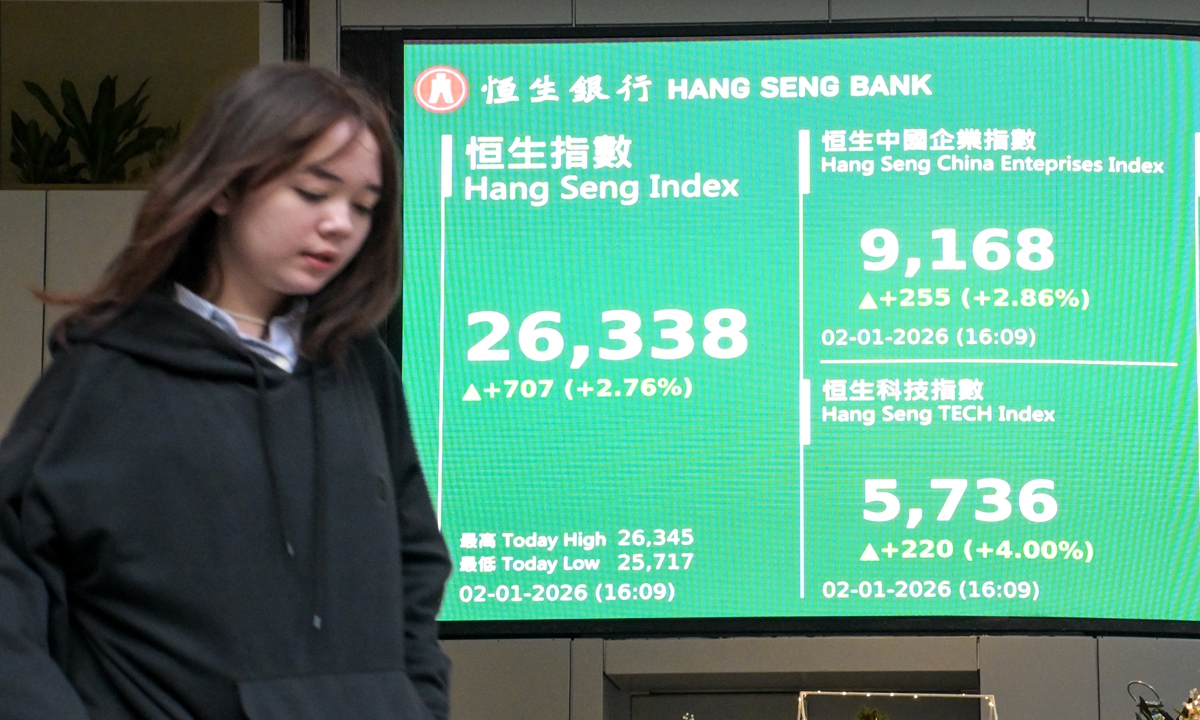
Hong Kong's Hang Seng Index closes at 26,338.47 points on January 2, 2026, up 707.93 points, or 2.76 percent, with a full-day turnover of HK$140.864 billion. Photo: VCG
Hong Kong's Hang Seng Index opened 2026 with a strong gain on its first trading day, led by innovation and technology stocks. In a blog post on Sunday, Paul Chan, financial secretary of the Hong Kong Special Administrative Region (HKSAR) government, said that the city will build on this momentum to foster a more vibrant innovation and industrial ecosystem and promote high-quality economic development.
On the first trading day of 2026, the Hang Seng Index rose by more than 700 points, or about 2.8 percent, marking its strongest start to a year since 2013. The Hang Seng Tech Index climbed 4 percent, with a number of artificial intelligence (AI)-related stocks continuing to attract strong investor interest, Chan said.
He said that by the end of 2025, more than 400 new-economy companies had been listed in Hong Kong, accounting for about 15 percent of all listed firms, while representing roughly 30 percent of the market's total capitalization and trading turnover. He added that among companies applying for listings this year, a growing number are expected to be frontier technology firms.
The HKSAR government welcomes these companies to list and raise funds in Hong Kong, he said, and encourages them to establish a local presence, set up research and development centers and commercialize research outcomes, Chan said. He also encourages them to build advanced manufacturing facilities in the city, leverage Hong Kong's strengths in basic research and its pool of international scientific talent to accelerate growth, and further strengthen the city's innovation and technology ecosystem and industrial base. In addition, the government supports these firms in establishing regional or international headquarters in Hong Kong, using the city as a springboard to Southeast Asia and global markets, according to Chan.
Chan said that in recent years, Hong Kong Cyberport and East China's Jiangsu Province have jointly established the Hong Kong-Jiangsu Science and Technology Innovation Center to promote a model under which research and development is carried out in Hong Kong while applications are implemented in Jiangsu, advancing coordinated innovation development between the two sides.
The Hong Kong branch of the National Torch Academy of Innovation and Entrepreneurship has also been set up to strengthen talent development and business incubation between Beijing and Hong Kong, he added.
Chan said that the first three buildings at the Hong Kong-Shenzhen Innovation and Technology Park have been completed, with two Wet-lab buildings recording occupancy rates of nearly 80 percent. More than 60 enterprises and institutions from the mainland, overseas and Hong Kong have gradually moved in. By sector, about half of the tenants are engaged in AI and data science, while around 40 percent operate in life and health technologies.
Bian Yongzu, an executive deputy editor-in-chief of Modernization of Management magazine, told the Global Times on Sunday that Hong Kong is entering a rare window of opportunity to advance its innovation and technology sector. As the city's economic structure undergoes adjustment and support from the central government continues to intensify, the HKSAR government has placed greater emphasis on innovation as a driver of long-term competitiveness and is accelerating policy efforts to turn it into a new engine of economic growth.
Bian noted that Hong Kong has a solid foundation for developing the sector, with several universities ranking among the world's leaders in high technology and life and health sciences, providing strong support for innovation and the commercialization of research. At the same time, as an international financial center, Hong Kong boasts a mature capital market and professional investment institutions, with financial resources increasingly flowing into innovation-driven industries.
He added that a sound legal framework and Hong Kong's high level of internationalization further enhance its appeal, with mature legal and professional services helping innovation firms handle complex ownership structures, intellectual property, and cross-border cooperation, while positioning the city as a key hub and bridge for technological collaboration between the Chinese mainland and global markets, one of the main reasons investors remain bullish on Hong Kong's innovation prospects.
RELATED ARTICLES