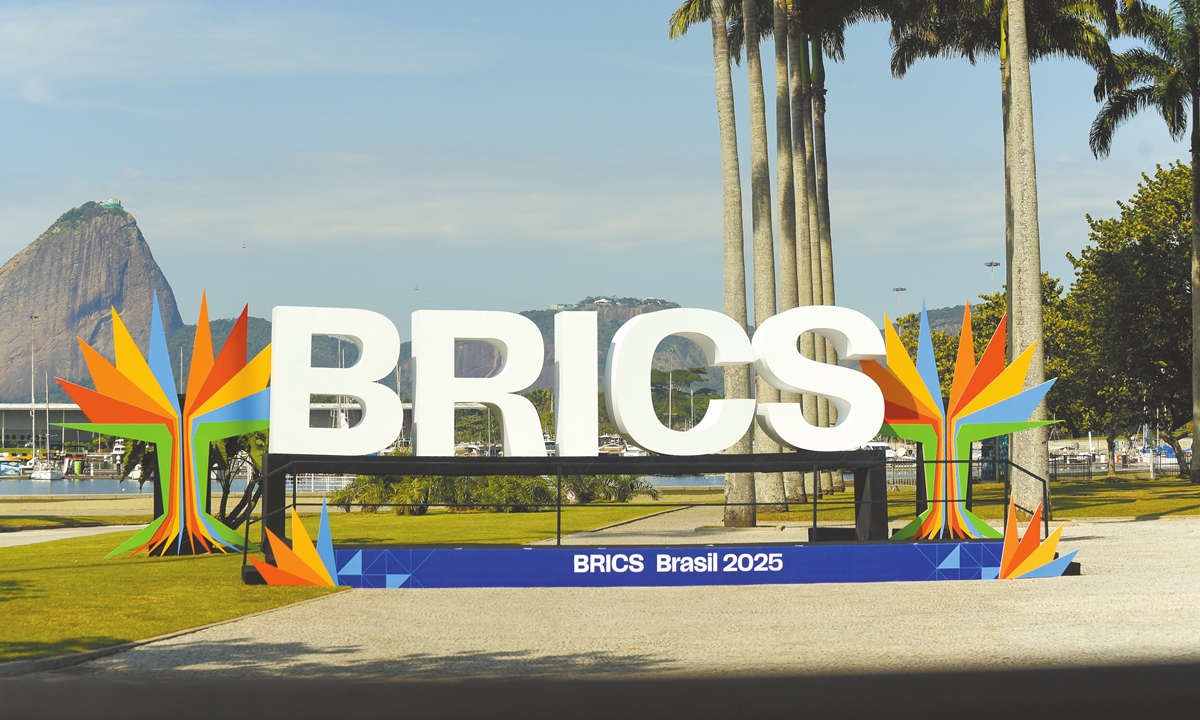
A view of the Museum of Modern Art, where the 17th BRICS Summit takes place, in Rio de Janeiro, on July 6, 2025. Photo: VCG
The inaugural meeting of the China-BRICS New Quality Productive Forces Research Center was held in Beijing recently. The center will adopt a "physical + network" organizational structure, building an international platform for research, exchanges, and cooperation under the BRICS cooperation mechanism, according to a statement by the Ministry of Science and Technology of China (MOST) on Sunday.Speaking at the meeting, MOST Vice Minister Chen Jiachang stated that the BRICS cooperation mechanism is the most influential platform for cooperation among emerging markets and developing countries today.
The establishment of the center was first proposed by Chinese Premier Li Qiang when addressing the 17th BRICS Summit in July 2025.
"China will establish the China-BRICS New Quality Productive Forces Research Center and the BRICS New Industry Golden Egret Excellence Scholarships, which will help BRICS countries train talent in areas such as industry and telecommunication, and pursue innovation-driven development," said Li.
The center will focus on conducting cooperative research on the theory and practice of new quality productive forces, promoting scientific and technological innovation cooperation through policy dialogues and academic exchanges, carrying out personnel exchanges and professional training to cultivate international composite talent, and building a cooperative research network to provide intellectual and decision-making support for policy formulation and common prosperity in BRICS member states and partner countries.
First introduced in 2023, new quality productive forces refer to advanced productivity freed from the traditional economic growth mode and productivity development paths, according to the Xinhua News Agency.
Scientific and technological innovation and industrial innovation are basic pathways for developing new quality productive forces, said Xinhua.
"Steering the development of new quality productive forces" has been included as a key objective for the coming five years, as unveiled in China's 15th Five-Year Plan (2026-30).
After several years of efforts to boost new quality productive forces, the China Innovation Index, a key measure of national innovation capacity, climbed 5.3 percent in 2024 to 174.2 from the 2023 level, according to the National Bureau of Statistics (NBS) in October 2025.
The innovation environment improved steadily, driven by increased investment, faster output growth, and stronger economic contributions, said Lin Mei, a statistician at the NBS.
Sci-tech innovation is effectively supporting economic growth, with the innovation effectiveness index rising 1.9 percent to 132.4. Notably, the share of GDP from new technologies, industries, and business models grew 4.3 percent year-on-year, according to the NBS.
The new center with BRICS members means that China is sharing its experience and achievements with other countries, analysts said.
Erik Solheim, former UN under-secretary-general, said that the most important catch word for 2025 for China was "new quality productive forces," according to media reports on Saturday.
Solheim said that new quality productive forces brought a green economy, and a highly productive, high-tech economy.
"But it should be shared with everyone else. For example, DeepSeek made a breakthrough in artificial intelligence. It made the platform available for everyone, which means that if you run a business in Cameroon, in Africa, or in Paraguay, in Latin America, you can use this platform to drive your business.
"That's sharing the digital economy with everyone. China can help set up data centers, provide expertise and knowledge, and help drive a digital economy which is available for everyone," said Solheim.
Global Times
RELATED ARTICLES