China's Yangtze River remains world's busiest inland waterway by cargo throughput

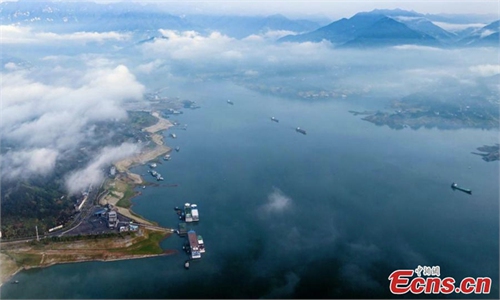
An aerial drone photo taken on Dec. 7, 2025 shows the scenery of Wuxia Gorge, one of the Three Gorges on the Yangtze River, in southwest China's Chongqing. (Photo by Wang Zhonghu/Xinhua)
China's Yangtze River trunk line remains the world's busiest inland waterway in terms of cargo throughput, an official said on Monday, according to the Xinhua News Agency.
The annual cargo throughput at ports along the river's trunk line has surged by 71 percent to 4.2 billion tons over the past decade, Wang Changlin, deputy head of the National Development and Reform Commission (NDRC), said at a press conference on Monday, which provided an overview of the progress and achievements of the Yangtze River Economic Belt over the past decade.
Amid expanding capacity and networks, the Yangtze River Economic Belt, which comprises 11 provincial-level regions that account for nearly half of the country's population and GDP, is playing an increasingly prominent role as a comprehensive transport corridor and a stabilizer for regional and even global trade, analysts said.
Speaking at the press conference, the NDRC official said that efforts have been made to advance high-level opening-up, promote the high-quality development of China-Europe (Asia) freight train services and the New International Land-Sea Trade Corridor, and foster coordinated development among nine pilot free trade zones along the Yangtze River.
In 2025, cargo throughput at ports along the Yangtze River's trunk line is estimated to have reached 4.2 billion tons, up 71 percent from 2015, Jin Jingdong, an official with the department of comprehensive planning of the Ministry of Transport, said on Monday.
Jin said that the number of regional ports handling more than 100 million tons annually is estimated to have risen to 18, up 50 percent from 2015, and the average tonnage of cargo vessels is estimated to have exceeded 2,300 tons, up 67 percent from 2015.
According to Wang Changlin, the Yangtze River Economic Belt has seen its regional GDP more than double over the past decade, with its share of the national total rising from 42.2 percent 10 years ago to 47.3 percent.
"The Yangtze River trunk line has long been the world's busiest inland waterway, highlighting its unique advantages in lowering logistics costs, improving transport efficiency, and supporting large-scale industrial deployment," Cao Heping, an economist at Peking University, told the Global Times on Monday.
Through effective connectivity with coastal ports, railway networks and cross-border freight trains, the Yangtze River Economic Belt has become a key hub linking domestic and international markets, providing strong support for China's participation in global industrial and supply chains, Cao said.
The economic belt is not only a key pillar of China's high-quality economic development, but is also rapidly emerging as an inland economic corridor and trade route with growing global influence, experts noted.
Amid rising volatility in global logistics costs and heightened attention to supply chain security, this high-efficiency, low-cost inland waterway transport system helps enhance China's stability and resilience within global value chains, Wang Peng, an associate research fellow at the Beijing Academy of Social Sciences, told the Global Times, noting that it supports cross-regional industrial coordination, facilitates the flow of resources across the country, and promotes the integrated development of domestic and foreign trade.
In addition to economic progress, environmental protection in the region has improved. During the same period, the proportion of water bodies in the Yangtze River Economic Belt with good water quality rose from 67 to 96.5 percent, according to Wang Changlin.
As part of the three-year action plan for the protection of the Yangtze River that spans from 2025 to 2027, key policy measures have been introduced and implemented, with more than 100 billion yuan ($14.3 billion) allocated through ultra-long-term special treasury bonds and central government budget investment to support major Yangtze River protection projects, including ecological restoration of key rivers and lakes, said the official.
The Yangtze River Economic Belt still has significant development potential. Wang Peng said that continued progress in the intelligent and green upgrading of the shipping system, combined with closer coordination among pilot free trade zones along the river and deeper institutional opening-up, will further strengthen its role in facilitating the dual circulation of domestic and international markets.
As the industrial structure along the river continues to improve, advanced manufacturing, modern services, and strategic emerging industries are increasingly forming clusters. Cao said that the shipping function of the Yangtze River Economic Belt is evolving from a single transport channel into an integrated platform that combines industry, logistics, and trade, laying a solid foundation for upgrading regional trade capacity.
Global Times
RELATED ARTICLES