Scholars’ Perspectives: Four global initiatives highly aligned with UN agenda, provide significant impetus for advancing relevant goals: former UN advisor
By and Zhang Han Published: Jan 05, 2026 10:02 PM

Editor’s Note:
At the “Shanghai Cooperation Organization Plus” Meeting in North China’s port city of Tianjin in September 2025, Chinese President Xi Jinping formally proposed the Global Governance Initiative. With that proposal, the Global Development Initiative (GDI), the Global Security Initiative (GSI), the Global Civilization Initiative (GCI) and the Global Governance Initiative (GGI) together form a package of global public goods that China offers as a response to address global challenges.
The GDI provides the material foundation; the GSI safeguards a peaceful environment; the GCI builds a consensus of values; and the GGI supplies institutional and procedural guarantees.
Through these reflections on the questions of “what kind of world to build and how to build it,” President Xi has established a comprehensive framework for action. This framework drives the practice of building a community with a shared future for humanity, contributing Chinese wisdom and solutions to the preservation of world peace and development, and the advancement of human civilization.
Because of the timing of its publication, the book series Xi Jinping: The Governance of China fully documents the conceptual depth and practical progress of the GDI, GSI and GCI. In Volume V of the series, Chapter 15 is titled “A community with a shared future for humanity.” Volume V also contains multiple references to the idea of “global governance.” The four initiatives should therefore be read as an integrated whole. Viewed as a unified framework, the four initiatives form a “four-in-one” interactive structure: development as the foundation, security as the guarantee, civilization as the bond, and governance as the coordinating mechanism – all serving the overarching objective of building a community with a shared future for humanity.
In the 19th installment of the special series “Decoding the Book of Xi Jinping: The Governance of China,” the Global Times (GT), along with the People’s Daily Overseas Edition, continues to invite Chinese and foreign scholars, translators of Xi’s works, practitioners with firsthand experience, and international readers to delve into the logical connections between the four global initiatives and the vision of a community with a shared future for humanity, and to discuss their practical significance and contemporary value.
In the 17th article of the "Scholars' Perspectives" column, the Global Times (GT) spoke with Xu Bu (Xu), President of Institute of International Development and Security Studies(IIDSS), Jiangsu University, former president of the China Institute of International Studies and former member of the United Nations Secretary-General's High-Level Advisory Board on Effective Multilateralism.
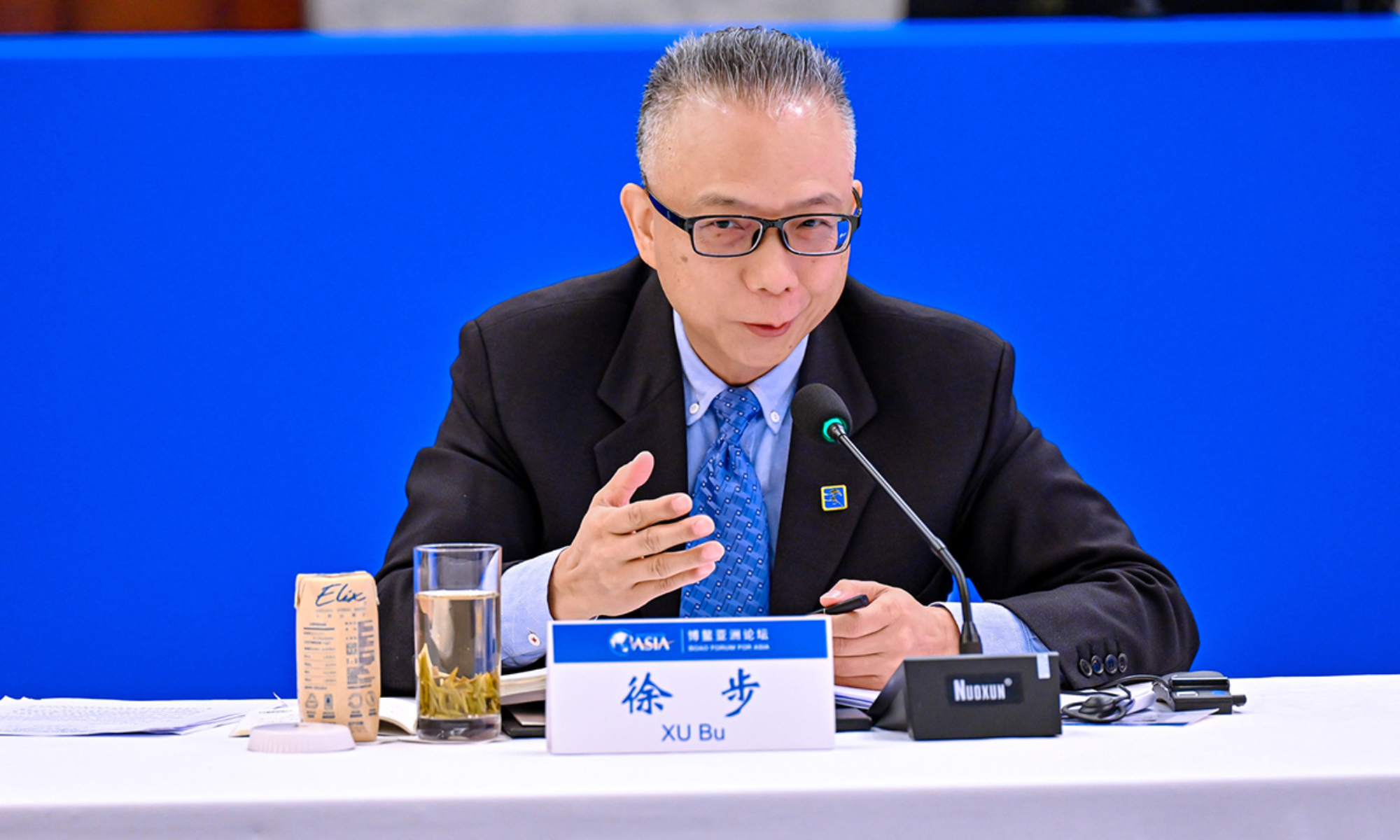
Xu Bu, President of Institute of International Development and Security Studies(IIDSS), Jiangsu University, former president of the China Institute of International Studies and former member of the United Nations Secretary-General's High-Level Advisory Board on Effective Multilateralism
GT: Volume V of Xi Jinping: The Governance of China includes the article “Translate the Vision of a Community with a Shared Future for Humanity into Reality” in which President Xi Jinping systematically elaborates on Global Development Initiative, Global Security Initiative, and Global Civilization Initiative. In September 2025, President Xi proposed the Global Governance Initiative. In your view, what global challenges does each of the four global initiatives address? How do you understand the intrinsic connections between the four global initiatives and the internal logic underlying their core connotations?
Xu: At present, the world is undergoing profound changes unseen in a century. This is a major strategic assessment made by President Xi Jinping regarding the current international landscape and its trajectory for a considerable period to come. The most salient feature of the changes is the significant shift in the balance of international power, with developing countries and countries of the Global South unprecedentedly playing an increasingly important role in international affairs.
At the same time, the international economic, political, and security landscape is facing a series of major challenges. The most notable challenges stem from unilateralism, protectionism, power politics, and Cold War mentality. Severely disrupted by these factors, economic globalization has encountered headwinds, global industrial and supply chains have come under strain, the world economy faces serious difficulties, global security has become more turbulent and unstable, and the world is entering a new period of turbulence and transformation.
It is precisely against this backdrop that President Xi has put forward the four global initiatives, each addressing the prominent challenges facing today’s world—namely the deficits in peace, development, trust, and governance—and responding to the questions of our times and of the world. The four global initiatives each have their own focus while mutually reinforcing one another, forming an organically integrated and functionally complementary whole with a rigorous and clear internal logic.
Development is a hard truth and should also be the top priority of any country, any government, and any political party. Development is an enduring theme of human society, and achieving high-quality development and building a global community with a shared future for development are imperatives that all countries must address.
Since its founding more than a century ago, the Communist Party of China has united and led the Chinese people in the pursuit of national independence and rejuvenation. Through the unremitting efforts of several generations, China has forged a new path of Chinese modernization. The Global Development Initiative vividly embodies the distinctive features, essential requirements, and major principles of Chinese modernization. It represents a concentrated expression of China’s development philosophy in the field of international development cooperation, closely linking China’s development with that of the world. Through positive interaction with the international community, it promotes the building of a global community with a shared future for development. By sharing development gains and achieving win-win cooperation, it offers a Chinese solution to the dilemmas of Western modernization and provides a brand-new option for developing countries as they explore their own paths to modernization.
Peace is the foundation of cooperation and development. Today’s world is rife with conflicts and instability. President Xi has pointed out that “confronted with complex threats to international security, fighting alone or fighting with a blind faith in the use of force will not get one anywhere. The only right solution lies in cooperative security, collective security and common security.” The Global Security Initiative takes the “six commitments” as its core principles: stay committed to the vision of common, comprehensive, cooperative and sustainable security; stay committed to respecting the sovereignty and territorial integrity of all countries; stay committed to abiding by the purposes and principles of the UN Charter; stay committed to taking the legitimate security concerns of all countries seriously; stay committed to peacefully resolving differences and disputes between countries through dialogue and consultation; and stay committed to maintaining security in both traditional and non-traditional domains. The Global Security Initiative is another important global public good contributed by China, and a “Chinese solution” for rallying the international community to jointly address security challenges.
Civilizations become more vibrant through exchange and richer through mutual learning. The Global Civilization Initiative is dedicated to promoting the inclusive coexistence of different civilizations and mutual exchanges and learning, and it is of irreplaceable significance for advancing the modernization of human society and fostering the flourishing diversity of world civilizations. Human society should acknowledge the differences among civilizations. It is precisely these differences that make the world more diverse and colorful. Yet difference does not imply superiority or inferiority; all civilizations are equal, each with its own unique strengths, and should coexist in shared appreciation and harmony. Concepts advocated by China’s fine traditional culture—such as “harmony is to be cherished,” “harmony without uniformity,” and “all things grow side by side without harming one another”—emphasize the harmonious coexistence and mutual accommodation of diverse elements, giving rise to new vitality through integration. The Global Civilization Initiative embodies the civilizational vision of Chinese modernization. Its underlying ethos of equality, mutual learning, dialogue, and inclusiveness constitutes an essential condition for promoting mutual understanding, trust, and cooperation among different countries and peoples.
Development is the foundation of security, security is the precondition for development, mutual learning among civilizations is the key to understanding and trust, and governance reform provides the institutional guarantee for achieving the first three goals. The Global Governance Initiative focuses on the major question of “what kind of global governance system should be built and how to reform and improve global governance.” It takes upholding sovereign equality, abiding by international law, practicing multilateralism, advocating a people-centered approach, and emphasizing action-oriented implementation as its core principles. Rich in profound insight and sharply problem-oriented, it injects strong intellectual impetus into advancing global governance toward a more just and equitable direction. The Global Governance Initiative proposed by President Xi aligns with historical trends, provides both a theoretical framework and practical pathways for building a more just and equitable international order, and highlights China’s constructive role in the reshaping of the global governance system.
GT: In the above mentioned article, President Xi noted “Ten years ago, I made the proposal to build a community with a shared future for humanity," and "we in all countries must have a correct understanding of our world, our history, and our overall interests, and we must act to translate the vision of a community with a shared future for humanity into reality. " What role do you believe the four global initiatives play in the process of translating the vision of building a community with a shared future for humanity into reality?
Xu: Since the 18th National Congress of the CPC, General Secretary Xi Jinping, by grasping the historical experience and objective laws governing the development of human society, and proceeding from the perspective of conforming to the historical trend and enhancing human well-being, innovatively put forward the important concept of promoting the building of a community with a shared future for humanity.
To achieve shared human destiny and build a community with a shared future for humanity, it is essential to foster a world of lasting peace, universal security, and common prosperity. It is also imperative to promote greater mutual understanding and trust among countries to cultivate positive interactions, while also effectively addressing common challenges and global issues facing the human society.
The vision of building a community with a shared future for humanity stands as the core tenet of Xi Jinping Thought on Diplomacy, serving as the overarching and fundamental goal and guiding framework. The Global Development Initiative, Global Security Initiative, Global Civilization Initiative, and Global Governance Initiative constitute the "four pillars and eight beams" – the essential structural underpinnings – for advancing the building of such a community. Only by continuously consolidating the foundation and advancing steadily in these four crucial areas can human society keep moving toward a future of shared destiny and win-win cooperation.
GT: UN Secretary-General António Guterres has repeatedly stated publicly that the global initiatives proposed by China are highly aligned with the UN's core agenda, noting that these initiatives are “totally compatible” with the issues of concern to the UN and the UN Charter. What is your perspective on the connections and alignment between the four global initiatives and the UN agenda?
Xu: Guterres once pointed out that "fragmentation" has become a prominent trend of the current international community. In recent years, the North-South development gap has been widening, momentum for international development cooperation has been insufficient, and development issues have been increasingly marginalized in the international agenda. In 2015, the UN launched the 2030 Agenda for Sustainable Development, yet progress has fallen far short of expectations, and many Sustainable Development Goals (SDGs) become increasingly elusive to achieve.
The four global initiatives are highly aligned with the goals of the UN's 2030 Agenda for Sustainable Development, providing significant impetus for advancing the achievement of SDGs. They have refocused international attention on development issues, offering crucial support for pooling global efforts, building mutual trust, and enhancing effective governance. These initiatives are not only practically actionable but also strategically forward-looking, serving as accessible global public goods for the international community and laying a solid foundation for addressing global development challenges and advancing the shared goals of security and development.
GT: Some analysts argue that the four global initiatives serve as a clear roadmap toward a multipolar world. Against the backdrop of accelerating transformation in the global governance system, what significance do these initiatives hold for the future development of international relations?
Xu: The four global initiatives transcend the traditional Western theories of international relations and politics, providing fundamental guidance for the development of international relations in the 21st century. The core essence of these four initiatives lies in highlighting shared responsibility, emphasizing joint participation, promoting collective action, and achieving mutual benefits and win-win outcomes. These four aspects are inherently different from the power politics and zero-sum game emphasized by traditional Western international relations theories, and their starting point and ultimate goal are to respond to the universal aspirations of the international community, conform to the common wishes of people of all countries, and commit to realizing the shared objectives of human society.
For a long time, the modernization of Western countries has been built on the exploitation, plunder and aggression against developing countries across the globe, with interests seized through colonization, expansion and frequent wars. Even in the 21st century, some Western countries still chant slogans such as "my country first," attempting to build up their own development on the poverty of other countries, and their own security on the insecurity or even threats faced by other nations. In contrast, the four global initiatives fully demonstrate the global vision of the CPC members and the broad-mindedness of the Chinese leader.
GT:From China's propositions to international consensus, and from cooperation concepts to joint actions, what far-reaching impacts have the four global initiatives generated? How should China and other countries, especially Global South nations, work together to advance the implementation of these initiatives?
Xu: Since the launch of the four global initiatives, China has rolled out a series of practical supporting measures, including large-scale assistance, systematic training, and multi-level on-site visits and exchanges, which have won widespread recognition and positive responses from Global South countries. Political figures and young elites in many nations have earnestly studied President Xi’s important works on governance. During my interactions with government officials, journalists, and young scholars from countries in Asia, Africa, and Latin America, I have consistently heard such comments: the important initiatives put forward by Chinese leader truly prioritize developing countries, which stands in fundamental contrast to the long-standing practice of some Western countries that is full of talks but little action.
