IN-DEPTH / IN-DEPTH
Practitioners’ Insights: ‘Africa Tech Challenge’ illuminates dreams of African youth, a vivid embodiment of China’s four global initiatives
By and Fan Wei Published: Jan 05, 2026 11:41 PM

Editor's Notes:
At the "Shanghai Cooperation Organization Plus" Meeting in North China's port city of Tianjin in September 2025, Chinese President Xi Jinping formally proposed the Global Governance Initiative. With that proposal, the Global Development Initiative (GDI), the Global Security Initiative (GSI), the Global Civilization Initiative (GCI) and the Global Governance Initiative (GGI) together form a package of global public goods that China offers as a response to address global challenges.
The GDI provides the material foundation; the GSI safeguards a peaceful environment; the GCI builds a consensus of values; and the GGI supplies institutional and procedural guarantees.
Through these reflections on the questions of "what kind of world to build and how to build it," President Xi has established a comprehensive framework for action. This framework drives the practice of building a community with a shared future for humanity, contributing Chinese wisdom and solutions to the preservation of world peace and development, and the advancement of human civilization.
Because of the timing of its publication, the book series Xi Jinping: The Governance of China fully documents the conceptual depth and practical progress of the GDI, GSI and GCI. In Volume V of the series, Chapter 15 is titled "A community with a shared future for humanity." Volume V also contains multiple references to the idea of "global governance." The four initiatives should therefore be read as an integrated whole. Viewed as a unified framework, the four initiatives form a "four-in-one" interactive structure: development as the foundation, security as the guarantee, civilization as the bond, and governance as the coordinating mechanism - all serving the overarching objective of building a community with a shared future for humanity.
In the 19th installment of the special series "Decoding the Book of Xi Jinping: The Governance of China," the Global Times (GT), along with the People's Daily Overseas Edition, continues to invite Chinese and foreign scholars, translators of Xi's works, practitioners with firsthand experience, and international readers to delve into the logical connections between the four global initiatives and the vision of a community with a shared future for humanity, and to discuss their practical significance and contemporary value.
In the 18th installment of the "Practitioners' Insights" column, a China-initiated program, "Africa Tech Challenge," shares stories of how it practices the four global initiatives in Africa through helping local young people pursue their dreams, by offering them non-profit vocational skill training, competitions, and opportunities to further study in China.
The air is thick with the metallic tang of cutting fluid; the low, steady hum of machines fills every corner. The young operators' gazes are fixed, fingertips dancing across a CNC panel, with each movement precise and practiced. As the spindle eases to life, a cold steel blank yields beneath the cutter, gradually taking shape until it becomes a precision part measured in microns.
This was not an ordinary factory workshop, but the final competition site of the 10th Africa Tech Challenge (ATC) in Nairobi, the capital of Kenya, in 2025. Initiated by a Chinese enterprise and jointly built by China and Africa as a public-good platform, ATC has grown since its inaugural 2014 event in Kenya into an 11-year, 10-edition journey. It has become an important stage for African youth to upgrade vocational skills and pursue their dreams.
Amid numerous global challenges, Chinese President Xi Jinping has put forward four interlinked global initiatives - the Global Development Initiative (GDI), the Global Security Initiative (GSI), the Global Civilization Initiative (GCI), and the Global Governance Initiative (GGI). Through these initiatives, Xi has created a systematic framework for translating the concept of "building a community with a shared future for humanity" into concrete action.
For Samuel Irungu, a young Kenyan, these visionary concepts proposed by the Chinese president are not just grand aspirations; they are also reflected in practical, people-centered projects that China has helped to launch around the world.
In Africa, the ATC project represents Samuel's opportunity to change his destiny. After excelling in the competition, he won the chance to study in China and is now enrolled at a Chinese university.
"The ATC was a unique and golden opportunity. It felt like a dream," Irungu told the Global Times with a smile that encapsulates, in one personal snapshot, how China's four global initiatives are being realized on the frontlines across the continent.
'Door opener' for the young
Irungu's journey, from Kenya to a university in East China's Jiangsu Province, began with a single bold step.
In 2023, while studying in Kenya, Irungu learned about the ATC program. Hoping to broaden his horizons, he signed up for that year's eighth edition and entered the mechanical drawing and CAD (computer-aided design) software application competitions. For several weeks, Irungu trained and competed alongside peers from other countries. His strong performance at the competitions earned him top placements in the contest and, more importantly, a precious opportunity to study in China. In the fall of 2024, Irungu traveled to China to pursue a degree in Mechanical Design Manufacturing and Automation at Jiangsu University.
Samuel's story is far from unique, it's a path many young ATC participants have followed. Now in its 10th edition, the ATC program, co-hosted by AVIC INNO (AVIC Innovation Holding Limited), Ministry of Education of Kenya, and the China Education Association for International Exchange, has attracted nearly 2,000 young people from 14 African countries, including Kenya, Zambia, Uganda, Egypt and Cote d'Ivoire. Over the years it has characterized China-African cooperation in vocational education.
As one of the organizers, AVIC INNO said that the skills competition offers African youth free, targeted vocational training across a range of fields, and a platform to compete and demonstrate their abilities alongside peers from other countries. Beyond improving individual technical skills, top performers can gain access to desirable jobs or further study opportunities in China.
The ATC initiative grew out of an old Chinese saying: ''To give people fish and you only provide them with one meal; to teach them how to fish and they can benefit throughout their lives.'' It emphasizes that imparting learning methods matters more than merely transferring knowledge," Huang Xuchen, the executive manager of ATC, told the Global Times.
Huang said that during their early work on TVET (Technical and vocational Education and Training) projects in Africa, they found that many African countries urgently needed skilled talents to power development, yet large numbers of local young people lacked employable skills and faced unsatisfied employment. Strengthening youth employability became a priority for many African governments, and that need was precisely what the ATC was created to address.
"Every country has the right to development, and the people in every country should have the freedom to pursue a happy life," President Xi said in the article "Translate the Vision of a Community with a Shared Future for Humanity into Reality" in Volume V of the book series Xi Jinping: The Governance of China. Xi noted that, he has proposed the Global Development Initiative, "with the goals of having the international community promote development for all, and of boosting the UN 2030 Agenda for Sustainable Development."
Xi's important exposition on the GDI has helped frame ATC's mission and provide strategic direction. "We believe skills are the most practical 'door opener' for young people seeking a better life," said Shi Yue, the Project Manager of ATC. Shi added that, by crossing borders to provide thousands of young Africans with high-quality, equitable vocational training, ATC helps them obtain the market-ready skills that lead to stable employment or entrepreneurship. That helps raise local household incomes and supply the skilled labor needed for Africa's industrialization.
"This is how, on a micro level, we respond to the GDI and the idea of building a community with a shared future for humanity," said Shi.
On September 1, 2025, President Xi proposed the GGI when chairing the "Shanghai Cooperation Organization Plus" Meeting, urging efforts to narrow the North-South gap, and safeguard the common interests of all countries.
These profound concepts also shine with wisdom in the practice of projects like ATC. Over more than a decade, ATC's focus has shifted from traditional machine tools, to the introduction of CNC (computer numerical control) technology, PLCs (programmable logic controllers) and CAD. Since 2022, it has added online competition categories and deployed a self-developed online education platform to break the limits of time and space. The program has kept pace with global industrial upgrading, and is committed to bringing frontier digital and intelligent skills to Africa in order to narrow the North-South development divide, according to Shi.
"We do not introduce competition categories out of thin air. Every expansion into a new field is guided by one basic principle: the skill must be among those most urgently needed by the local industrialization process and have real market potential," Shi told the Global Times. ATC's insistence on staying current ensures that, what trainees learn directly serves local employment and industrial development, she said.
A bridge connecting people
In the article "Translate the Vision of a Community with a Shared Future for Humanity into Reality," Xi said he has proposed the GCI, "calling for diversity among global civilizations, and promoting the common values of humanity and people-to-people and cultural exchanges and cooperation."
On the broad stage of China-Africa cooperation, the ATC program has become not only a platform for skills training, but also a vital link for cultural exchange.
According to AVIC INNO, since its inception, the ATC has reached 1,933 participants. Among them, 249 people from 51 teams have won cash awards, and roughly thirty distinguished students, like Irungu, obtained full scholarships to pursue further study in China. Through the program they gain sharper professional skills and broader horizons, and they become living bridges of mutual understanding between the peoples of China and Africa.
One such story is that of Geofrrey James Masengwe from Tanzania. Masengwe took part in the eighth ATC competition in 2023, which bolstered his technical confidence and helped him connect with excellent mentors and friends. Masengwe said he still remembers the sense of nervousness during the competition. "I didn't expect to win, which made the experience even more exciting and rewarding," he told the Global Times.
On the strength of his performance, Masengwe earned the opportunity to study in China, and now he is pursuing a master's degree in in Mechatronics (Robotics) Engineering at Beihang University. Stories like Masengwe's are multiplying. Through ATC, young participants are moving into wider arenas and becoming the next generation of envoys -- connecting China and Africa and communicating with the world.
People-to-people exchange is a foundational pillar of China-Africa cooperation, and young people are its main driving force, Shi said. She said that the ATC program has created a platform where Chinese and African teachers, engineers and students learn and engage side by side. In the process, young people from different countries learn from and inspire one another, deepening mutual understanding and trust, and laying a solid, warm foundation for the diversity of world civilizations and for closer China-Africa ties. "This is a vivid manifestation of putting the GCI into practice and strengthening cultural cooperation among youth."
Behind the deepening China-Africa cultural exchange lies the bedrock of peace and security. In the article "Translate the Vision of a Community with a Shared Future for Humanity into Reality," President Xi said he proposed the GSI, noting that "we should favor dialogue and oppose confrontation, forge partnerships rather than alliances, pursue win-win outcomes and oppose zero-sum games, and work together to build a community of security for all."
"Win-win outcomes are the core principle of China-Africa cooperation." Shi told the Global Times that the ATC is sowing the seeds of dialogue, partnership and mutual benefit among young people across nations. "The foundation of security is understanding and trust. The ATC program provides a pure platform for 'skills dialogue' and cultural exchange,'" said Shi. "This is the approach China advocates: advancing shared security through shared development."
Chinese wisdom resonates
From the GDI in 2021, to the GSI in 2022, followed by the GCI in 2023, and the GGI in 2025, the four global initiatives proposed by the Chinese president are interwoven into a logically rigorous and organically unified system.
On the broad terrain of China-Africa cooperation, this grand blueprint has been translated into countless tangible projects that quietly but decisively transform landscapes and everyday lives. The concepts of development, security, civilization and governance embody in the initiatives find their firmest footholds in these on-the-ground works: schools, clinics, infrastructure and training programs that carry the imprint of Chinese builders and educators and that deliver visible benefits to local communities.
As one of many China-Africa cooperation projects, the ATC connects China's technical expertise, training systems, and development philosophy with African youth's thirst for skills and their pursuit of a better life. "The four global initiatives proposed point the way for global development and international cooperation in the new era, and provide an action guide for our practical projects," Shi said.
She said that through practical cooperation with African nations, China practices the spirit of these initiatives, not only helping Africa address development challenges, but also contributing the wisdom of China-Africa cooperation to the reform of the global governance system.
In 2023, the ATC was officially incorporated into the "Future Africa - China Africa TVET Cooperation Program." This initiative is an important component of the capacity building category of the nine cooperation programs China announced during the Eighth Ministerial Conference of the Forum on China-Africa Cooperation (FOCAC) held in 2021. As a shining name card in the field of China-Africa vocational education cooperation, ATC has won wide praise across the continent. "ATC is doing a great job, keep it up!" Julius Migos Ogamba, cabinet secretary in the Ministry of Education of Kenya, once inscribed after an ATC competition.
ATC beneficiary Irungu, now a freshman at Jiangsu University, told the Global Times that he has felt the initiatives' far‑reaching meaning firsthand. The initiatives proposed by President Xi aim to narrow development gaps and convey the values of development, security, civilization and governance - exactly what the world needs today. Guided by these initiatives, many China-Africa cooperation projects are already having a profound impact on young Africans like him.
"The initiatives have empowered me, and allowed me to pursue my dreams," he said.
At the "Shanghai Cooperation Organization Plus" Meeting in North China's port city of Tianjin in September 2025, Chinese President Xi Jinping formally proposed the Global Governance Initiative. With that proposal, the Global Development Initiative (GDI), the Global Security Initiative (GSI), the Global Civilization Initiative (GCI) and the Global Governance Initiative (GGI) together form a package of global public goods that China offers as a response to address global challenges.
The GDI provides the material foundation; the GSI safeguards a peaceful environment; the GCI builds a consensus of values; and the GGI supplies institutional and procedural guarantees.
Through these reflections on the questions of "what kind of world to build and how to build it," President Xi has established a comprehensive framework for action. This framework drives the practice of building a community with a shared future for humanity, contributing Chinese wisdom and solutions to the preservation of world peace and development, and the advancement of human civilization.
Because of the timing of its publication, the book series Xi Jinping: The Governance of China fully documents the conceptual depth and practical progress of the GDI, GSI and GCI. In Volume V of the series, Chapter 15 is titled "A community with a shared future for humanity." Volume V also contains multiple references to the idea of "global governance." The four initiatives should therefore be read as an integrated whole. Viewed as a unified framework, the four initiatives form a "four-in-one" interactive structure: development as the foundation, security as the guarantee, civilization as the bond, and governance as the coordinating mechanism - all serving the overarching objective of building a community with a shared future for humanity.
In the 19th installment of the special series "Decoding the Book of Xi Jinping: The Governance of China," the Global Times (GT), along with the People's Daily Overseas Edition, continues to invite Chinese and foreign scholars, translators of Xi's works, practitioners with firsthand experience, and international readers to delve into the logical connections between the four global initiatives and the vision of a community with a shared future for humanity, and to discuss their practical significance and contemporary value.
In the 18th installment of the "Practitioners' Insights" column, a China-initiated program, "Africa Tech Challenge," shares stories of how it practices the four global initiatives in Africa through helping local young people pursue their dreams, by offering them non-profit vocational skill training, competitions, and opportunities to further study in China.
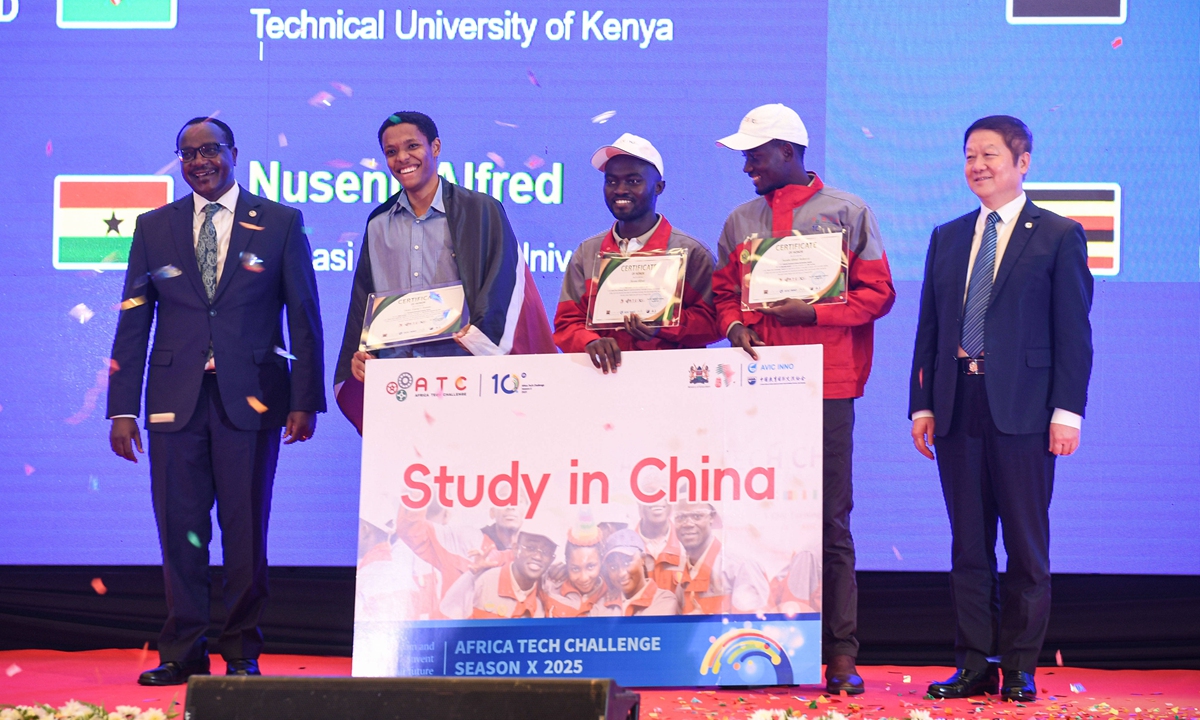
A photo taken at the closing ceremony of Africa Tech Challenge (ATC) Season 10 in Nairobi, Kenya, on September 1, 2025 Photo: IC
The air is thick with the metallic tang of cutting fluid; the low, steady hum of machines fills every corner. The young operators' gazes are fixed, fingertips dancing across a CNC panel, with each movement precise and practiced. As the spindle eases to life, a cold steel blank yields beneath the cutter, gradually taking shape until it becomes a precision part measured in microns.
This was not an ordinary factory workshop, but the final competition site of the 10th Africa Tech Challenge (ATC) in Nairobi, the capital of Kenya, in 2025. Initiated by a Chinese enterprise and jointly built by China and Africa as a public-good platform, ATC has grown since its inaugural 2014 event in Kenya into an 11-year, 10-edition journey. It has become an important stage for African youth to upgrade vocational skills and pursue their dreams.
Amid numerous global challenges, Chinese President Xi Jinping has put forward four interlinked global initiatives - the Global Development Initiative (GDI), the Global Security Initiative (GSI), the Global Civilization Initiative (GCI), and the Global Governance Initiative (GGI). Through these initiatives, Xi has created a systematic framework for translating the concept of "building a community with a shared future for humanity" into concrete action.
For Samuel Irungu, a young Kenyan, these visionary concepts proposed by the Chinese president are not just grand aspirations; they are also reflected in practical, people-centered projects that China has helped to launch around the world.
In Africa, the ATC project represents Samuel's opportunity to change his destiny. After excelling in the competition, he won the chance to study in China and is now enrolled at a Chinese university.
"The ATC was a unique and golden opportunity. It felt like a dream," Irungu told the Global Times with a smile that encapsulates, in one personal snapshot, how China's four global initiatives are being realized on the frontlines across the continent.
'Door opener' for the young
Irungu's journey, from Kenya to a university in East China's Jiangsu Province, began with a single bold step.
In 2023, while studying in Kenya, Irungu learned about the ATC program. Hoping to broaden his horizons, he signed up for that year's eighth edition and entered the mechanical drawing and CAD (computer-aided design) software application competitions. For several weeks, Irungu trained and competed alongside peers from other countries. His strong performance at the competitions earned him top placements in the contest and, more importantly, a precious opportunity to study in China. In the fall of 2024, Irungu traveled to China to pursue a degree in Mechanical Design Manufacturing and Automation at Jiangsu University.
Samuel's story is far from unique, it's a path many young ATC participants have followed. Now in its 10th edition, the ATC program, co-hosted by AVIC INNO (AVIC Innovation Holding Limited), Ministry of Education of Kenya, and the China Education Association for International Exchange, has attracted nearly 2,000 young people from 14 African countries, including Kenya, Zambia, Uganda, Egypt and Cote d'Ivoire. Over the years it has characterized China-African cooperation in vocational education.
As one of the organizers, AVIC INNO said that the skills competition offers African youth free, targeted vocational training across a range of fields, and a platform to compete and demonstrate their abilities alongside peers from other countries. Beyond improving individual technical skills, top performers can gain access to desirable jobs or further study opportunities in China.
The ATC initiative grew out of an old Chinese saying: ''To give people fish and you only provide them with one meal; to teach them how to fish and they can benefit throughout their lives.'' It emphasizes that imparting learning methods matters more than merely transferring knowledge," Huang Xuchen, the executive manager of ATC, told the Global Times.
Huang said that during their early work on TVET (Technical and vocational Education and Training) projects in Africa, they found that many African countries urgently needed skilled talents to power development, yet large numbers of local young people lacked employable skills and faced unsatisfied employment. Strengthening youth employability became a priority for many African governments, and that need was precisely what the ATC was created to address.
"Every country has the right to development, and the people in every country should have the freedom to pursue a happy life," President Xi said in the article "Translate the Vision of a Community with a Shared Future for Humanity into Reality" in Volume V of the book series Xi Jinping: The Governance of China. Xi noted that, he has proposed the Global Development Initiative, "with the goals of having the international community promote development for all, and of boosting the UN 2030 Agenda for Sustainable Development."
Xi's important exposition on the GDI has helped frame ATC's mission and provide strategic direction. "We believe skills are the most practical 'door opener' for young people seeking a better life," said Shi Yue, the Project Manager of ATC. Shi added that, by crossing borders to provide thousands of young Africans with high-quality, equitable vocational training, ATC helps them obtain the market-ready skills that lead to stable employment or entrepreneurship. That helps raise local household incomes and supply the skilled labor needed for Africa's industrialization.
"This is how, on a micro level, we respond to the GDI and the idea of building a community with a shared future for humanity," said Shi.
On September 1, 2025, President Xi proposed the GGI when chairing the "Shanghai Cooperation Organization Plus" Meeting, urging efforts to narrow the North-South gap, and safeguard the common interests of all countries.
These profound concepts also shine with wisdom in the practice of projects like ATC. Over more than a decade, ATC's focus has shifted from traditional machine tools, to the introduction of CNC (computer numerical control) technology, PLCs (programmable logic controllers) and CAD. Since 2022, it has added online competition categories and deployed a self-developed online education platform to break the limits of time and space. The program has kept pace with global industrial upgrading, and is committed to bringing frontier digital and intelligent skills to Africa in order to narrow the North-South development divide, according to Shi.
"We do not introduce competition categories out of thin air. Every expansion into a new field is guided by one basic principle: the skill must be among those most urgently needed by the local industrialization process and have real market potential," Shi told the Global Times. ATC's insistence on staying current ensures that, what trainees learn directly serves local employment and industrial development, she said.
A bridge connecting people
In the article "Translate the Vision of a Community with a Shared Future for Humanity into Reality," Xi said he has proposed the GCI, "calling for diversity among global civilizations, and promoting the common values of humanity and people-to-people and cultural exchanges and cooperation."
On the broad stage of China-Africa cooperation, the ATC program has become not only a platform for skills training, but also a vital link for cultural exchange.
According to AVIC INNO, since its inception, the ATC has reached 1,933 participants. Among them, 249 people from 51 teams have won cash awards, and roughly thirty distinguished students, like Irungu, obtained full scholarships to pursue further study in China. Through the program they gain sharper professional skills and broader horizons, and they become living bridges of mutual understanding between the peoples of China and Africa.
One such story is that of Geofrrey James Masengwe from Tanzania. Masengwe took part in the eighth ATC competition in 2023, which bolstered his technical confidence and helped him connect with excellent mentors and friends. Masengwe said he still remembers the sense of nervousness during the competition. "I didn't expect to win, which made the experience even more exciting and rewarding," he told the Global Times.
On the strength of his performance, Masengwe earned the opportunity to study in China, and now he is pursuing a master's degree in in Mechatronics (Robotics) Engineering at Beihang University. Stories like Masengwe's are multiplying. Through ATC, young participants are moving into wider arenas and becoming the next generation of envoys -- connecting China and Africa and communicating with the world.
People-to-people exchange is a foundational pillar of China-Africa cooperation, and young people are its main driving force, Shi said. She said that the ATC program has created a platform where Chinese and African teachers, engineers and students learn and engage side by side. In the process, young people from different countries learn from and inspire one another, deepening mutual understanding and trust, and laying a solid, warm foundation for the diversity of world civilizations and for closer China-Africa ties. "This is a vivid manifestation of putting the GCI into practice and strengthening cultural cooperation among youth."
Behind the deepening China-Africa cultural exchange lies the bedrock of peace and security. In the article "Translate the Vision of a Community with a Shared Future for Humanity into Reality," President Xi said he proposed the GSI, noting that "we should favor dialogue and oppose confrontation, forge partnerships rather than alliances, pursue win-win outcomes and oppose zero-sum games, and work together to build a community of security for all."
"Win-win outcomes are the core principle of China-Africa cooperation." Shi told the Global Times that the ATC is sowing the seeds of dialogue, partnership and mutual benefit among young people across nations. "The foundation of security is understanding and trust. The ATC program provides a pure platform for 'skills dialogue' and cultural exchange,'" said Shi. "This is the approach China advocates: advancing shared security through shared development."
Chinese wisdom resonates
From the GDI in 2021, to the GSI in 2022, followed by the GCI in 2023, and the GGI in 2025, the four global initiatives proposed by the Chinese president are interwoven into a logically rigorous and organically unified system.
On the broad terrain of China-Africa cooperation, this grand blueprint has been translated into countless tangible projects that quietly but decisively transform landscapes and everyday lives. The concepts of development, security, civilization and governance embody in the initiatives find their firmest footholds in these on-the-ground works: schools, clinics, infrastructure and training programs that carry the imprint of Chinese builders and educators and that deliver visible benefits to local communities.
As one of many China-Africa cooperation projects, the ATC connects China's technical expertise, training systems, and development philosophy with African youth's thirst for skills and their pursuit of a better life. "The four global initiatives proposed point the way for global development and international cooperation in the new era, and provide an action guide for our practical projects," Shi said.
She said that through practical cooperation with African nations, China practices the spirit of these initiatives, not only helping Africa address development challenges, but also contributing the wisdom of China-Africa cooperation to the reform of the global governance system.
In 2023, the ATC was officially incorporated into the "Future Africa - China Africa TVET Cooperation Program." This initiative is an important component of the capacity building category of the nine cooperation programs China announced during the Eighth Ministerial Conference of the Forum on China-Africa Cooperation (FOCAC) held in 2021. As a shining name card in the field of China-Africa vocational education cooperation, ATC has won wide praise across the continent. "ATC is doing a great job, keep it up!" Julius Migos Ogamba, cabinet secretary in the Ministry of Education of Kenya, once inscribed after an ATC competition.
ATC beneficiary Irungu, now a freshman at Jiangsu University, told the Global Times that he has felt the initiatives' far‑reaching meaning firsthand. The initiatives proposed by President Xi aim to narrow development gaps and convey the values of development, security, civilization and governance - exactly what the world needs today. Guided by these initiatives, many China-Africa cooperation projects are already having a profound impact on young Africans like him.
"The initiatives have empowered me, and allowed me to pursue my dreams," he said.
RELATED ARTICLES