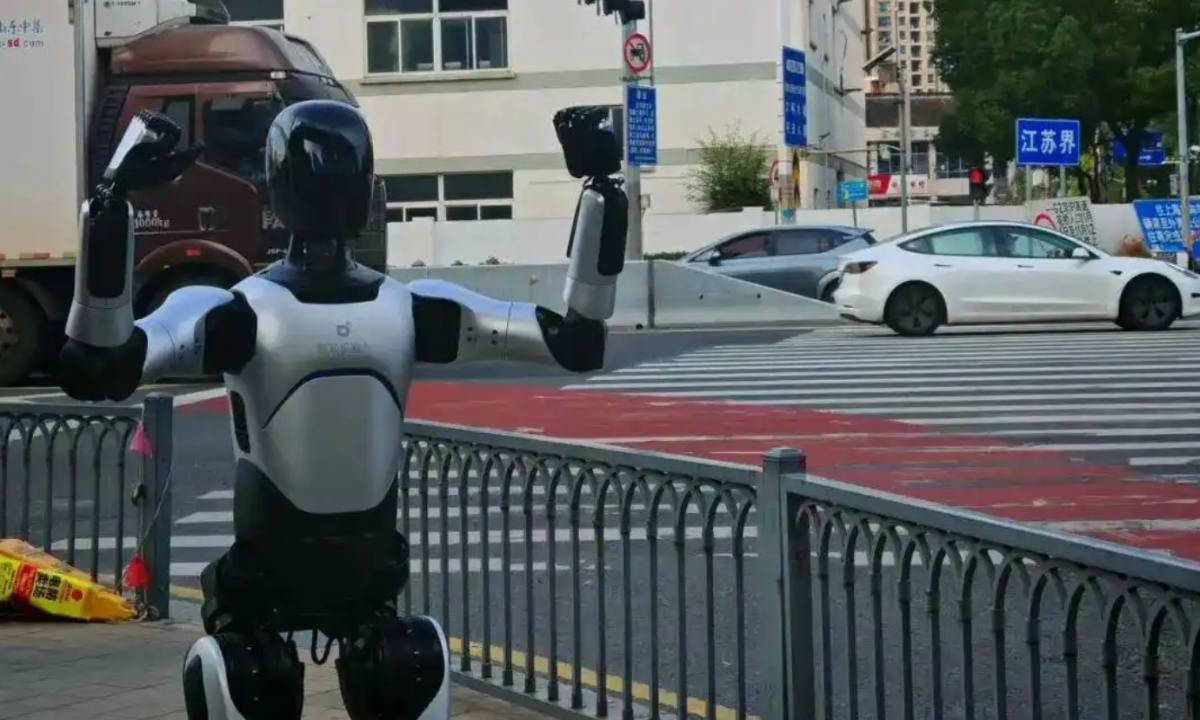
Recently, the Shanghai-made Agibot "A2" robot set off from Suzhou in East China's Jiangsu Province and successfully reached the North Bund in Shanghai after 56 hours. Photo: web
As this year's Consumer Electronics Show (CES) in Las Vegas approaches, Chinese exhibitors told the Global Times they will unveil cutting-edge technologies, showcasing the latest advances of the nation's technology players in innovation and industrial capability.
The show, under the theme "Innovators Show Up," with a wave of Chinese AI hardware and humanoid robot exhibitors lining up to showcase products aimed at moving AI from lab concept to commercial reality, the Global Times has learned.
Vision Intelligence, a subsidiary of iFlytek, said that it would bring its iFLYBUDS Pro 3 and iFLYBUDS Air 2, next-generation flagship conference earphones with voice recording and noise reduction features. The company officially launched its overseas brand viaim at the show last year, iFlytek said in a note sent to the Global Times on Monday.
Nearly a dozen well-known humanoid robot manufacturers - including Unitree Robotics, AgiBot, Galbot, Engine AI, Noetix Robotics and the Beijing Humanoid Robot Innovation Center - are expected to show their wares at the CES, the South China Morning Post (SCMP) reported on Monday.
According to the latest directory released by the CES, China's embodied intelligence companies account for more than half of all related exhibitors, according to domestic business & technology information provider TMTpost.
Shanghai-based robot producer AgiBot told the Global Times on Monday that the company would bring its "full product portfolio and industry-leading solutions" to CES 2026. Yao Maoqing, founding partner at AgiBot, said "it demonstrates how we are able to build an ecosystem of humanoid robots, not for a single task or setting, but for a future where embodied intelligence can serve people across industries, environments, and everyday life."
Beijing Humanoid Robot Innovation Center said that it will showcase a variety of its Tiangong Walker models, pitching full autonomy and "one‑brain, many‑machines" coordination for high‑efficiency industrial sorting and other heavy‑duty tasks.
Booster Robotics, which supplies embodied development platforms used by RoboCup teams, will present its Booster K1 and T1 systems. The company said that it will demonstrate multi‑task capabilities and scenario‑ready robot systems rather than single‑task prototypes, according to the information the company shared with the Global Times on Monday.
These firms are poised to compete for attention at the show against other major humanoid proponents, such as Massachusetts-based robotics pioneer Boston Dynamics. Boston Dynamics said that its new Atlas humanoid would make its public debut at the CES, the SCMP reported.
Physical AI and robotics are ready to take center stage at this year's CES, Wang Peng, an associate researcher at the Beijing Academy of Social Sciences, told the Global Times on Monday. Robots driven by large-language AI models are shifting from concept validation to autonomous task execution in complex environments. The exhibits will signal market expectations and help firms calibrate production, supply chains and research and development efforts.
Alongside robots, Chinese companies will debut a wide range of AI‑enabled consumer devices. TCL — the largest Chinese exhibitor this year with a pavilion of about 2,453 square meters — will show printed OLED, SQD‑Mini LED TVs, NXTPAPER eye‑care displays and an HDR10 AR eyewear prototype, China National Radio reported.
Alibaba will introduce its first self‑developed AI glasses, known as Quark AI Glasses S1, which the company said integrates its ecosystem services and the Qwen AI assistant for navigation, translation, prompting and on‑device imaging. Other Chinese smart eyewear vendors scheduled to appear include Rokid, XReal and Even Realities, according to TMTpost.
According to global market research firm International Data Corp, global shipments of smart glasses reached about 12.8 million units in 2025, up 26 percent year-on-year. Shipments in China alone are estimated to have hit 2.75 million units, a remarkable rise of 107 percent, the Xinhua News Agency reported in June 2025.
According to Wang, CES2026 is the major first industry event of the year and serves as an industry benchmark. It will showcase the latest AI developments from tech players big and small, while also laying out a blueprint for how the technology will reshape different industries in 2026.
CES 2026 marks the first year of commercial AI hardware deployment and exemplifies the layered competition-and-cooperation between China and the US. The US dominates foundational innovation, while China feeds technological iteration through scenario-driven implementation. Together they accelerate the shift of technology from the lab to industry, Wang said.
RELATED ARTICLES