Top South Korean business executives’ visit to China attracts broad attention
Participation shows desire for closer cooperation: expert
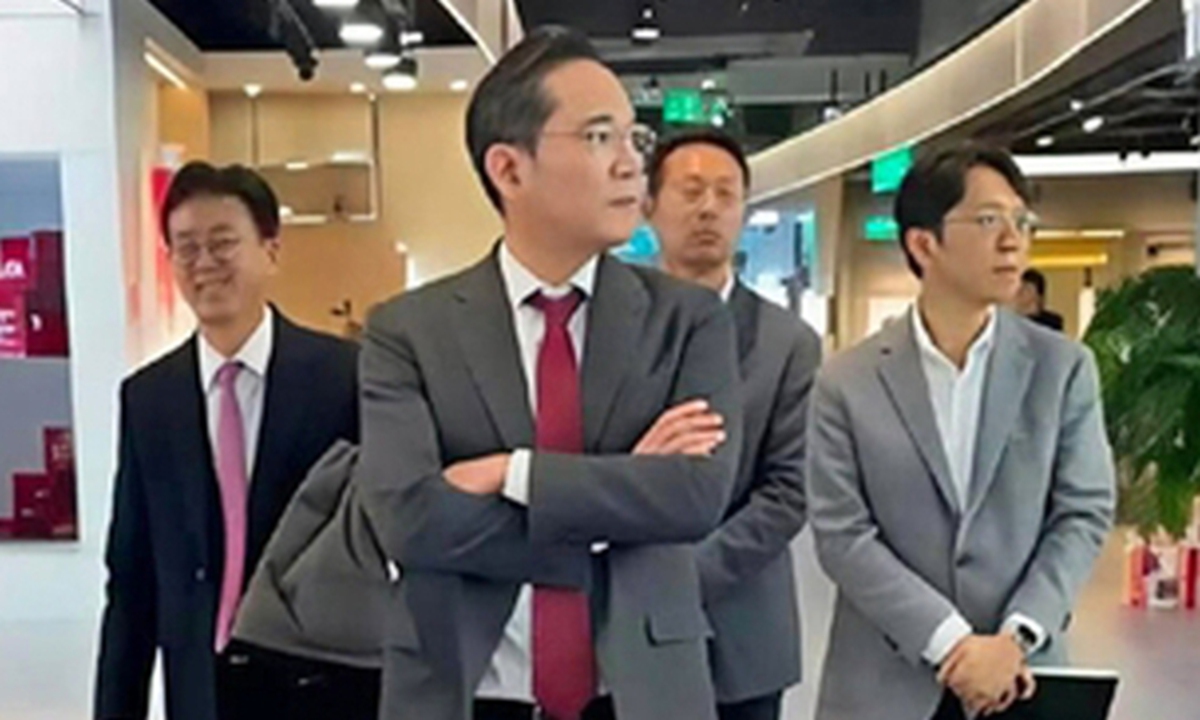
Samsung Electronics Chairman Lee Jae-yong is spotted at a shopping mall in Beijing, China on January 5, 2026. Photo: Screenshot from Sisa Journal
South Korean President Lee Jae-myung has reportedly brought a huge delegation of about 200 business leaders on his ongoing state visit to China. Among them, the participation of the heads of the four most prominent South Korean conglomerates - Samsung Electronics, SK Group, Hyundai Motor Group and LG Group - has drawn widespread attention. It demonstrates the South Korean businesses' desire for closer cooperation, an expert said.Highlighting that close attention, media reports said that Lee Jae-yong, executive chairman of Samsung Electronics, was spotted shopping at the JD MALL (Beijing Shuangjing Branch) on Monday afternoon, following his attendance at the China-South Korea Business Forum.
Lee Jae-yong and his party reportedly arrived at the mall at about 2 pm on Monday, looked at products in many stores, and bought about 100 Labubu products, according to Jimu News. However, a report from Sisa Journal claimed on Tuesday that Samsung said that upon verification, Lee Jae-yong visited local Samsung stores and the shopping mall but did not purchase any items on site.
A staff member from the shopping mall confirmed the visit to the Global Times on Tuesday, adding that the group consisted of about four or five people.
On Monday, SK Group Chairperson and CEO Chey Tae-won delivered a speech at the opening ceremony of the China-South Korea Business Forum.
"I attended as a delegation member back then at Diaoyutai; returning now as a co-host fills me with emotion and joy," Chey said, expressing gratitude for the strong turnout amid busy schedules and highlighting high expectations for bilateral economic ties.
The broad participation of business leaders, including those of major South Korean giants, in South Korean President Lee Jae-myung's state visit to China fully demonstrates the South Korean side's high regard for China-South Korea economic and trade cooperation, Lü Chao, a professor at the Liaoning Academy of Social Sciences, told the Global Times on Tuesday.
"The gathering of top executives from core South Korean companies such as Samsung and SK Group in China this time reflects the country's desire to achieve new cooperation breakthroughs with China in key industries such as electronic products and semiconductors," Lü said.
South Korean media outlets have paid close attention to the participation of the business delegation in the state visit.
The JoongAng reported that Hyundai Motor Group Chairperson Chung Eui-sun said on Monday that although sales and production have significantly decreased (in the Chinese market), "we plan to increase them again with a humble attitude," adding that the company expected that if bilateral relations improved following this South Korea-China summit, it would also benefit Hyundai Motor.
The Korea Herald on Monday reported, with a sub-headline "big hitters at biz forum," that "the business forum was co-hosted by the KCCI [the Korea Chamber of Commerce and Industry] and the China Council for the Promotion of International Trade, with an attendance roster that underscored the breadth and depth of the two countries' industrial overlap."
Some reports also highlighted the potential for China-South Korea business cooperation under the global geoeconomic landscape. Amid intensifying US-China competition and growing uncertainties in global supply chains, the core objective of this visit is to explore cooperation between South Korea and China, particularly in key industries such as semiconductors and batteries, EBN reported.
The JoongAng said that the business community is watching closely to see if this visit will reignite warmth in South Korea-China economic cooperation. The report cited a business sector official as saying that this will be an opportunity to re-examine points of economic cooperation with China, which serves as a key production base and core market for domestic companies in sectors such as semiconductors, batteries, and displays.
On Monday, China and South Korea signed 15 cooperation documents in fields including scientific and technological innovation, ecological environment, transportation, and economic and trade cooperation, according to the Xinhua News Agency. Lee Jae-myung concluded his three-day visit to Beijing on Tuesday and departed for Shanghai, the Yonhap News Agency said on Tuesday.
While the visit to Beijing likely focuses more on overall policy communication on bilateral relations and cooperation, the trip to Shanghai may focus on more specific cooperation between enterprises, and project consultations are expected to be more active, Lü said.
While no new business deals were announced publicly by the South Korean giants as of press time on Tuesday, they all have a considerable presence in the Chinese market.
According to EBN, Samsung Electronics currently operates a NAND flash production plant in Xi'an and a semiconductor back-end (packaging) plant in Suzhou. SK Hynix runs a DRAM plant in Wuxi, a NAND packaging plant in Chongqing, and a NAND plant in Dalian. Hyundai Motor and Kia maintain production plants in Beijing and Yancheng respectively, while LG Energy Solution operates a battery factory in Nanjing.
Amid a complex external environment, the visits of these South Korean companies are likely aimed at both deepening cooperation with China in traditional electronics manufacturing and semiconductors, as well as exploring new collaboration opportunities in power batteries, clean energy, artificial intelligence, and robotics, according to Lü.
"In these fields, China holds advantages in industry scale and market size, while South Korea possesses strengths in technology and manufacturing expertise, demonstrating clear complementarity," Lü said.
RELATED ARTICLES