IKEA restructures business in China, planning to shut down 7 malls, but launch over 10 small stores
By Published: Jan 07, 2026 03:46 PM

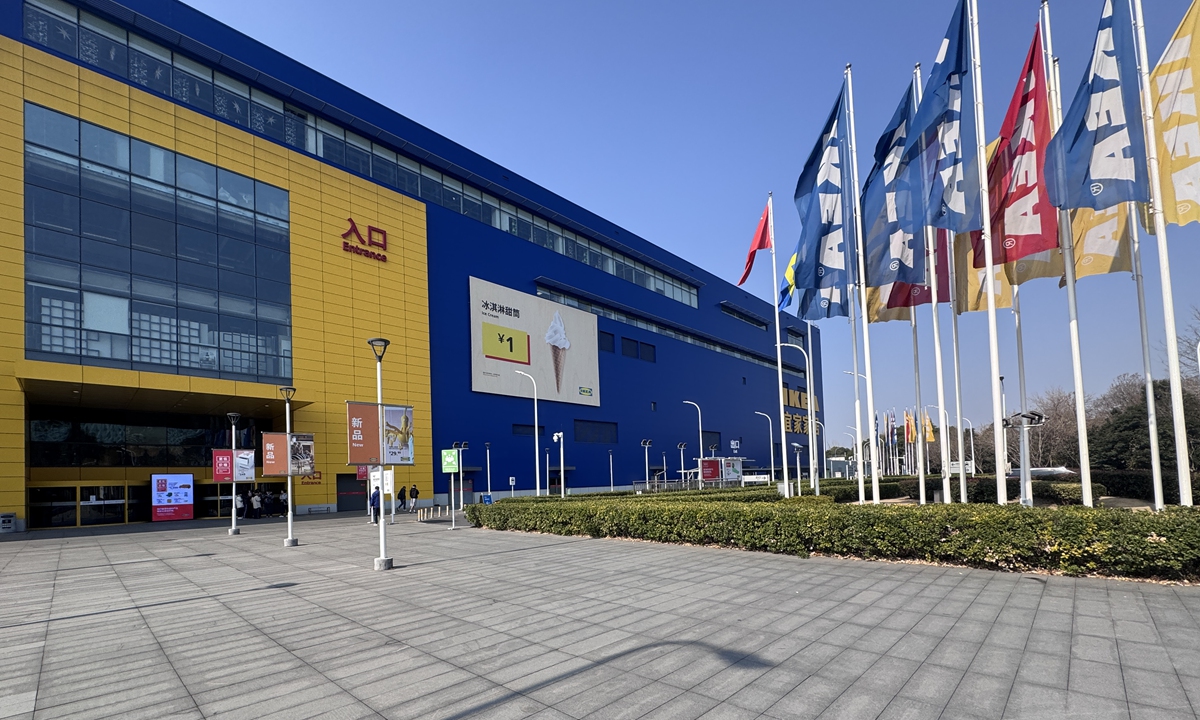
A view of IKEA Shanghai Baoshan store on January 7, 2026. IKEA said that it has decided to stop operating seven offline touch points starting from February 2, 2026, including IKEA Shanghai Baoshan, IKEA Guangzhou Panyu, IKEA Tianjin Zhongbei, IKEA Nantong, IKEA Xuzhou, IKEA Ningbo and IKEA Harbin. Photo: VCG
Swedish budget furniture retailer IKEA said on Wednesday that it will close seven physical stores in China that are scattered in major cities such as Shanghai, Guangzhou and Tianjin, while the company confirmed to the Global Times that it will open more than 10 small stores in the upcoming two years, eyeing for the long-term and healthy operation and growth in China.
"With the comprehensive review of our existing channel matrix, we have decided to stop operating seven offline touch points starting from February 2, 2026, including IKEA Shanghai Baoshan, IKEA Guangzhou Panyu, IKEA Tianjin Zhongbei, IKEA Nantong, IKEA Xuzhou, IKEA Ningbo and IKEA Harbin," said a statement the company sent to the Global Times on Wednesday.
And, the company said that they will shift from scale-based expansion to precision-driven market penetration, starting from Beijing and Shenzhen as the prioritized places.
More than 10 small format stores will be opened in upcoming two years in Beijing and Shenzhen, including IKEA Dongguan store in February 2026, and IKEA Tongzhou store in April 2026, the company said, adding that they will also continue to enhance online presence and invest in existing stores to make them better for customers and co-workers.
The decision marks an important step of the transformation journey of IKEA in China to build a resilient foundation for its business growth in the future, according to the company.
In the statement, the company highlighted the importance of Chinese market, saying that "China is and will continue to be one of the most important and strategic markets for IKEA," and "IKEA is committed to long-term and healthy growth in China, developing its business in a sustainable way."
Veteran industry analyst Liu Dingding told the Global Times on Wednesday that the strategy makes IKEA more market-oriented. Much like a small vessel can swiftly respond to market shifts, this move allows IKEA to better align with end-users' needs, signaling a major transformation in the industry.
Liu added that while this shift does not reflect a lack of market confidence for the foreign companies, it demonstrates the company's adaptation to new trends. On the contrary, these new-format stores highlight its optimism about Chinese market.
Currently, IKEA is reaching a potential customer base of 1 billion people across China with 41 offline shopping malls, three owned digital channels, and two stores on major e-commerce platforms, while still exploring to enhance the omni customer experience, according to the information the company provided.
According to KPMG's newly released report in December of 2025, 94 percent of surveyed multinational companies (MNCs) continue to invest in and maintain confidence in the Chinese market. The report indicates that 75 percent plan to maintain or increase their investment in Chinese mainland in 2026.
The number of newly established foreign-invested enterprises maintained a rapid growth trend. In the first 11 months of 2025, 61,207 new foreign-invested enterprises were established nationwide, a year-on-year increase of 16.9 percent; in November alone, 7,425 new foreign-invested enterprises were set up, a year-on-year increase of 35.3 percent, data from the Ministry of Commerce showed.
As one of the most localized multinational enterprises, Schneider Electric holds firm confidence in the Chinese market. We believe that investing in China means investing in the future, Yin Zheng, Executive Vice President, China & East Asia Operations, Schneider Electric, told the Global Times on Monday.
The company said the expansion project of Schneider Electric's Beijing Yizhuang Industrial Park and the new Wuxi Industrial Park are set to be completed soon. Additionally, the new Xiamen Industrial Park will be inaugurated in 2026, becoming Schneider Electric's largest medium-voltage production base worldwide.
We will continue to deepen the company's roots in China, actively integrate into the wave of New Quality Productive Forces and high-quality development, and work hand in hand with Chinese industries to achieve an efficient and sustainable future, Yin said.
RELATED ARTICLES