ARTS / CULTURE & LEISURE
Physical bookstores embrace chances amid new regulations
Functions, value need reassessment in digital era
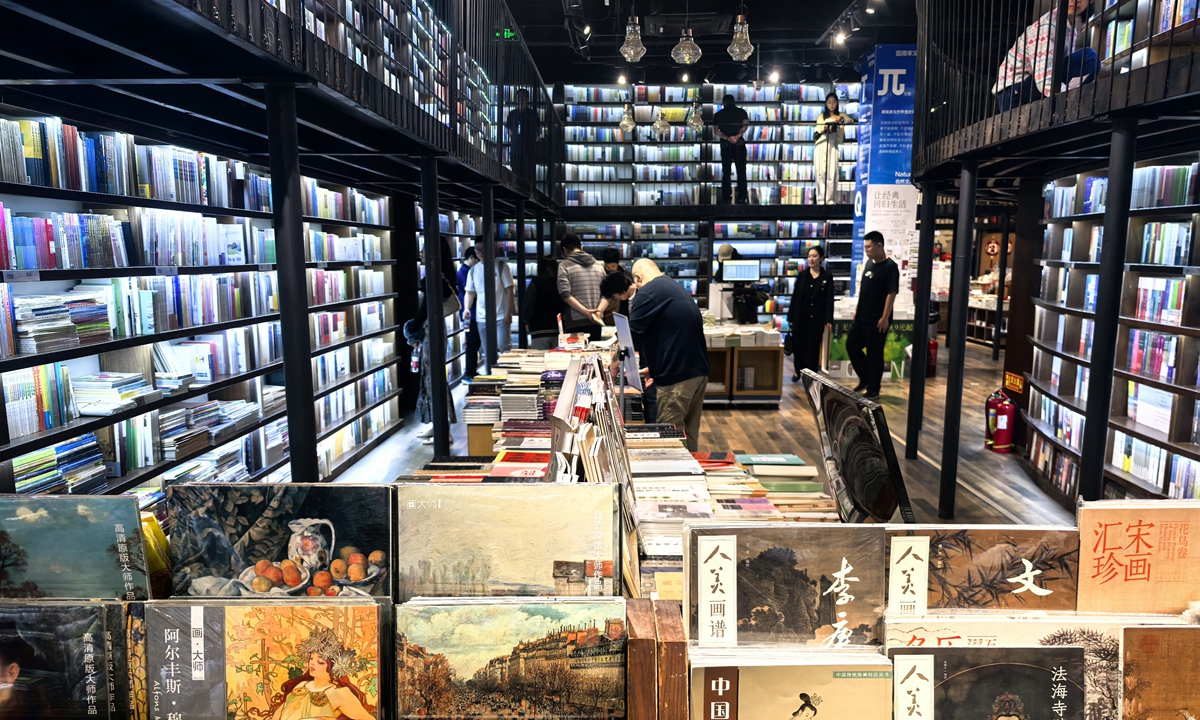
Readers immerse themselves in books at a bookstore in Beijing on October 9, 2025, Beijing. Photo: VCG
With China's new regulations to promote public reading set to take effect on February 1, brick-and-mortar bookstores are ushering in new opportunities and exploring ways to attract readers to cultural activity spaces rather than mere book retail outlets, bookstore owners told the Global Times on Wednesday.
The regulations, issued by the State Council in December, aims to boost nationwide reading, raise the intellectual, moral, scientific, and cultural standards of the Chinese people and enhance overall social civility, contributing to China's efforts to build itself into a country with a strong socialist culture.
Wu Yanping, manager of the Owspace bookstore, told the Global Times on Wednesday that the regulations are a significant boon for physical bookstores, which are no longer seen merely as commercial spaces but as an integral part of social and cultural life.
In Wu's view, bookstores were primarily retail-oriented; today, they need to think about how to attract readers to these offline interactive spaces through compelling content and events. "The offline, in-person interactive experiences offered by brick-and-mortar bookstores are irreplaceable even in the digital era," he said.
The 2026 Brick-and-Mortar Bookstore Development Conference (formerly named the Chinese Bookstore Conference) was held in Beijing on Tuesday. With public reading having been integrated into the national strategy, the conference explored new pathways for the development of brick-and-mortar bookstores.
Wan Guoying, found of the Qingyuan Bookstore in Nanchang, East China's Jiangxi Province, participated in the conference. Wan told the Global Times on Wednesday that the regulations will bring bookstores a series of tangible and perceptible opportunities.
The regulations define reading as a public service and encourage the participation of social forces. This means that bookstores could better connect with government procurement programs for public cultural services. Bookstores are thus shifting from being purely retail outlets to becoming providers and partners of public cultural services, opening up a new pathway that combines social benefits with economic returns, said Wan.
The fourth week of April each year will be designated as the national reading week, according to the regulations.
Regular scheduling will help foster a richer and more sustained social atmosphere for reading, while providing bookstores with a recurring window to reach broader audiences on an ongoing basis, she said.
Against the backdrop of e-commerce retail and evolving reading habits, Wan noted that the core competitiveness of brick-and-mortar bookstores can be distilled into three points: "human-curated" book selection, warm and engaging spaces for interaction, and a "cultural DNA" connected to the local city.
"By delving into the local culture of Jiangxi such as ceramics, revolutionary history, and ancient villages, and hosting themed lectures, we position bookstores as windows for discovering and sharing local culture - a unique value that no online platform can replace," she added.
Wu also acknowledged the importance of hosting offline events and noted that AI has brought more possibilities to the reading activities at bookstores.
"For example, we used AI to turn scenes from One Hundred Years of Solitude into short videos for readers, helping them engage with classic literature, while also organizing offline exhibitions of classic literary works to spark readers' interest," said Wu.
Ai Limin, chairman of the Books and Periodicals Distribution Association of China and one of the organizers of the conference, told the Global Times that amid rapid advances in digital technology, shifting reading habits, and the upgrading of cultural demand, brick-and-mortar bookstores are facing unprecedented challenges while also embracing major opportunities for transformation and upgrading.
Brick-and-mortar bookstores need to reassess their functions and value. They should become "cultivators" and "promotion hubs" for nationwide reading, fostering regional reading cultures through diverse activities; and serve as "experience centers" and "aesthetic spaces" for cultural consumption, meeting people's increasingly multifaceted spiritual needs, Ai said.
The regulations stipulate that local authorities above the county level shall, in light of actual conditions, adopt policy measures to support the development of brick-and-mortar bookstores and encourage such bookstores to improve reading environments and organize reading activities, so as to better serve the promotion of nationwide reading.
In the future, Wan said, bookstores will engage in collaborations with local universities, libraries, and communities, and launch "cultural and tourism pop-up stores" to make them more "mobile," transforming them into traveling cultural hubs that connect cities and rural areas, culture and tourism.
RELATED ARTICLES