ARTS / ART
China’s ice artists thrive as galas, winter tourism flourish
From frozen craft to hot careers
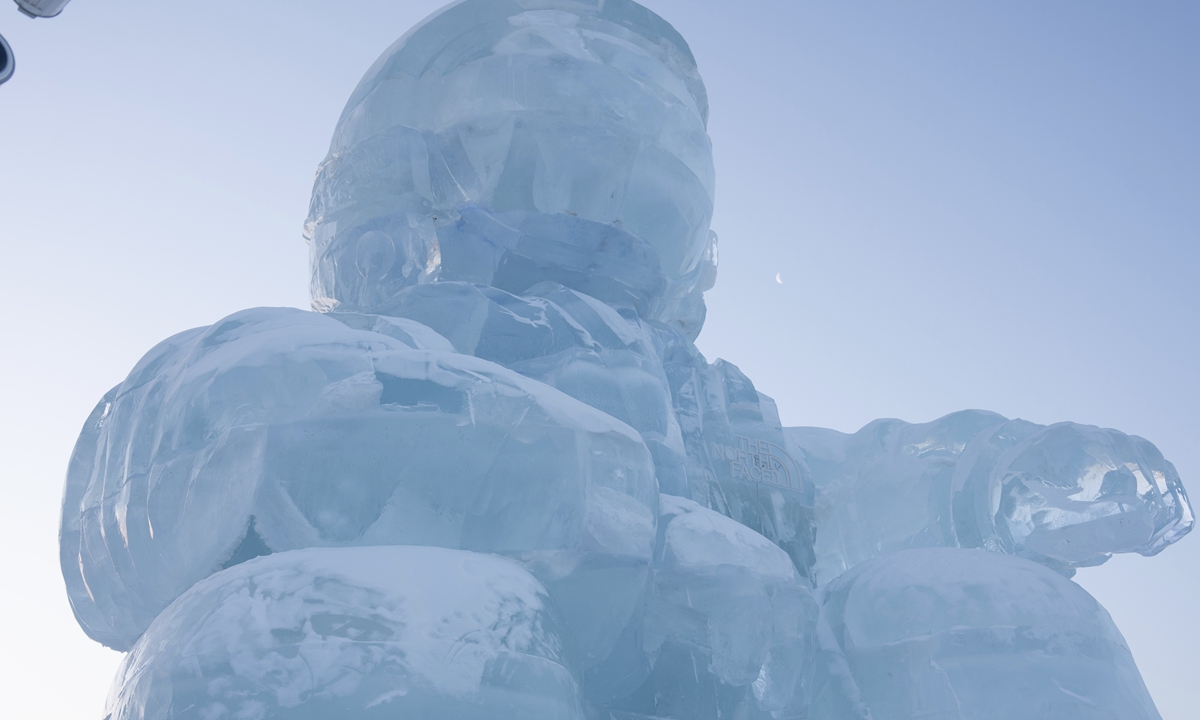
Two ice sculptures created by Yuan Xiao (Vance) and his team Photos: Courtesy of Yuan Xiao (Vance)
As night falls over Harbin, capital of Northeast China's Heilongjiang Province, the 42nd Harbin International Ice and Snow Festival comes alive. Lights illuminate the Harbin Ice-Snow World, one of China's most popular winter tourism destinations, revealing the towering ice sculptures: multi-meter ice spires piercing the night sky and clusters of ice buildings standing firmly in the sub-zero temperatures.During the festival, an international snow sculpture competition drew over 100 artists from countries including Russia, South Korea, and France. Several award-winning pieces quickly became must-see highlights for the visitors, many of whom took photos of the ice sculptures.
Yet, quite a few may realize that behind these translucent, seemingly delicate works lies an "extreme operation" that balances time, temperature, and structural precision.
"Ice sculpting isn't about carving slowly; it's a contest against time, temperature, and structure all at once," Sun Wenxiang, a 31-year-old professional ice sculptor from Heilongjiang, told the Global Times. The ice sculptor was awarded a bronze medal at the National Professional Ice Sculpting Competition held in January 2025.
"When the ice cracks, there's almost no way to fix it; even a small spot can throw off the balance of the entire structure," he said.
In the ice sculpting community, this awareness of the "irreversible" is universal. Unlike stone or wood, every cut in ice is a decision that cannot be undone.
Uncertain beauty
Looking back at the development of the ice sculpting industry, Sun said that he first encountered ice sculpting over a decade ago, at a time when there was no complete teaching system, and learning relied largely on an art background and constant trial and error.
"The first time I used an ice chisel, my hands hurt," he said. "I immediately realize that this material does not forgive mistakes."
Like many ice sculptors, Sun initially thought of ice carving as a craft exclusive to winter, something fleeting and seasonal. He only began to reconsider this assumption after seeing an indoor ice sculpting workshop.
"In a temperature-controlled environment, ice sculptures can still remain structurally stable," he recalled. "That was the moment I realized ice carving isn't just a 'consumable' for winter; it's a craft worth pursuing long-term."
With the growth of ice festivals and urban winter landscapes, the way ice sculptures are presented has also evolved. Early works were primarily about shape and form, but they have gradually shifted toward emphasizing space, interaction, and engagement.
"Now, people aren't satisfied with just looking from a distance," Sun said. "You have to make them want to walk in, to stop, to experience it."
From dragon-and-horse sculptures that creatively incorporate two Chinese zodiac elements to ice buildings that are carved into sci-fi forms and on to giant ice chessboards visitors can step onto, the art is no longer just a backdrop; it has become part of the experience. Yet behind this "cool and fun" appeal lies an intense work pace.
"When we're on tight deadlines, working outdoors for more than 10 hours at a stretch is normal," Sun said.
For Sun, the greater pressure comes from uncertainty: One sudden rise in temperature or a brief rainfall can alter the structure.
Art through ice
For ice sculptors, uncertainty isn't just a personal challenge, it's built into the very nature of the material. Yuan Xiao, aka Vance, a 36-year-old artist who also creates ice sculptures and has over 100,000 followers on Chinese social media platform Red Note or Xiaohongshu, sees this as one of the defining features of the craft.
For Yuan, ice sculpting is closer to a form of "process-based material art."
"It isn't meant to be preserved permanently; it is destined to disappear," he said. "Many works aren't 'finished' in the traditional sense; they are continuously adjusted, even undone, by changes in the environment."
He recalled creating for hours in extreme cold, only to see the piece quickly crack and fragment afterward.
"The sense of failure is very real," Yuan said, "but in that moment, I realized that ice sculpting doesn't aim for permanence. It's more like an intensely focused dialogue, with the material, with the environment, and with oneself."
For Yuan, because of this, ice sculpture carries a public dimension in festival culture. It immediately connects with the audience. At the same time, in the context of contemporary art, it offers a path that challenges the notion of "permanence."
"Art doesn't have to be about preservation forever," Yuan said. "A single occurrence, a single experience, even disappearance itself, can constitute value."
Shaping winter memories
In recent years, with the rise of ice-and-snow tourism and the growing number of winter landscapes across the country, ice sculptors have gradually transformed from "cold, grueling, low-reward" craftsmen into a highly sought-after profession.
"They didn't suddenly become valuable," Sun said. "It's just that this craft is finally being taken seriously."
This surge in interest has grown alongside the ice-and-snow economy. Ski resorts, ice festivals, and illuminated nighttime ice displays have turned naturally occurring snow and ice into highly anticipated public experiences.
China's ice-and-snow industry is expected to surpass the 1-trillion-yuan mark this year, reaching 1.0053 trillion yuan ($140.74 billion), an indicator that the ice-and-snow economy has become an emerging force in the country's economic development, according to the Xinhua News Agency.
At the same time, the industry faces new challenges: how to avoid homogenization, and how to preserve creative depth and cultural expressions, issues that many ice sculptors grapple with.
"In the future, ice sculptors can't just know how to 'make,' they also need to know how to 'tell,'" Sun said. "You have to understand why this block of ice stands here in the first place."
Ice will melt, snow will disappear. But every winter, someone braves the cold to carve fleeting ice and snow into lasting urban memories. The rise of ice sculptors is not an overnight trend. It is the result of a craft repeatedly tested and gradually warmed by time.
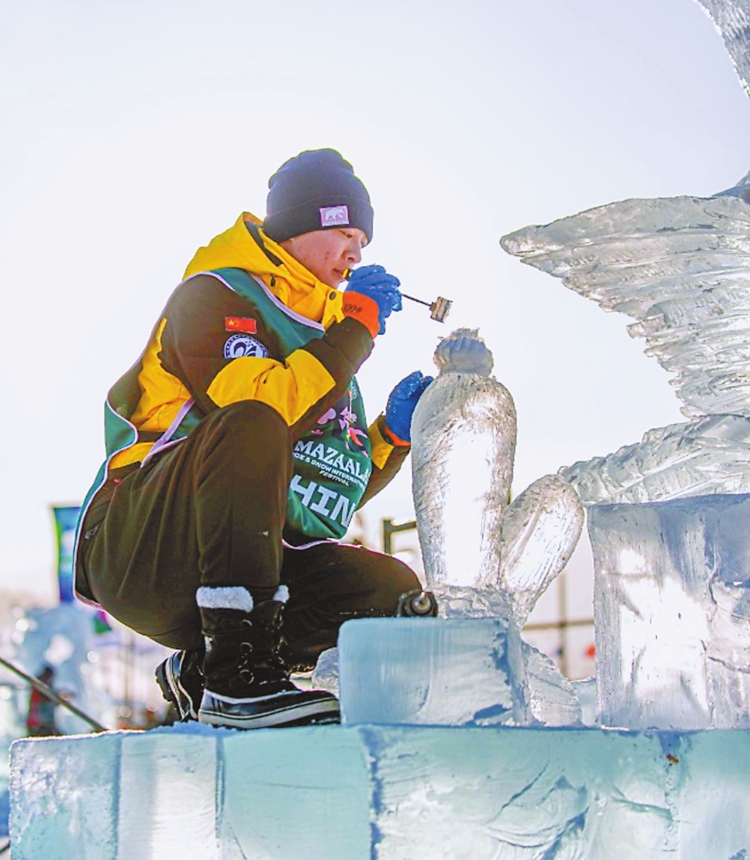
Ice sculptor Sun Wenxiang works on an art piece in Ulaanbaatar, Mongolia, in 2024. Photo: Courtesy of Sun Wenxiang
RELATED ARTICLES