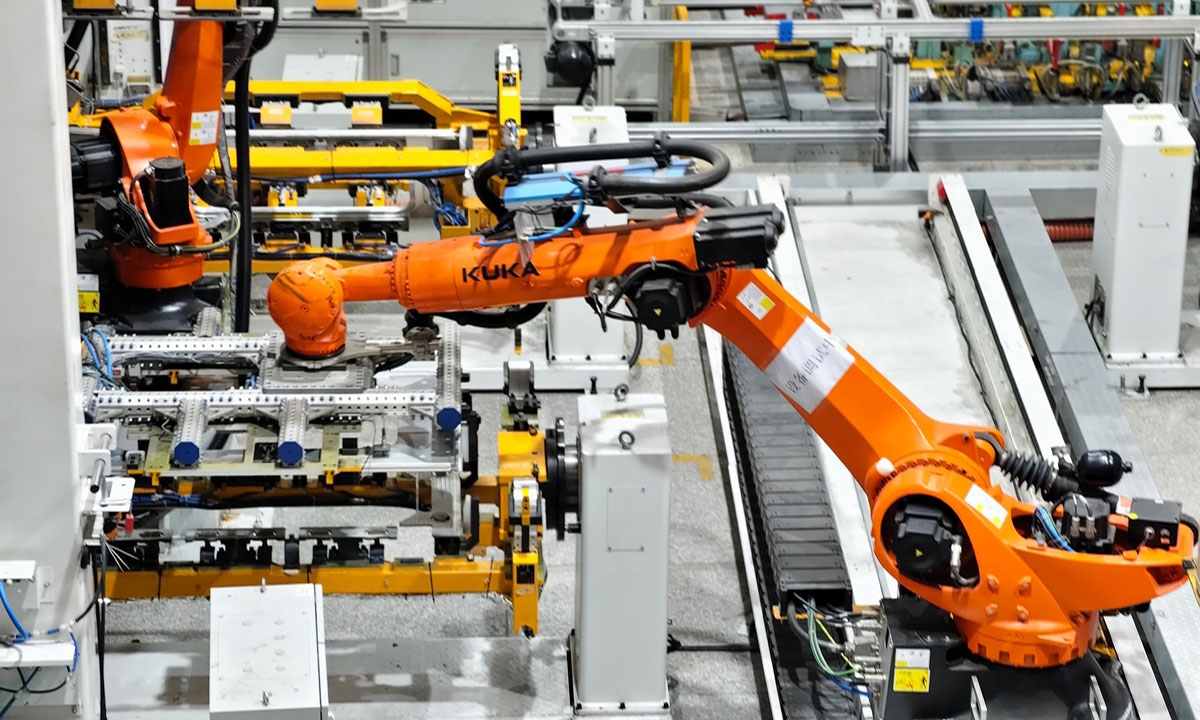
Robotic arms perform precision operations at an intelligent factory in Nanjing, East China's Jiangsu Province, on September 20, 2025.Photo: VCG
China will promote at least 50,000 companies to undergo new industrial network upgrading by 2028, in a move to seek further synergy between the country's vast industrial sector and the fast-growing artificial intelligence (AI) sector, according to a notice issued by the Ministry of Industry and Information Technology (MIIT), China's top industry regulator, on Wednesday.
By 2028, the integration and empowerment capabilities of the industrial internet and AI will be significantly enhanced, according to the document titled "Action Plan on Industrial Internet and Artificial Intelligence Integration and Empowerment," published on the MIIT's WeChat account.
According to the notice, the deployment of new industrial networks that meet the high-throughput, low-latency, high-reliability, and low-jitter communication requirements for industrial AI applications will continue to expand.
These networks will be widely deployed and applied in key industrial sectors such as raw materials, equipment manufacturing, consumer goods, and electronics, driving the transformation and upgrading of at least 50,000 enterprises with new industrial networks, according to the MIIT.
In addition, the ministry envisions that the industrial data ecosystem - encompassing data collection, governance, circulation, and sharing - will be continuously improved, with high-quality datasets to be developed across 20 key industries.
The plan is one of the earliest documents issued by the MIIT in the new year.
According to an article by Minister Li Lecheng in November, China will establish a comprehensive policy framework to support the application of AI.
These policies will specifically address the intelligent transformation requirements for key industries, critical production processes, and strategic sectors, supplemented by an AI application guide tailored for manufacturing enterprises.
"The target of transforming and upgrading 50,000 industrial enterprises represents a relatively large scale, indicating the widespread adoption of new industrial network technologies. With such network infrastructure in place, demand for the industrial internet can be better unleashed, driving enterprises to implement industrial internet applications," Pan Helin, a member of the expert committee of the MIIT, told the Global Times on Wednesday.
The objective of the new policy is to advance the application of the industrial internet, developing tailored industrial internet solutions for different industries, thereby providing referenceable demonstration solutions for the digital transformation of industrial enterprises, Pan noted.
As the first policy of its kind announced by the MIIT this year, it underscores the importance of promoting the digital transformation of industrial enterprises and highlights the policy emphasis on the widespread adoption of industrial internet applications, said Pan, adding that this also aligns with the implementation of the high-quality development strategy.
China's core AI industry scale exceeded 1 trillion yuan ($142 billion) in 2025, according to a national conference on industry and information technology held in December, the Xinhua News Agency reported.
The country also boasts more than 5,000 AI enterprises, while more than 400 national-level AI "little giant" companies - specialized and innovative small and medium-sized enterprises - were recognized for their technological sophistication.
As part of its 2026 agenda, the MIIT emphasized cultivating and expanding emerging and future industries, as well as supporting AI research and development, according to the conference.
According to the document issued on Wednesday, targeting critical links and typical scenarios in key industrial chains, a group of intelligent solution providers will be cultivated to effectively promote coordinated upgrades among large, medium-sized, and small enterprises.
Key enterprises, technological products, public services, and other resource elements will be allocated more efficiently, according to the ministry.