More than 1,000 companies reportedly suing Trump administration over tariffs and asking for refunds, highlighting damage to US economy
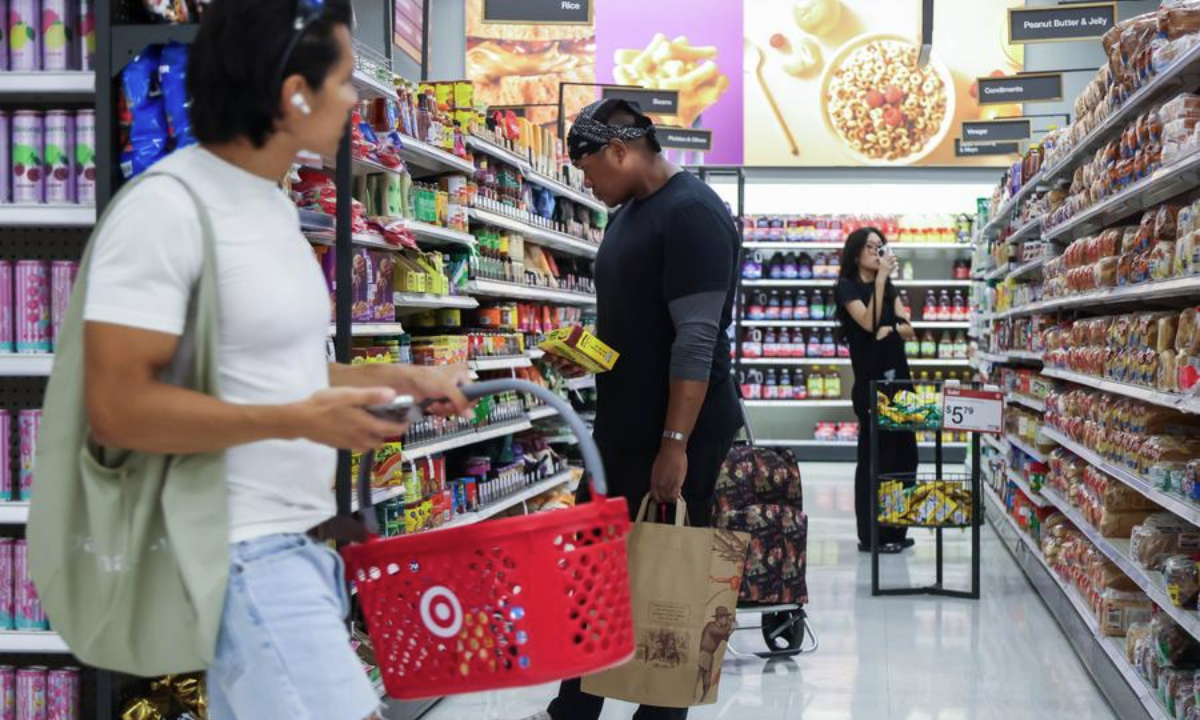
People shop at a retail store in New York, the United States, on Aug. 12, 2025. (Photo by Michael Nagle/Xinhua)
More than 1,000 companies are reportedly suing the Trump administration over tariffs and demanding refunds, the Bloomberg reported on Thursday. A Chinese expert said as the US Supreme Court is set to make a ruling on the legality of these tariffs, the situation has highlighted the tariff's disruptive impacts on US economy.
Companies based in the US are flocking to challenge the Trump administration's import taxes in court, as the US Supreme Court is set to decide the fate of most of the US President Donald Trump's tariffs as soon as Friday, according to Bloomberg.
Publicly traded companies, including Costco Wholesale Corp, EssilorLuxottica SA and Goodyear Tire & Rubber Co, are among the companies suing for refunds, the report said, adding that in the first days of 2026 alone, dozens of entities, including Dole Fresh Fruit Co, e.l.f. Cosmetics Inc and J. Crew Group LLC, have sued.
Others are smaller companies affected by the tariffs. The suing companies came from a broad sweep of industries.
The administration had collected approximately $133 billion in duties under the emergency authority as of December 14, the Bloomberg reported, citing a US government report.
Zhou Mi, a senior research fellow at the Chinese Academy of International Trade and Economic Cooperation, told the Global Times on Thursday that the fact that the growing number of companies suing the Trump administration for tariffs refunds underscores the negative impacts of the so-called reciprocal tariffs on US trade and the disruptive impact of the disruptive policy flux that lasted for several months.
"Plainly said, tariffs incur additional costs, [in many cases] the burden is shifted onto importers, and fuels up US inflation," Zhou said.
Zhou said the recent mutual easing of tariffs between China and the US has improved the vitality of bilateral trade, which is a case demonstrating that lower tariffs can unleash economic vitality and increase protection to the interests of market entities. "That explains why lowering trade costs by means of removing tariffs is something the business community should strive for."
According to Bloomberg, Friday is the first time that the US Supreme Court will release opinions this year.
During a November hearing, key members of the Supreme Court expressed skepticism that Trump had authority to rely on the 1977 International Emergency Economic Powers Act to impose the global tariffs.
US customs authorities had collected tariffs tied to Trump's use of the emergency powers law from more than 301,000 importers across 34 million shipments of goods entering the country as of December 10, the Bloomberg reported, citing a US government court filing. The payments make up a significant portion of the more than $200 billion that the US government says it has collected as a result of Trump's broader package of tariff actions in 2025.
According to Bloomberg, there's precedent for mass refunds, when the US trade court created a claims process after the Supreme Court in 1998 struck down a harbor maintenance tax on exporters as unconstitutional.
According to a November 17 analysis on US tariffs by The Budget Lab at Yale University, US consumers face an overall average effective tariff rate of 16.8 percent, the highest since 1935.
In terms of real GDP effects, tariffs slow US real GDP growth by 0.5 percentage points in 2025 and 0.4 percentage points 2026. In the long run, the US economy is persistently 0.3 percent smaller, the equivalent of $90 billion annually in 2024 dollars.
In a January 5 report, the Reuters reported that beyond the sectors lifted by an Artificial Intelligence investment boom, Trump's sweeping import duties have undercut US manufacturing, even as he touts them as necessary to shore up a long-declining domestic factory base.
The Institute for Supply Management survey released on Monday showed that the US manufacturing activity slumped to a 14-month low in December, with new orders contracting further and input costs grinding higher as the sector continued to bear the imprint of Trump's import tariffs.
The Chinese government has repeatedly opposed the imposition of US tariffs on all its trading partners, including China.
Last April, the Chinese government released its position on opposing US abuse of tariffs, pointing out that the tariffs severely infringe upon the legitimate rights and interests of nations, violates World Trade Organization rules, harms the rules-based multilateral trading system, and severely disrupts the stability of the global economic order.
RELATED ARTICLES