New business formats and models become new engines driving China-South Korea cooperation: MOFCOM on outcomes of President Lee’s China visit
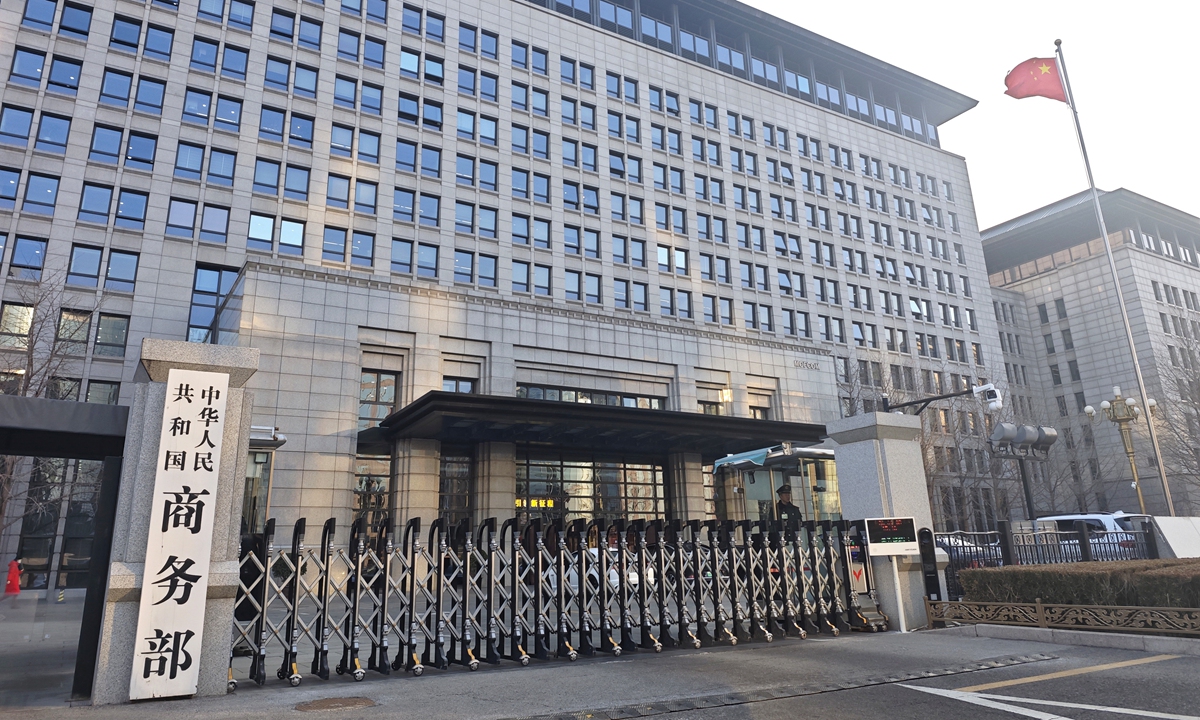
China's Ministry of Commerce Photo: Yin Yeping/GT
In response to media inquiry on what economic and trade cooperation outcomes have been achieved between China and South Korea as South Korean President Lee Jae-myung concluded his visit to China this week, and what new features are emerging in bilateral cooperation, He Yadong, a spokesperson of China's Ministry of Commerce (MOFCOM), said on Thursday that this visit marked that the Chinese and South Korean heads of state have achieved reciprocal visits two months after their previous meeting, and it was President Lee Jae-myung's first visit to China since taking office.
The two heads of state provided strategic guidance for deepening the development of China-South Korea strategic cooperative partnership and pointed the way forward for advancing bilateral economic and trade relations, said He.
China-South Korea economic and trade ties are close, with deeply intertwined industrial and supply chains. New business formats and models of cooperation continued to emerge, gradually becoming new highlights and new engines driving bilateral cooperation, said He.
China has for many years remained South Korea's largest trading partner, while South Korea is China's second-largest trading partner. According to Chinese statistics, bilateral trade reached $298.9 billion from January to November in 2025. As of the end of November last year, South Korea's cumulative actual investment in China totaled $104.65 billion. The role of economic and trade cooperation as a "ballast stone" and "propeller" in bilateral relations has become increasingly prominent, said the MOFCOM spokesperson.
During Lee's visit, a series of important consensuses on deepening pragmatic cooperation in the economic and trade field were reached. China's Ministry of Commerce and South Korea's Ministry of Trade, Industry and Energy signed the Memorandum of Understanding on Establishing a China-South Korea Economic and Trade Cooperation Dialogue Mechanism and the Memorandum of Understanding on Deepening Cooperation on China-South Korea Industrial Parks, according to the MOFCOM spokesperson.
He said that the two sides will actively leverage the dialogue mechanism, expand the demonstrative and driving effects of industrial park cooperation, and jointly promote the upgrading and quality improvement of China-South Korea economic and trade cooperation.
Going forward, the MOFCOM is willing to work with the South Korean side to jointly implement the important consensus reached by the two leaders, strengthening the alignment of economic and trade cooperation plans and enhancing policy coordination, while safeguarding the stability and smooth functioning of industrial and supply chains, said He.
Moreover, the ministry will support mutual investment by enterprises and accelerate efforts to achieve substantive progress at an early date in the second-phase negotiations of the China-South Korea Free Trade Agreement.
At the same time, both sides will further tap cooperation potential in emerging areas such as high-end manufacturing, artificial intelligence, green industries, and the silver economy, said the MOFCOM spokesperson, noting that they will also encourage multi-level and multi-format economic and trade exchanges, with the aim of continuously expanding the shared interests of both sides.
Global Times
RELATED ARTICLES